GEO Is Different in Every Industry. Here's the Proof.
The Biggest Mistake in GEO: Treating Every Industry the Same
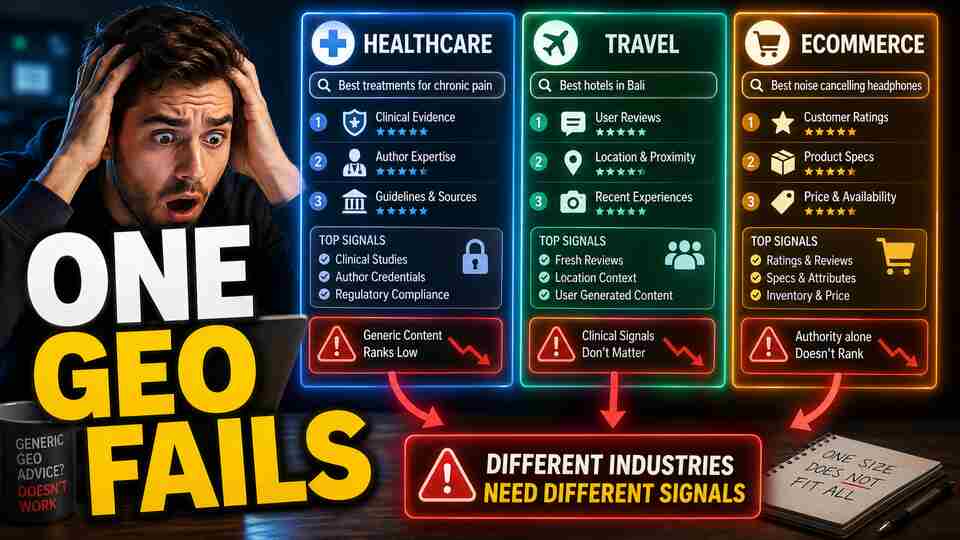
Most GEO advice is written as if it applies universally. Optimize your content for AI citations. Build authority signals. Structure your answers clearly. Get cited by reputable sources. All of that is directionally correct, but it glosses over something the research makes increasingly hard to ignore: citation behavior in AI engines is not consistent across industries. The signals that earn you visibility in e-commerce are different from the ones that matter in healthcare. What works in travel may actively hurt you in regulated industries. And the gap between a generic GEO strategy and an industry-calibrated one is growing.
Travel and Hotels: Your Own Website Is Almost Irrelevant
A March 2026 study on hotel search behavior in Gemini (arXiv:2603.20062) documented what the authors call an Intent-Source Divide: a systematic gap between what users are actually looking for and which sources Gemini draws on to answer them.
When users queried for specific hotel attributes, things like price ranges, location proximity, amenities lists, Gemini's responses were dominated by aggregator platforms and review sites. TripAdvisor, Booking.com, and similar platforms were cited far more frequently than hotel brand websites, even when the hotel's own site contained exactly the information the query was asking for. Direct website content was consistently underweighted.
For travel brands, this changes the GEO priority stack entirely. Optimizing your own site matters less than optimizing your presence on the platforms AI engines actually pull from. That means managing your Booking.com and TripAdvisor profiles as GEO assets, not just booking channels.
Healthcare: The Credential Gap Is Measurable
A January 2026 study (arXiv:2601.17109) found that AI engines apply stricter authority filters to health content than to commercial or informational queries. The primary citation drivers in health are medical credentials, institutional affiliation (specifically .edu, .gov, and major hospital system domains), and the presence of clinical citations within the content itself. Consumer health brands that lack those markers face a measurable citation disadvantage, independent of their content quality.
A separate November 2025 audit of Google AI Overviews found that baby care and parenting queries were dominated by citations to the American Academy of Pediatrics, Mayo Clinic, and similar institutional sources. Brand content and product blogs rarely appeared for sensitive parenting queries, regardless of how well-written or accurate they were.
For healthcare brands in AI search, the path to visibility is not primarily about writing better content. It's about building the authority architecture that AI engines use as proxies for trustworthiness: clinical citations, author credentials, institutional partnerships, and publication in venues that carry medical credibility. A startup with great content but no institutional backing is competing not just against other startups, but against the Mayo Clinic.
E-Commerce: Intent Wins, Storytelling Loses
The MIT E-GEO study (November 2025) analyzed 7,151 product queries against 52,165 products. Product descriptions optimized for user intent, competitive differentiation, and social proof (reviews, ratings, comparison signals) significantly outperformed all other approaches. More striking: storytelling-framed product descriptions dropped AI rankings by an average of 4.03 positions.
The narrative approach that works well in content marketing and brand building is actively counterproductive when the user is in a shopping mindset and the AI is trying to match them with a product. For more on e-commerce AI optimization: audit your product descriptions for storytelling language and replace it with intent-matching language. If your description talks about your brand story before answering what the product does and why it's better than alternatives, you're optimizing for the wrong signal.
The MIT study also identified recency and inventory signals as e-commerce-specific factors. Whether a product is in stock, whether pricing is current, whether reviews are recent, these signals influence citation in ways that matter in commercial queries but are largely irrelevant in informational or health queries.
Regulated Industries: Compliance Is a Citation Signal
A March 2026 study on iGaming content (arXiv:2603.12282) found that AI search engines apply compliance filters in heavily regulated industries. Content that does not explicitly address regulatory context (age verification, responsible gambling language, licensing) is systematically de-cited in iGaming queries, regardless of its quality on other dimensions.
In other words, regulatory compliance language is not just a legal requirement. It is a citation prerequisite. The study also found significant market-level variation: compliance signals that work for UK iGaming do not transfer directly to US or EU markets because AI engines have learned those differences. The broader principle applies to any industry with heavy regulatory oversight: financial services, pharmaceuticals, legal services. The compliance layer is a prerequisite, and getting it wrong may actively filter you out of AI responses entirely.
How to Know Which Signals Actually Matter for You
The honest answer is that you need data from your specific queries in your specific industry. Studies like these give directional guidance, but they measure averages across large query sets. Your brand's citation patterns may differ based on your existing authority, competitor landscape, and the specific queries you're trying to win.
This is the argument for query-level tracking rather than category-level assumptions. An industry-specific source gap analysis needs to show not just which sources are cited for your category in general, but which sources are cited for your specific queries across ChatGPT, Gemini, and Grok.
BabyPenguin tracks citations at the prompt level across multiple AI engines. For a healthcare brand, that might reveal that Mayo Clinic and AAP are dominating every query and that no consumer brand is breaking through, which is a strategic input. For an e-commerce brand, it might show that one engine consistently cites your product pages while another consistently cites a competitor, telling you something specific about what each engine weights differently.
Note that schema markup for different industries also diverges significantly: the structured data types that matter in healthcare (MedicalCondition, Physician, MedicalOrganization) are completely different from what moves the needle in e-commerce (Product, Review, Offer). Treating them as interchangeable is a common and costly mistake.
And understanding how competitors in your industry are performing in AI search is not something you can infer from their website content or general SEO rankings. AI citation patterns can diverge significantly from traditional search rankings, and they do so in industry-specific ways. A competitor with weaker traditional SEO may have stronger AI visibility because they have invested in the signals that matter for your specific category.
The One-Size-Fits-All Problem Is Getting More Expensive
As AI search matures, industry-specific citation patterns are likely to become more pronounced, not less. AI engines are getting better at applying category-appropriate authority standards. Brands that discover this early and calibrate their GEO strategy to their actual industry dynamics will compound that advantage over time. Brands that keep applying generic GEO principles and wondering why their citation share is not growing may not realize until much later that they have been optimizing for the wrong signals all along.
The research is clear: GEO is not one discipline. It is a set of overlapping disciplines with shared foundations and industry-specific execution layers. Getting the shared foundations right is necessary. Getting the industry layer right is what actually moves the needle.