Brand vs Brand in AI Search: Who Wins in Your Category?
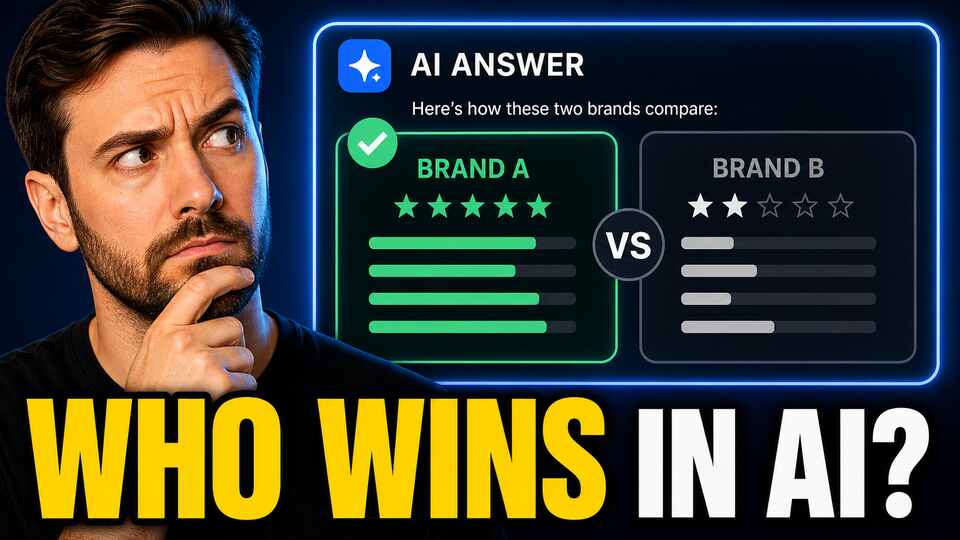
Every category has a winner in AI search, and it might not be who you think. When someone opens ChatGPT and asks "what's the best project management tool for a growing startup?" or "which CRM should I use for outbound sales?", they get a confident, synthesized answer. That answer almost always names specific brands. The brands it names, how prominently it names them, and how positively it frames them, this is the new competitive battlefield. And right now, most companies have no idea how they're performing on it.
AI search has created a fundamentally different kind of competition. In traditional search, you competed for rankings on specific keywords. In AI search, you compete for share of voice across an entire conversation space. The AI engine doesn't just pull one result, it synthesizes a narrative, and in that narrative, some brands appear as the obvious choice and others are mentioned as afterthoughts, or not mentioned at all. Understanding who wins in your category, and why, is the first step to closing the gap.
The New Competitive Landscape in AI Search
Traditional SEO competitive analysis focused on keyword overlap, domain authority comparisons, and backlink profiles. AI search competitive analysis requires a completely different set of metrics. The question isn't "who ranks #1 for this keyword?", it's "when someone asks the AI about a problem our product solves, which brands get mentioned, in what order, and with what framing?"
To illustrate what brand-vs-brand competition looks like in AI search, consider three well-established categories:
Project management (Notion vs Asana vs Monday.com): These three tools compete for nearly identical prompts, "best project management software," "tool for managing team tasks," "how to organize my team's work." In AI search, Monday.com tends to get mentioned when users ask about structured enterprise workflows, while Notion performs strongly on prompts about documentation and flexible workspaces. Asana holds a strong position on task-tracking and deadline-focused prompts. None of them dominates uniformly, each has pockets of strength and weakness depending on how the question is framed.
CRM (HubSpot vs Salesforce vs Pipedrive): Salesforce captures a disproportionate share of mentions on prompts about large enterprise CRMs, thanks in large part to its Wikipedia presence, review volume, and years of third-party content. HubSpot dominates on inbound marketing and SMB prompts. Pipedrive tends to appear on prompts specifically mentioning pipeline management or sales team simplicity. The brand that "wins" depends entirely on prompt intent, and most prompts in this category are framed differently enough that the competitive picture shifts dramatically.
Email marketing (Mailchimp vs ConvertKit vs ActiveCampaign): Mailchimp's enormous brand recognition means it appears in nearly every broad email marketing prompt, even when it's not the best fit. ConvertKit (now Kit) performs much better on creator-focused prompts. ActiveCampaign tends to appear on prompts about automation sequences and complex workflows. This shows a key dynamic: older, more widely-known brands often have higher mention frequency, but their sentiment and position scores may be weaker than newer, more specialized competitors.
The Key Metrics in a Brand-vs-Brand Comparison
When BabyPenguin runs a competitive analysis across a category, it surfaces several distinct metrics that together tell the full story of how brands are performing relative to each other in AI search.
Mention frequency: The most basic metric, out of all the prompts run in a category, what percentage trigger a mention of each brand? A brand with 65% mention frequency is appearing in the majority of relevant conversations. A brand at 12% is barely present. This single number often tells a stark story.
Sentiment score: Being mentioned isn't enough. How the AI describes a brand matters enormously. Is it mentioned as "the industry leader" or "a popular option that some users find limiting"? Sentiment scoring tracks the qualitative framing across mentions, positive, neutral, or negative, and surfaces patterns. A brand that's frequently mentioned but consistently described with caveats has a different problem than a brand that's rarely mentioned.
Average position when mentioned: In AI responses that name multiple brands, position matters. Being named first in a recommendation list carries different weight than being an afterthought in the fourth bullet. Average position tracks where in the response a brand typically appears, giving a cleaner signal of actual prominence.
Platform breakdown: ChatGPT, Gemini, and Perplexity don't produce the same answers. A brand might perform strongly on ChatGPT but barely register on Gemini, or vice versa. This breakdown is critical because different user populations are asking questions across different platforms. If your target customers skew toward Perplexity for research, that's where you need to win, regardless of your ChatGPT performance.
Prompt coverage: How many of the relevant prompts in a category trigger a mention of each brand? A brand might have high mention frequency on the prompts it appears in, but low prompt coverage, meaning it's only appearing on a narrow slice of the category's question space. Prompt coverage gaps often reveal where a competitor has content and authority that you're missing.
What Drives Brand-vs-Brand Gaps?
When you look at the competitive data and see that a competitor is getting mentioned in 70% of category prompts while you're at 25%, the question is: why? The drivers are usually a combination of the following factors.
Third-party review coverage: AI engines heavily weight trusted third-party sources like G2, Capterra, Trustpilot, and category-specific review sites. A brand with 2,000 reviews on G2 is significantly more likely to be cited than a brand with 150 reviews. This isn't just about volume, it's also about recency and specificity. Reviews that describe specific use cases in detail are more likely to inform AI responses on those use cases. As noted in Search Engine Land's citation study across 11 industries, third-party authority sites dominate AI citation sources across most verticals.
Wikipedia presence: Wikipedia is one of the highest-weighted sources for AI language models. Brands with substantial, well-cited Wikipedia articles appear in AI responses far more consistently than brands without them. This matters especially for definitional and comparative prompts, the kind that explicitly ask "what is [brand]" or "how does [brand] compare to [competitor]."
Brand age and recognition: Older brands have more years of content, reviews, and citations across the web. Language models trained on internet text naturally reflect this accumulated signal. This is one reason why established incumbents like Salesforce or Mailchimp maintain AI search presence even when newer tools outperform them functionally. It's not entirely fair, but it's the reality of how training data works.
Content depth on specific use cases: AI engines are remarkably good at matching prompt intent to content depth. A brand that's published thorough, authoritative content on a specific use case, with real examples, specific workflows, and meaningful differentiation, is much more likely to be cited when that use case is mentioned in a prompt. Thin or generic content rarely drives AI citations.
Structured data and technical signals: Pages with proper schema markup and technical SEO fundamentals are more reliably parsed and indexed by AI crawlers. While schema isn't a magic bullet, pages with strong technical foundations tend to perform better in AI citation studies over time. The Princeton GEO paper found that structured signals could improve AI visibility by meaningful margins, particularly for factual and comparative queries.
Entity consistency across the web: How consistently is your brand described across your own website, review sites, Wikipedia, press coverage, and social profiles? AI engines build a composite understanding of a brand from all of these signals. Inconsistency in how a brand is described, different taglines, different value propositions, different positioning statements across different sites, creates a weaker entity signal and reduces citation likelihood. This is explored in detail in our guide on entity consistency and knowledge graph signals.
How to Close the Gap on a Stronger Competitor
Once you understand what's driving a brand-vs-brand gap, the next question is how to close it. The approach depends on which factors are most responsible for the gap.
If the gap is primarily driven by review volume, the fix is relatively straightforward: build a systematic review generation program on the platforms that AI engines weight most heavily. G2, Capterra, and Trustpilot are the highest priority for most B2B categories. Even a 3-month focused effort can meaningfully shift citation frequency if the gap isn't enormous.
If the gap is driven by content depth, the answer is publishing highly specific, use-case-level content that matches how prompts in your category are actually phrased. Use the prompt-level tracking data from your AI monitoring to identify which specific questions your brand is missing from. These gaps are content briefs waiting to be written.
If the gap is driven by entity recognition, the AI simply doesn't "know" your brand as well as a competitor, the work is broader. It includes building Wikipedia presence, earning coverage in industry publications, ensuring consistent brand descriptions across all third-party profiles, and investing in the kind of original research that multiplies AI visibility by creating citable content that other publishers reference.
If the gap is platform-specific, you're performing well on ChatGPT but invisible on Gemini, the strategy becomes more targeted. Different platforms weight different source types. Understanding how Gemini surfaces brands versus how ChatGPT picks sources can reveal specific content and technical interventions that will move the needle on underperforming platforms.
The Danger of Not Knowing Your Position
The most dangerous position in AI search competitive analysis isn't being behind a competitor, it's not knowing you're behind. Many brands operate with a completely false sense of security, assuming that because they rank well on Google, they're performing well in AI search. The correlation between the two is weak and getting weaker. A brand can have strong Google rankings and virtually no AI search presence, while a competitor with mediocre organic rankings has quietly built dominant AI citation share.
As Search Engine Land's overview of LLM visibility tracking makes clear, the measurement tools and frameworks for AI search are fundamentally different from traditional SEO analytics. Brands that wait for AI search to "mature" before investing in measurement are ceding ground that will become increasingly difficult to reclaim.
The brands that win in AI search over the next three years won't necessarily be the ones that were most visible in 2023. They'll be the ones that understood the new competitive landscape earliest and built systematic programs to monitor, analyze, and improve their AI search presence. That starts with knowing exactly where you stand relative to your competitors, not with guesswork, but with data.
Benchmarking competitors in AI search requires a repeatable methodology and consistent tracking over time. One-time snapshots are nearly meaningless given how frequently AI responses change. The competitive picture you see today may look completely different in six weeks, which means you need continuous visibility, not periodic audits.
BabyPenguin's competitive analysis feature lets you run head-to-head brand comparisons across ChatGPT, Gemini, and Grok simultaneously, tracking mention frequency, sentiment, position, and prompt coverage for your brand and up to five competitors. If you want to know who's winning in your category and exactly why, start your analysis at BabyPenguin.ai.