Agentic GEO: The Next Phase of AI Search Optimization Has Already Started
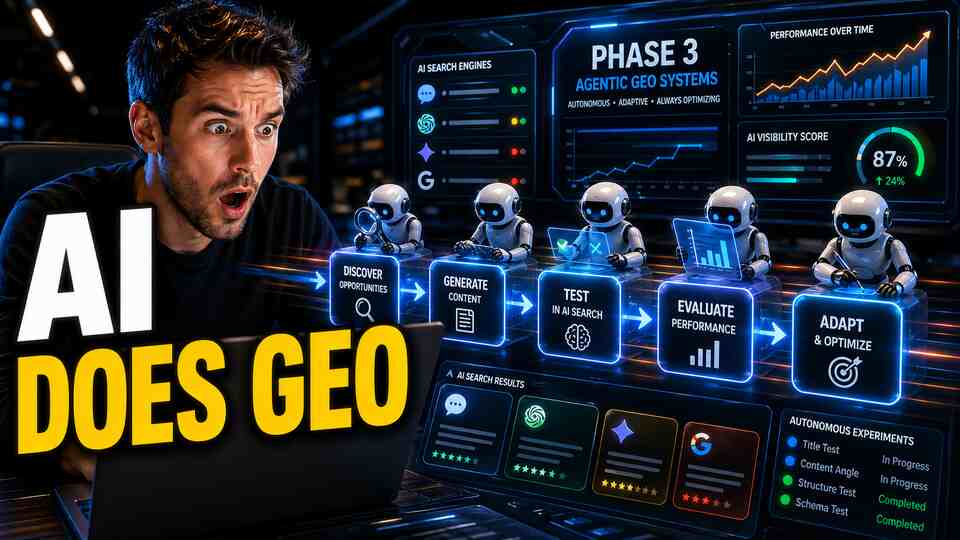
We Are Already in Phase Three
For the past two years, GEO (Generative Engine Optimization) has been a human-driven discipline. Marketers experiment with phrasing, test whether adding statistics improves citation rates, and manually check whether their brand shows up in ChatGPT or Gemini responses. It works, to a degree. But a series of research papers published in late 2025 and early 2026 make one thing clear: the field is about to change faster than most people expect.
Agentic systems are now doing the optimization work. Not eventually. Now.
Three Phases of GEO, and Why Phase One Is Over
Phase one ran roughly from 2023 through mid-2024. It was defined by experimentation. Marketers noticed that AI engines were citing some sources and ignoring others. Early practitioners started documenting patterns: use statistics, write in clear declarative sentences, structure content so AI can extract discrete facts.
Phase two started in 2025 with systematic study. Academic benchmarks appeared. AutoGEO from CMU (October 2025) demonstrated a lightweight model trained with reinforcement learning rewards that learned generative engine preferences automatically. The result was a 35.99% improvement in content visibility, achieved through automated iteration rather than manual guesswork.
Phase three is 2026. It is agentic, self-evolving, and already in production at scale.
AgenticGEO: Continuous Adaptation at the Content Level
In March 2026, researchers published AgenticGEO, a self-evolving system that uses evolutionary strategies to continuously optimize content visibility in black-box generative search engines. A lightweight surrogate model approximates how AI engines respond to content changes, reducing the computational cost of running experiments at scale.
The system does not require knowing what weights or heuristics determine citation behavior. It treats the engine as a black box, runs structured experiments, observes outcomes, and adapts. The evolutionary framing means it does not optimize a fixed piece of content once. It keeps adapting as engine behavior changes.
The core conclusion: static content optimization is becoming obsolete. Content optimized once in 2024 will degrade over time as AI engines update their training data and ranking signals. Brands that rely on one-time GEO work will lose ground to brands running continuous adaptation loops.
Pinterest Proved This Works in Production
In February 2026, Pinterest published research on a production GEO system they deployed using Vision-Language Models combined with an agent framework. The result was a 20% increase in traffic from generative search. Pinterest is not a startup running a controlled experiment. They have hundreds of millions of users and a business that depends on traffic. A 20% lift from generative search is a significant number.
The Pinterest case also highlights the visual content angle. Most GEO work focuses on text. Pinterest's system uses VLMs to optimize visual content for AI search engines that increasingly understand images. Infographics, product images, diagrams, charts: all of it is underoptimized for AI search because most practitioners are still thinking in text-first terms.
If you want to understand where a large portion of untapped GEO opportunity lives right now, visual content is a strong candidate. The brands ahead on this two years from now will likely be the ones that started thinking about it in 2026.
AI Agents Are Now the Search Intermediary
There is a second dimension to agentic GEO that is separate from content optimization. AI agents are increasingly browsing the web, synthesizing information, and making recommendations on behalf of users without a human looking at search results at all.
The AgentWebBench paper (April 2026) introduced the first benchmark for multi-agent coordination in the agentic web. The scenario is not hypothetical: a user asks an AI assistant to research project management tools, compare five options, and recommend the best one. The agent browses, reads, synthesizes, and produces an answer. The user never sees a search results page.
In that scenario, your content is being evaluated by an AI agent, not a human. The agent is looking for clarity, factual density, and direct answers. Content optimized for dwell time or emotional engagement does not serve an agent the way it serves a human browser. This connects directly to the broader question of how AI decides what to recommend.
The Human Intent Problem Nobody Is Talking About
RedNote published work in March 2026 on SearchLLM, a system designed to align LLM search behavior with what human searchers actually want. The key finding: what LLMs are trained to prefer and what human searchers actually want diverge significantly.
Content that is optimized purely for AI citation, without regard for what the human searcher needs, loses in the long run. If your content gets cited but does not satisfy the underlying query intent, AI engines that track downstream satisfaction signals will eventually learn that your citations are not serving users well. The CMO's guide to AI search covers this in depth: GEO and content quality are not in tension. The brands that win long-term are genuinely useful to the humans behind the queries, not just technically optimized to trigger citation behavior.
What This Means for Brands Operating Today
The gap between brands that have built systematic AI visibility infrastructure and brands that have not is going to widen fast over the next 18 months.
Agentic optimization systems need data to operate. They need to know which content is getting cited, in which engines, for which queries, and how that changes over time. Without that measurement layer, there is nothing for an agentic system to optimize against. Brands tracking AI visibility right now are building the data foundation that agentic systems will require. Brands that are not measuring anything will not be able to adopt agentic approaches in 2027 because they have no baseline to work from.
BabyPenguin's prompt-level tracking shows you which specific queries trigger citations and which do not. Citation source analysis shows you why competitors are appearing in your place. Cross-engine comparison across ChatGPT, Gemini, and Grok shows you whether your visibility is engine-specific or consistent. Automating AI monitoring at this level is accessible at pricing built for teams of any size.
The Measurement Problem Is the Hardest Part
Researchers building AgenticGEO, AutoGEO, and similar systems all face the same foundational challenge: measuring visibility in generative search engines is not straightforward. There is no equivalent of a rank position. The same query asked twice may produce different citations. Engines update constantly.
This is why companies building monitoring infrastructure now have a durable advantage. The measurement methodology matters. For brand building in the AI era, citation frequency, share of AI-generated recommendations in your category, and visibility consistency across engines are the numbers that will define brand health. They require purpose-built tooling to track reliably.
The Window Is Narrow
GEO is not going to stay in a state where manual effort and systematic measurement are sufficient. Agentic, continuously adapting optimization systems are coming, and early production deployments prove they work. The question for any brand is whether you are building the foundation now or planning to catch up later.
AI visibility data compounds. The brands with six months of citation tracking data understand their visibility patterns. The brands with 18 months of data understand how they respond to algorithm changes and which content types consistently drive AI recommendations. That institutional knowledge does not exist without consistent measurement over time.
Start measuring what matters now. The agentic systems will give you more leverage when they arrive, but only if you have built the data infrastructure they need to operate on. Understand how AI shopping optimization works and where your brand stands in those recommendation flows. The brands that act in 2026 will look back at this window the same way early SEO adopters look back at 2010: a period when systematic effort created durable advantages that competitors spent years trying to close.