How to Do a Source Gap Analysis for GEO
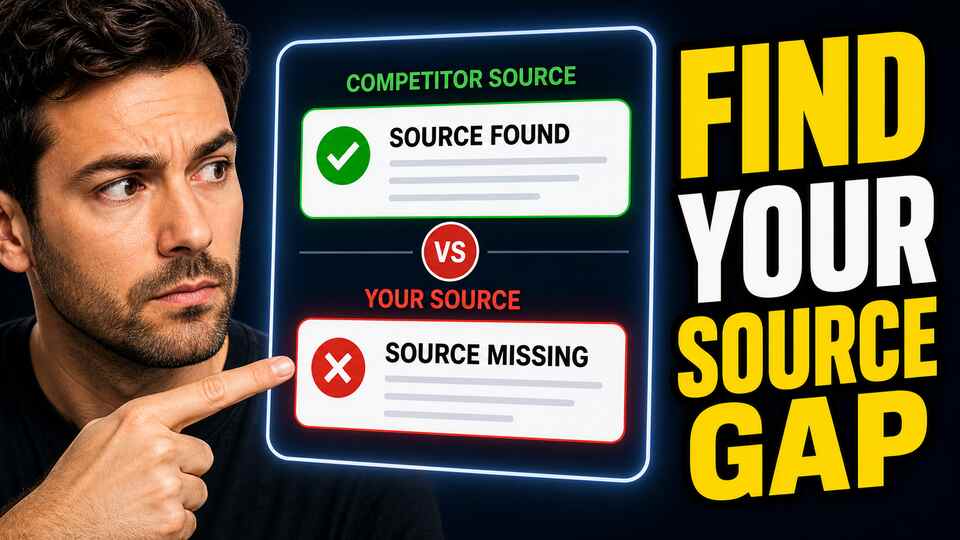
There's a category of AI visibility problem that's genuinely underdiagnosed. Most teams focus on why AI engines aren't citing their own content. The harder question, and the one with more actionable answers, is which domains AI engines are citing in your category that don't currently mention your brand at all. These are your source gaps: the trusted nodes in the AI citation graph where your brand is absent. Closing these gaps is often faster and more impactful than trying to make your own content more citable, because you're using trust that AI engines have already assigned to these third-party sources.
A source gap analysis is a systematic approach to identifying, prioritizing, and closing these gaps. It's not complicated, but it requires discipline and a clear framework. What follows is the step-by-step method that BabyPenguin's data has validated as most effective.
Step 1: Define Your Category Queries
Before you can analyze which domains AI engines cite in your category, you need to define your category precisely in terms of the queries your target buyers are asking. This is more specific than your keyword universe, it's the set of prompts that a buyer at the awareness and consideration stage would ask an AI assistant when they're trying to solve a problem you address.
For a B2B HR software company, the category queries might include:
- "best HR software for mid-size companies"
- "how to automate employee onboarding"
- "HR software comparison Workday vs BambooHR"
- "what HR tools do fast-growing startups use"
- "how to manage performance reviews at scale"
Aim for 20-40 category queries that collectively represent the research journey of a prospective buyer. These should span awareness-level questions (broad problem framing) through consideration-level questions (specific comparisons and feature evaluations). The goal is coverage of the full query space where AI engines will be synthesizing answers that could include or exclude your brand.
For guidance on mapping this query space comprehensively, see how to build a GEO content strategy and query fanouts explained, the fanout sub-queries generated from your surface queries are also important category queries to include.
Step 2: Pull the Cited Domains for Each Query
For each of your 20-40 category queries, you need to identify which domains AI engines are actually citing. There are two approaches to this data collection.
Automated tracking: BabyPenguin tracks source citations across ChatGPT, Gemini, and Grok systematically, so if your category queries are set up as tracked prompts, you can pull the source citation data directly from the platform. This gives you aggregated citation frequency data by domain, which is the foundation of the gap analysis.
Manual prompt analysis: Run each category query across ChatGPT (with web browsing), Gemini, Perplexity, and Google AI Mode. Record every source cited in the response. Do this across multiple sessions and times, since citation sources vary. After running 20-40 queries across 3-4 platforms, you'll have 200-400 data points on cited sources. Compile these into a spreadsheet with domain, query context, and platform.
Search Engine Land's analysis of 8,000 AI citations found that citation patterns cluster strongly around a small number of domain types: established industry publications, major review aggregators, high-authority news sites, and platform-specific communities like Reddit. Your manual data collection will likely show the same concentration, a relatively small number of domains accounting for a large proportion of citations across your category queries.
Step 3: Check Each Cited Domain for Brand Mentions
Once you have your list of cited domains, the gap analysis itself is straightforward. For each domain in your citation dataset, run a site search to check whether your brand is mentioned anywhere on that domain. The syntax varies by platform, but "site:g2.com [your brand name]" or equivalent searches will surface existing mentions.
Categorize each cited domain into one of three buckets:
- Covered: The domain cites your brand, reviews your product, or mentions you in relevant context. These are your existing citation sources.
- Partial: The domain mentions your brand but not in the context most relevant to your category queries. For example, you appear in a general listicle but not in the specific comparison article that drives most of the citations. These are optimization opportunities within existing relationships.
- Gap: The domain has no content mentioning your brand. These are your source gaps, trusted nodes in the AI citation graph where you're entirely absent.
The gap list is the output of this step. It's almost always longer than teams expect. In competitive categories, it's common to find 15-30 high-citation domains where a brand is entirely unrepresented.
Step 4: Score Gaps by Citation Frequency
Not all gaps are equal. A domain cited 200 times across your category queries is a much higher priority gap than a domain cited 5 times. Before building a coverage strategy, score each gap by its citation frequency in your dataset.
A simple prioritization framework:
- Tier 1 (highest priority): Domains cited more than 50 times across your category queries. These are the backbone of AI citation in your category. Being absent from them means being absent from a large proportion of AI-generated answers.
- Tier 2 (medium priority): Domains cited 10-50 times. Important but not the primary driver of category citation patterns.
- Tier 3 (lower priority): Domains cited fewer than 10 times. Worth addressing eventually, but not where you start.
Also weight by platform: a domain that appears heavily in Gemini citations may be a different priority than one that dominates ChatGPT citations, depending on where your target buyers are most active. BabyPenguin's cross-platform tracking allows this kind of platform-specific weighting.
After scoring, you should have a prioritized list of Tier 1 and Tier 2 gaps to address. For most brands, this is 5-15 domains, a manageable workload for a focused outreach and coverage campaign.
Step 5: Build a Coverage Strategy by Domain Type
Different domain types require different coverage strategies. The right approach for G2 is not the right approach for TechCrunch or Reddit. Here's the playbook by domain category:
Review aggregators (G2, Capterra, TrustRadius, Trustpilot): If you're absent from these platforms, claim and fully optimize your profile immediately. A complete profile with accurate feature data, category tags, and product descriptions is the foundation. Then actively recruit reviews from your customer base, AI engines weight review platforms by review volume and recency, not just presence. Search Engine Land's study of AI citation sources found that review platforms are among the highest-cited domain types across AI search engines, making them mandatory coverage for any SaaS or product brand.
Industry news and trade publications: If a publication regularly covers your category and you're not appearing in their coverage, you have a PR gap that's also an AI citation gap. The strategies here are pitching original data studies (publications love data-led stories), making your team available as expert sources for category trend pieces, and sponsoring or contributing to editorial content where the guidelines allow. Data studies are particularly powerful because a publication that covers your research will cite your brand in the context of credible, informational content, exactly the citation type AI engines prefer.
Industry blogs and comparison sites: Sites that publish "best X tools" or "X vs Y comparison" roundups are among the most citable content types in AI search. Research from the Princeton GEO paper confirms that comparative and evaluative content is disproportionately cited by AI engines. If influential blogs in your category are running roundups that don't include you, outreach for inclusion is the highest-priority coverage tactic. Guest posting on these blogs, contributing genuinely educational content, also builds citation presence in a different format.
Reddit and other forums: Reddit appears as a cited domain at remarkably high rates across all AI engines. Search Engine Land's citation study found Reddit among the top-cited domains across AI search engines, alongside YouTube and LinkedIn. Forum presence requires authentic participation, AI engines recognize and discount spam, and the Reddit community will reject it immediately. The effective approach is identifying subreddits where your target buyers discuss category questions and contributing genuinely useful answers over time. When forum discussions about your category mention your brand in authentic context, that content becomes a citation source. See how to appear in Perplexity answers for more on forum strategy.
Wikipedia: Wikipedia is cited at extraordinarily high rates by AI engines because its structured, referenced, consensus-driven content aligns closely with what AI systems have been trained to treat as authoritative. If your brand qualifies for a Wikipedia entry (established companies with third-party coverage generally do), creating and maintaining an accurate, well-referenced entry is among the highest-return GEO activities available. If you already have a Wikipedia entry, ensure it's current, accurately describes your product and category, and is supported by quality references. Don't add promotional language, Wikipedia editors will remove it and your entry's credibility will suffer.
LinkedIn and professional networks: LinkedIn content appears in AI citations more than most brands expect, particularly for B2B queries. Systematic thought leadership publishing on LinkedIn, not promotional content, but genuine expertise sharing, builds a citation presence on a domain that AI engines trust highly for professional and business topics.
The Prioritized Gap Analysis Spreadsheet
A source gap analysis is most useful when it's organized in a format that drives execution. The spreadsheet structure that works best has the following columns:
- Domain: The cited domain being analyzed
- Domain type: Review aggregator, news, blog, forum, Wikipedia, social, other
- Citation frequency: Number of times this domain was cited across your category queries
- Citation frequency tier: 1, 2, or 3 based on the thresholds above
- Platforms citing: Which AI platforms (ChatGPT, Gemini, Grok, Perplexity, Google AI Mode) cite this domain
- Current brand coverage: Covered / Partial / Gap
- Coverage action: Specific next step (claim profile, pitch story, request inclusion in roundup, etc.)
- Owner: Team member responsible
- Status: Not started / In progress / Complete
- Notes: Contact information, specific articles to target, relationship notes
Sort by citation frequency tier, then by domain type. Start execution at the top of the list and work down. A team that closes five Tier 1 gaps in a quarter will see more AI citation improvement than a team that closes twenty Tier 3 gaps.
Tracking the Impact of Gap Closure
Source gap analysis isn't a one-time exercise. As you close gaps, as review sites publish more reviews, as publications cover your data studies, as forum discussions mention your brand, you should see measurable changes in your AI citation rates across the category queries you defined in Step 1.
The measurement approach is straightforward: run your category queries through AI engines before you begin the gap closure campaign, record citation rates and source appearances, and rerun the same queries 60-90 days after closing each tier of gaps. The expected pattern is a steady increase in citation frequency as your third-party coverage expands, with Tier 1 gap closures producing the largest individual impact.
It's also worth monitoring for secondary effects. When a high-authority domain begins mentioning your brand, it often triggers mentions on other domains that syndicate or reference the original coverage. A single well-placed data study can produce a cascade of coverage across multiple domains simultaneously, and each of those domains may already be a cited source in your category.
For a complementary approach to identifying where you stand, see how to audit how AI models talk about your brand, and for understanding how to make your owned content more citable alongside your third-party coverage strategy, see how to track AI citations over time.
The Compound Effect of Closed Gaps
Source gaps compound in the wrong direction when left unaddressed. A brand absent from the top-cited domains in its category is also absent from the training signal that shapes how AI models understand the category. As AI engines continue to update their models with fresh web data, the brands consistently present across high-authority sources in a category become more deeply embedded in the model's representation of that category, and brands absent from those sources fall further behind.
Closing source gaps isn't just a citation frequency play. It's a brand authority play that shapes how AI models understand and represent your brand over time. The earlier you build presence across the domains that AI engines trust in your category, the stronger your position becomes as those trust signals compound into model-level brand recognition.
BabyPenguin makes the source gap analysis process significantly faster by tracking which domains AI engines cite for your category queries across ChatGPT, Gemini, and Grok, giving you the citation frequency data that's the hardest part of this framework to collect manually. With source-level tracking built in, you can run a complete gap analysis in hours rather than days, and track the impact of your coverage strategy in real time as new sources begin mentioning your brand.