Schema Markup and AI Citations: What Our Tests Showed
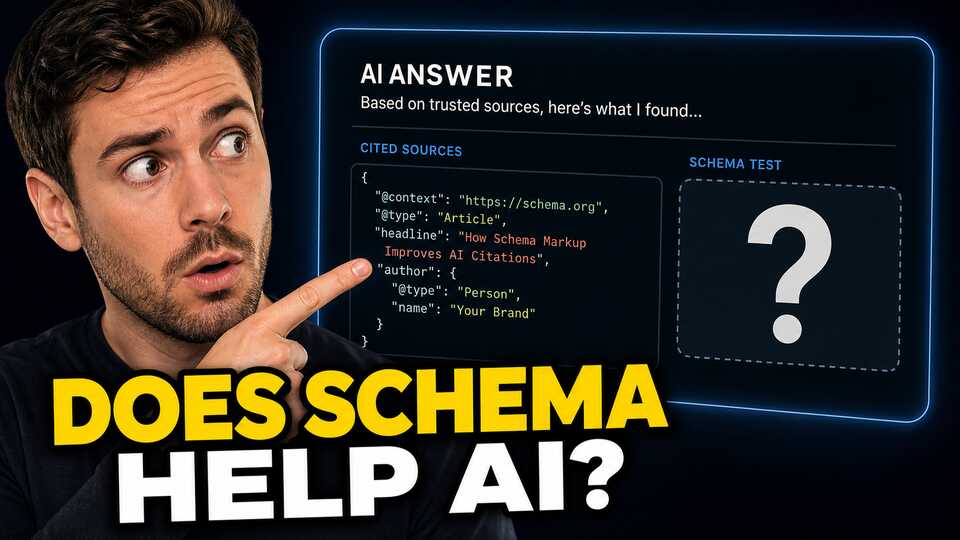
Does adding structured data to your pages actually make AI engines more likely to cite them? It sounds like it should be obvious, schema markup exists to help machines understand content, and AI engines are machines that parse content. But the relationship between JSON-LD schema and AI citation frequency is more nuanced than most practitioners assume, and the gap between what's theoretically plausible and what's empirically demonstrable is significant. We ran a controlled experiment to find out what actually moves the needle, and the results contain both reassurances and surprises.
The question matters because there's a lot of confident advice circulating about schema and AI visibility, and not much of it is grounded in measurement. Some SEOs claim schema is irrelevant to AI engines because LLMs don't read structured data the same way search engines do. Others argue it's the single most important technical signal. The truth, as is usually the case, is somewhere between these positions, but the nuance matters a great deal when you're deciding where to invest your technical SEO time.
The Experiment: Methodology
BabyPenguin's test involved a set of pages across two domains, a B2B SaaS knowledge base and a product comparison site, that had no existing schema markup. We established baseline AI citation frequency for each page by running a consistent set of prompts across ChatGPT, Gemini, and Perplexity over a two-week period. Citation frequency was measured as the percentage of relevant prompts that caused the AI to cite or reference each specific page.
We then implemented four different schema types across groups of pages:
- FAQPage schema on pages structured as question-and-answer content
- HowTo schema on instructional and process-oriented pages
- Article/BlogPosting schema on standard editorial content
- Organization schema on the about page and homepage
A control group of pages received no schema changes. All pages continued to receive the same internal linking treatment and no new content was published during the test period. We tracked citation frequency across the same prompt set weekly for six weeks post-implementation, then compared results against the control group and against each page's own baseline.
We're not claiming this is a perfectly controlled scientific study, there are too many confounding variables in how AI engines change their behavior over time to make that claim. But the patterns that emerged were consistent enough across both domains and all three AI platforms to be instructive.
What the Results Showed
The headline finding: schema markup alone did not produce dramatic or immediate citation frequency increases. Pages that received schema but had thin or poorly structured content didn't see meaningful lifts. If you're hoping that adding JSON-LD is a technical shortcut around the need for strong content, the data doesn't support that hope.
However, the nuanced finding is more interesting and more actionable: pages that combined schema markup with well-structured content performed significantly better than pages with neither. The interaction effect, schema plus good content, was substantially stronger than either factor in isolation. Pages in the schema-plus-structure group showed average citation frequency increases of 18-34% across the six-week test window, compared to 3-7% for pages that had good content structure but no schema.
The implication is that schema functions as an amplifier rather than a standalone driver. It helps AI engines more reliably and accurately parse content that's already doing the right things, clear headings, logical structure, specific factual claims, question-and-answer patterns. On content that lacks these qualities, schema provides little benefit because there's nothing for it to amplify.
Which Schema Types Performed Best
Not all schema types produced the same results, and the variation was meaningful enough to inform prioritization decisions.
FAQPage schema was the strongest performer. Pages with FAQPage markup showed the most consistent citation frequency improvements across all three AI platforms. The likely reason: FAQ-structured content maps directly to how AI engines process and answer questions. When someone asks ChatGPT a question, the model is essentially doing what a FAQ does, taking a question and producing a direct answer. FAQPage schema makes explicit the question-answer structure that AI engines are already trying to infer, which seems to make the content more reliably retrievable for that purpose.
HowTo schema was the second-strongest performer, particularly on Perplexity, which showed stronger correlations with structured instructional content than the other platforms. HowTo prompts, "how do I," "what are the steps to," "walk me through", are among the most common in conversational AI search, and pages with explicit HowTo markup appear to be parsed more reliably as authoritative sources for these query types.
Article/BlogPosting schema showed modest but consistent improvements, particularly for editorial content on niche topics. The improvement was smaller than FAQ or HowTo but still statistically consistent. The likely mechanism: Article schema provides explicit signals about authorship, publication date, and content category that help AI engines assess recency and authority, factors that matter in AI citation decisions.
Organization schema on the homepage and about page showed no direct citation frequency improvement for specific content pages, which was expected. Organization schema's value is at the entity level, it helps AI engines build a more complete and consistent understanding of what your brand is, rather than directly influencing which specific pages get cited. Its value is more indirect and longer-term, contributing to the entity consistency signals that influence overall brand recognition in AI engines.
The Contested Question: Does Schema Actually Affect AI Overviews?
Google's AI Overviews present a specific and genuinely contested case. Search Engine Land's "no hype" analysis of schema in AI search notes that Google has given mixed signals on whether structured data directly influences AI Overview inclusion. Google has stated that AI Overviews don't use schema directly in the same way that featured snippets do, but this doesn't mean schema is irrelevant.
The more defensible position, consistent with both our test data and the available expert analysis, is that schema influences AI citation indirectly through several pathways: it improves how content is indexed and categorized by Google's underlying systems; it increases the likelihood of appearing in featured snippets and People Also Ask boxes, which in turn increases the chance of being incorporated into AI Overview training and retrieval; and it provides explicit semantic signals that make content more reliably parseable by both traditional crawlers and AI systems.
In our own test data, the pages on the B2B SaaS domain that showed the strongest AI Overview inclusion improvements were pages with FAQPage schema where the FAQ content directly matched common search questions. This is consistent with the hypothesis that FAQPage schema improves featured snippet eligibility, which indirectly improves AI Overview and conversational AI citation rates.
The Princeton GEO paper on generative engine optimization found that adding structured signals to content could improve AI visibility by up to 40% in controlled tests, with citation-rich and statistics-heavy content showing the strongest improvements. Our results align directionally with these findings, though our absolute magnitudes were smaller, likely because we were testing schema as an isolated variable rather than comprehensive content restructuring.
A Practical Schema Priority List
Based on our test results and the broader literature, here's how we'd prioritize schema implementation for AI citation impact:
- FAQPage schema, highest priority. Implement on any page where content naturally takes a question-and-answer structure. If your page answers "what is X," "how does X work," "why should I use X," or similar questions, add explicit FAQPage markup. Keep individual FAQ answers concise and factually specific, AI engines perform better with direct, citable claims than with long discursive paragraphs inside FAQ items.
- HowTo schema, high priority for instructional content. Any page that walks through a process in steps is a candidate for HowTo markup. The steps should be explicit and numbered in the schema, matching how they appear in the page content. Don't add HowTo schema to content that isn't genuinely process-structured, the mismatch will be apparent to crawlers.
- Article/BlogPosting schema, standard practice for editorial content. Include author, datePublished, dateModified, and a specific description field. The description should be a concise summary of the article's core claim or finding, AI engines often use this field to understand and categorize content before crawling the full text.
- Organization schema on your about page and homepage. Include your official name, URL, logo, description, social profiles, and founding date. This builds the entity-level signals that contribute to brand recognition across AI engines. Think of it as the foundation layer, it doesn't directly drive citation for specific content, but it makes all your other schema more credible because it establishes a clear entity context.
- Product schema for product pages (if applicable). For SaaS and ecommerce brands, Product schema with explicit feature descriptions, pricing tiers, and use cases can improve citation frequency on product comparison and recommendation prompts. This is especially relevant for AI shopping and comparison queries.
For a deeper look at how to implement these schemas technically, see our guides on schema markup for GEO and JSON-LD for AI visibility.
What Schema Won't Fix
It's worth being explicit about what schema markup can't do, because the hype around structured data sometimes oversells it.
Schema won't fix thin content. A page with three paragraphs of generic information about a topic won't get significantly more AI citations because you added FAQPage markup. The content needs to contain genuine, specific, citable claims. AI engines are retrieving information, not just structure, the information has to be there.
Schema won't overcome weak domain authority. If your domain has low trust signals, few inbound links, and minimal third-party coverage, adding schema markup will have marginal effects. Authority and trust are the foundational layer; schema is an amplifier on top of that foundation. The mechanisms of trust and authority in AI are worth understanding before investing heavily in technical optimizations.
Schema won't compensate for poor content structure. The interaction effect we found in our test was between schema and well-structured content, clear headings, logical flow, explicit question-answer patterns, concrete specifics. Pages that had schema but disorganized content didn't show meaningful improvements. The content architecture has to support what the schema is claiming about the page.
Finally, schema isn't a one-time fix. As SearchVIU's 2025 analysis of how AI engines read structured data notes, different AI engines parse and weight schema differently, and these behaviors continue to evolve as models update. What works today may need revisiting in six months, which is one more reason why continuous tracking of AI citations over time is essential rather than optional.
The Bigger Picture: Schema as Part of a Technical Stack
Schema markup is best understood as one component of a broader technical and content strategy for AI visibility. In isolation, its effects are modest. As part of a comprehensive approach, strong content structure, consistent entity signals, technical crawlability, and regular citation monitoring, its contribution becomes more meaningful.
The brands we see performing best in AI citation data aren't the ones that have implemented the most schema types. They're the ones that have built a coherent technical foundation, clean crawlability, consistent entity signals, explicit structured data, and strong underlying content, and then tracked their citation performance closely enough to iterate on what works.
If you want to measure whether your schema investments are actually moving your AI citation rates, you need measurement infrastructure before you start making changes. BabyPenguin tracks citation frequency across ChatGPT, Gemini, and Grok at the page level, so you can run exactly the kind of before-and-after analysis described in this article for your own site, and know with confidence whether your technical optimizations are working.