How to Win Software Comparisons Run by AI Models
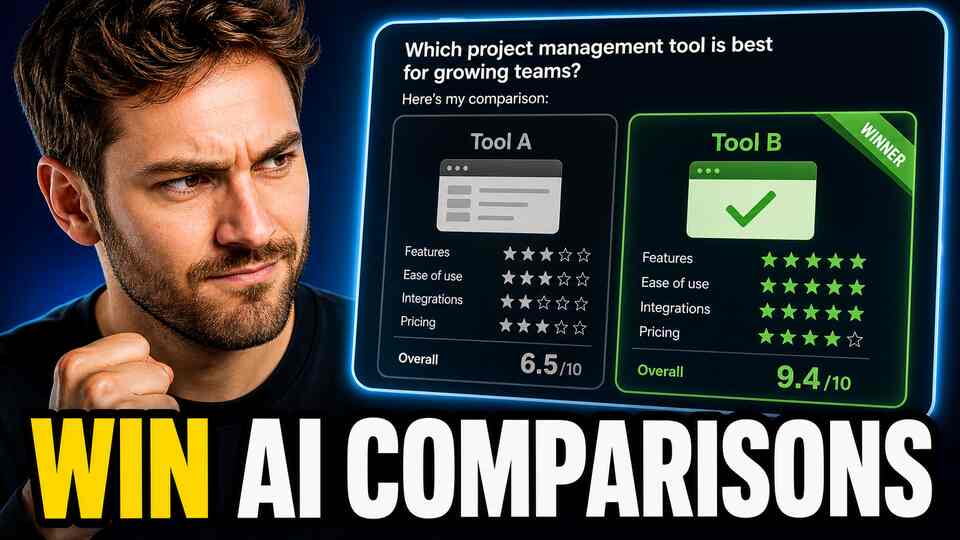
Software comparisons are one of the highest-intent moments in any buyer's journey. "Notion vs Coda." "HubSpot vs Salesforce." "Linear vs Jira." When a user types one of these into ChatGPT or Perplexity, they're already past awareness, they're choosing between specific options, and the AI's answer often becomes the deciding factor.
The brands that win in head-to-head AI comparisons aren't always the ones with the best products. They're the ones whose content is structured in a way the AI can extract cleanly, with specific named claims, verifiable evidence, and honest framing. Here's how to be one of those brands.
Why head-to-head comparisons are a different game
The key insight for software comparisons in AI search is one Writesonic frames cleanly: "AI engines don't 'rank' you; they choose you" based on whether they cite your content when answering. This is structurally different from traditional search ranking. There's no SERP position. There's a binary choice for each prompt: either your brand is included in the AI's answer, or it isn't.
For comparison queries specifically, "included" usually means one of three things:
- Mentioned as one of the two compared options (the dream, your brand is one of the two things being compared)
- Mentioned as a third or alternative option ("you might also consider X")
- Not mentioned at all (the AI compares the two named brands without bringing yours up)
Winning the first slot requires being the brand AI engines reach for in your category. Winning the second requires being credible enough that the AI thinks you're worth mentioning even when you weren't asked about. The third means losing the user entirely.
Build comparison pages on your own site
The most direct lever is to publish your own comparison content for the head-to-head queries that matter most. The Search Engine Land research on AI citation formats found that comparison and listicle content account for the largest share of commercial-intent AI citations, and head-to-head pages on your own site are one of the highest-leverage forms.
The pattern that works:
- One page per comparison, "Your Product vs Competitor A," "Your Product vs Competitor B," etc.
- Comparison table at the top, pricing, features, target audience, key differences in 4-6 rows
- Detailed comparison sections with question-shaped H2s ("Which one is more affordable?", "Which one has better support?", "Which one is easier to set up?")
- Honest treatment of competitor strengths, yes, including the parts where the competitor genuinely wins
- Clear "best for" guidance, name the specific use case where each option is the better pick
The honesty matters more than people realize. The Writesonic guidance reinforces this: AI engines weight trustworthiness signals heavily, and self-promotional comparison pages, the kind that frame your product as objectively winning every dimension, get downgraded in favor of pages that read as fair editorial.
Make every claim verifiable
The single biggest difference between a comparison page that wins AI citations and one that doesn't is verifiability. Vague claims get ignored. Specific, sourced claims get extracted.
Compare:
- ❌ "Linear is faster and more modern than Jira."
- ✅ "Linear's typical page-load time is under 200ms, compared to Jira's 1.2-second average. Linear's interface uses keyboard shortcuts for 90% of common actions, while Jira requires mouse navigation for most workflows."
The first version is opinion. The second version is two specific, verifiable claims that an AI extractor can quote and cite. Apply this rule to every comparison point: replace adjectives with measurements, replace superlatives with specific numbers, replace "easier" with "fewer steps," replace "better" with a named criterion.
Where measurements aren't possible, use named third-party evidence: "G2 reviewers rate Linear 4.7/5 from 1,800+ reviews; Jira sits at 4.3/5 from 5,200+ reviews." Both numbers, both sources, both quotable. The AI extractor can use either or both.
Acknowledge real competitor strengths
This is the part most teams find hardest. AI engines can detect bias. A comparison page that systematically frames the competitor as worse on every dimension reads as marketing, not analysis, and gets filtered accordingly.
The discipline: for each comparison, identify at least one or two areas where the competitor is genuinely better. Name them explicitly. Examples:
- "Salesforce has a more mature partner ecosystem and a wider library of pre-built integrations."
- "Notion's free tier is more generous than ours, with no team size limit."
- "HubSpot's marketing automation is more developed than ours, especially for email-heavy workflows."
Each acknowledgment makes your comparison more credible, and more useful to AI engines looking for honest editorial framing to draw from. This isn't a sacrifice. It's a credibility investment that pays off in citation behavior.
Optimize for the prompts users actually ask
The exact phrasing of your comparison page headings matters more for AI than for traditional search. AI engines match user prompts to content structure, so the closer your section headings match the natural language of real prompts, the more likely you are to be cited.
The exercise: search ChatGPT, Perplexity, and Gemini for the comparison queries in your category and observe the exact phrasing the AI tends to use in answers. Then mirror that phrasing in your H2s. If users ask "Which is better for solo founders?", make that the heading. If users ask "How much does each one cost?", make that the heading. The match between prompt phrasing and content structure is one of the most extractable signals you can give the AI.
Show pricing transparently
One specific pattern that consistently helps comparison pages perform: show pricing transparently for both your product and the competitor. Not "starting at" or "contact for pricing." Specific dollar amounts for each plan tier.
Pricing is one of the most-asked questions in comparison queries, and AI engines pull pricing data from comparison pages as canonical sources when answering "how much does X cost?" prompts. A comparison page with explicit, current pricing for both options becomes the authoritative source for both pricing prompts and the head-to-head prompt.
Keep this data current. Pricing comparisons go stale fast, refresh quarterly at minimum, and bump the dateModified field in the schema whenever you update.
Optimize the structured data
For comparison pages specifically, the schema combination that matters:
- Product for both your product and the competitor (yes, you can mark up competitors in schema as long as the data is accurate and public)
- ItemList to mark up the comparison as a structured list of options
- FAQPage for any FAQ section about the comparison
- Article for the editorial wrapper, with author and dateModified populated
The Product schema for the competitor should include their public pricing, brand name, and aggregateRating from G2 or Capterra. This isn't sketchy, it's marking up publicly available information that already exists. AI engines parse it as objective category data and weight your page as a more comprehensive comparison source.
Track which comparison prompts you're winning
For each "X vs Y" prompt that matters, track:
- Whether your brand is mentioned at all
- Whether you're one of the named compared options or only mentioned as an alternative
- Which sources the AI cites when answering the comparison
- How the AI characterizes you compared to the competitor
Run this weekly on the 20-30 most important comparison prompts in your category. Patterns reveal which competitors you're already winning against, which ones you're losing to, and which content investments would close the gap.
Push into competitor comparisons you're not in yet
One specific tactic that punches above its weight: build comparison pages for competitor pairs that don't include you yet. If your competitors are HubSpot and Salesforce, build a "HubSpot vs Salesforce vs Your Brand" comparison page on your own blog.
This works because AI engines that find a comparison page covering two named competitors plus a third option will often pull all three into the answer. You become the alternative the AI suggests when users ask about the head-to-head between your two biggest competitors. It's a backdoor entry into the comparison that costs almost nothing.
Don't ignore third-party comparison pages
The Writesonic article emphasizes that visibility depends on "which sources LLMs trust more than you." For comparisons, this means third-party comparison content, industry blogs, review sites, vertical publications, often outweighs your own pages. The same outreach work that goes into "best of" listicle inclusion applies here:
- Identify the third-party comparison pages that AI engines actually cite for your category
- Reach out to publishers with fresh data, free trial access, and specific angles
- Time outreach to coincide with content refresh cycles
- Build relationships, not one-off pitches
The most cited comparison content in your category isn't on your blog, it's on someone else's. Earning a fair mention there often outperforms anything you can do on your own pages.
The comparison playbook in summary
Build head-to-head pages for the comparisons that matter most. Lead with a comparison table. Use question-shaped headings that match real prompts. Make every claim verifiable with numbers or sourced evidence. Acknowledge competitor strengths honestly. Show pricing transparently for both options. Apply Product schema to both products. Track citation behavior weekly. Build "competitor vs competitor vs you" pages as a backdoor. Pursue third-party comparison inclusion.
None of these tactics is magical. All of them assume you're willing to write fair, specific, verifiable comparison content instead of dressed-up sales copy. AI engines reward the first and ignore the second, and the brands that take this seriously start showing up in head-to-head answers within weeks.
Related: How to Write Comparison Pages That Win in AI Search.