How to Build a GEO Content Strategy from Scratch
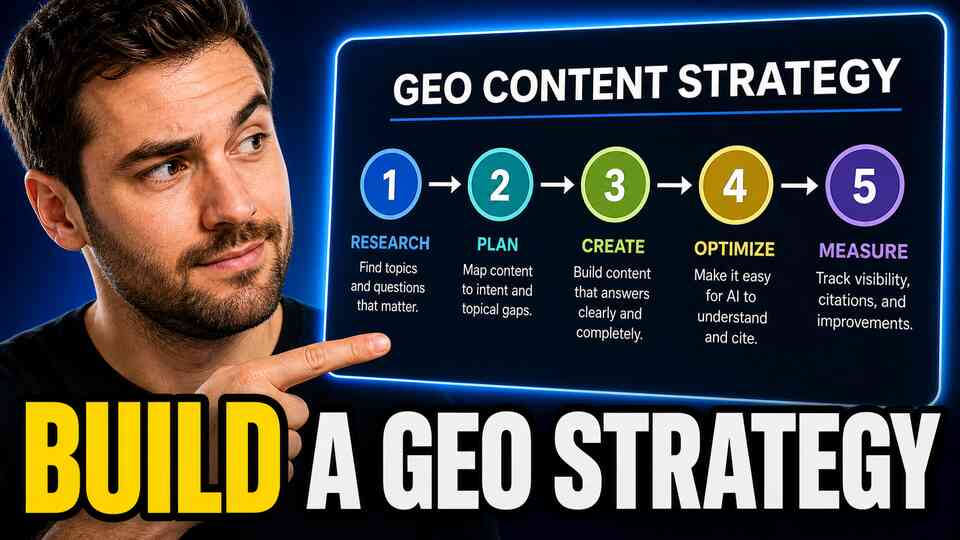
Most content strategies in 2026 are still optimized for a search engine that's slowly being replaced. They target keywords. They build for click-through. They measure success in rankings. And they're starting to underperform, not catastrophically, but persistently, as more user attention shifts to AI answers that resolve queries without the click ever happening.
Building a GEO content strategy from scratch isn't just SEO with new tools. It's a different problem requiring a different sequence of decisions. Here's the framework.
Start with the structural decision, not the content calendar
The biggest mistake teams make on day one is jumping straight to "what should we write?" That comes later. The first decision is structural: how is your site going to talk to AI crawlers, and what does the underlying content architecture need to look like before you publish anything?
Two technical decisions belong on day one:
1. Implement structured data from the start. JSON-LD with Schema.org vocabulary is the lingua franca AI systems use to parse and cite content across all major platforms. The schema types that matter most for early GEO work are Organization, Product, Article, FAQPage, HowTo, and SpeakableSpecification. Build them into your CMS as reusable components, fields for metaTitle (max 60 characters), metaDescription (max 155 characters), and schema markup, so every new piece of content inherits them automatically. Bolting structured data on later is exponentially harder than building it in from the start.
2. Use semantic HTML that AI crawlers can actually parse. Replace anonymous div soup with explicit HTML5 elements: article, section, nav, header, main, aside. Maintain a clean H1 → H2 → H3 hierarchy on every page. AI parsers walk the document structure to understand content, and they perform much better on cleanly structured HTML than on visually identical but structurally chaotic pages.
Get these two things right and the rest of your strategy has a foundation to build on.
Pick your authoritative content types before your topics
The second-day decision is what kind of content you're going to make. Not which topics, which formats. AI engines pull more readily from some content types than others, and the patterns are by now well understood.
The formats that get cited most consistently are:
- Definition pages, clean, single-topic explanations that lead with a one-sentence answer to "what is X?"
- How-to guides, numbered, step-by-step content with clear instructional structure
- Comparison pages, head-to-head breakdowns with explicit criteria, tables, and tradeoff statements
- Listicles, ranked or categorized lists that AI engines can extract individual items from
- FAQ sections, explicit question-and-answer pairs, ideally with FAQPage schema
- Original research and data pages, first-party numbers, charts, and findings nobody else has
Pick three or four of these formats as your primary content types. A new GEO program shouldn't try to publish in all six formats at once, focus produces better citations than coverage.
Lead with answer-first writing on every page
The third foundational decision is a writing rule: every page leads with the answer. This is the single biggest behavioral change for content teams who came up through traditional SEO, where the convention was to build context, set up tension, and reveal the answer halfway through.
For AI consumption, that pattern is wrong. AI models prioritize clarity and directness, not narrative flow. Your opening line has to be a standalone, quotable statement that resolves the user's intent immediately.
Compare these two openings:
- ❌ "In today's evolving digital landscape, AI visibility has become an increasingly important consideration for marketing teams looking to stay ahead of the curve."
- ✅ "AI visibility measures how often your brand appears in AI-generated answers across ChatGPT, Gemini, Perplexity, and similar platforms."
The second sentence is quotable. The first isn't. AI models extract and reuse the second one and skip the first one entirely. Train your writers to open every page with a sentence that could stand alone as the AI's answer.
Beyond the opening, the rest of the page should follow a fact-first structure: fact → interpretation → implication. Present data and evidence first. Then explain what it means. Then explain what to do about it. AI models prioritize what's explicit, measurable, and verifiable, and they cite the explicit parts before the interpretive ones.
Use questions as headings
Phrase your H2s and H3s as the actual questions users would ask. Not "Visibility Measurement" but "How do I measure AI visibility?" Not "Tool Comparison" but "Which AI visibility tool should I use?"
This works for two reasons. First, AI models classify content under question-shaped headings as authoritative answers to those questions, and pull the body text directly when constructing responses. Second, real users are now phrasing their AI prompts as natural questions, and matching your headings to their phrasing is the closest thing AI search has to a "keyword match" signal.
One small variation rule: don't make every heading literally a question. Mix in some statement-based headings to keep the page feeling natural to human readers. The goal is "every section signals a specific problem being resolved," not "every heading ends with a question mark."
Map your content to a prioritized launch sequence
With the structural foundation in place, you're finally ready to plan what to publish. The right launch sequence for a brand-new GEO program looks like this:
- Week 1-2: Foundation pages. Definition pages for the 5-10 most important terms in your category. These are your highest-leverage assets because they get cited as the canonical source of definitions for years.
- Week 3-4: Core comparison pages. One head-to-head page for each of your three or four most-asked-about competitors. Comparison content gets cited disproportionately in AI answers about category recommendations.
- Week 5-8: Tutorial and how-to content. Step-by-step guides for the jobs your customers come to you to do. These become the backbone of your "how do I [task]" prompt visibility.
- Week 9-12: Data and research. One original-research piece per month using first-party data nobody else has. These earn the most authoritative citations and tend to be the most-shared content you produce.
- Ongoing: Refresh cycles. Every existing page older than 12 months gets a structural and content refresh, in priority order based on traffic and citation potential.
This is a 90-day plan that builds GEO authority systematically rather than scattershot. Don't skip steps. Don't try to do all four formats in week one. Teams that stack their wins in the right order finish the quarter with a content library that compounds. Teams that publish randomly finish with a pile of pages that don't reinforce each other.
Validate every major piece in multiple AI engines before publication
One of the most useful habits to build into your strategy is pre-publication validation. Before you ship a new page, run the question it answers through ChatGPT, Gemini, and Perplexity. See what answers exist today and which sources are being cited. Then write your page to be a structurally cleaner, more directly useful, more current version of those existing sources.
You're not trying to copy what's there. You're trying to be the page that should be there, given what the AI is currently working with. This is the GEO equivalent of competitor analysis, and it produces a much higher hit rate than writing in a vacuum.
Wire monitoring in from day one
The last piece of the strategy is measurement, and the temptation is to leave it until you have content to measure. Don't. Set up tracking on day one, even if your first dataset has nothing in it.
The minimum monitoring setup is:
- A list of 30-50 prompts you want to win
- A weekly run of those prompts through every major AI engine
- A log of which brands and sources appear in the answers
- A trend line for your share of voice in your tracked prompt set
Treat this like a load-bearing system. AI citations are your unit tests, if ChatGPT or Gemini references your page, the test passes. If they don't, the test fails. The whole content strategy gets evaluated and adjusted against this signal week over week.
The strategy in one paragraph
Build the structural foundation first (semantic HTML, schema markup, reusable SEO components). Pick 3-4 content formats AI loves (definitions, comparisons, how-tos, listicles). Train your writers to lead with the answer and use questions as headings. Launch in a prioritized sequence over 90 days, starting with definition pages and comparisons. Validate each major piece against existing AI answers before publishing. Wire monitoring in from day one and let the citation data tell you what to invest in next.
That's a real GEO content strategy from scratch. Not SEO with extra steps, a different sequence of decisions, anchored in how AI actually consumes and cites content.