How to Write Comparison Pages That Win in AI Search
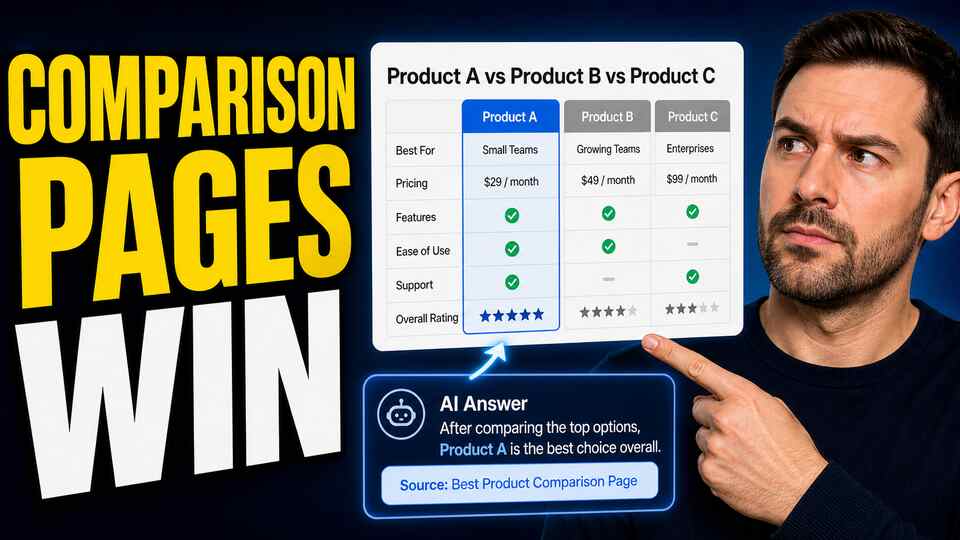
Comparison pages are the highest-leverage commercial content you can write for AI search. They're cited disproportionately in answers to category and recommendation prompts, they capture buyers at the moment of highest intent, and they're one of the few content types where being mentioned and being cited are essentially the same outcome.
The catch: most comparison pages are written for SEO, not for AI. They rank, they get clicks, and then AI engines route around them in favor of cleaner, more extraction-friendly comparisons elsewhere. Here's how to structure a comparison page that actually wins citations.
Why comparison pages punch above their weight
The data on this is unambiguous. A study of 75,000 AI answers from Wix Studio's AI Search Lab found that listicles, articles, and product pages combined account for 52% of all AI citations across ChatGPT, Google AI Mode, and Perplexity. Inside that group, the breakdown matters: listicles captured 40% of commercial-intent citations, almost double any other format.
That 40% number is the entire reason comparison content matters. When users ask AI engines "what's the best CRM?" or "should I use Notion or ClickUp?", the engine reaches first for ranked, structured listicles and head-to-head comparisons, and skips past the tool-specific landing pages and feature explainers most marketing teams write.
One important nuance from the same study: third-party listicles accounted for 80.9% of citations in professional services categories, compared to only 19.1% for self-promotional lists. AI engines strongly prefer neutral editorial comparisons over branded "we are the best" rankings. The bias against self-serving content is real, and it shapes how you should write your own comparisons.
Lead with a comparison table inside the first 200 words
The single most important structural element on a comparison page is a clean summary table placed above the fold, within the first 200 words. This table becomes an independent, citable chunk that AI engines can extract whole.
The table should include:
- Product or tool name (one column per option)
- 4-6 specific comparison criteria, price, integrations, key features, ratings, target user, free trial availability
- A "best for" row at the bottom that summarizes the ideal user for each option in one short phrase
Tables outperform prose by a wide margin in citation rates, research suggests comparison matrices achieve roughly 61% average citation rates, with tables outperforming equivalent prose by about 47%. The reason is mechanical: tables are pre-structured for extraction. The AI doesn't have to parse them; it just reads them. Prose requires interpretation; tables don't.
Put the table at the top, not the bottom. The bottom of an article is the wrong place for the most-cited element on the page.
Use Subject-Verb-Object sentences for every claim
Vague comparison language is the second biggest reason comparison pages fail to get cited. "Mixpanel has great analytics" is invisible to an AI extractor, there's no subject-verb-object structure, no specific claim, no quotable assertion.
The fix is to write every product description as an explicit SVO sentence with a named feature and a measurable detail. Compare:
- ❌ "Mixpanel offers great analytics."
- ✅ "Mixpanel's Funnels report tracks conversion drop-off across 10+ user steps without SQL queries."
The second version names the entity (Mixpanel), names the specific feature (Funnels report), describes what it does (tracks conversion drop-off), and quantifies the scope (10+ steps, no SQL). Every part of that sentence is extractable. Every part is verifiable. AI engines can quote it directly without losing context.
Apply this rule to every product mention on the page. By the end of the rewrite, every paragraph will be denser, more specific, and more useful, for both AI extractors and human readers.
Make every comparison block self-contained
AI engines extract sections independently. Your reader might experience your comparison page as one coherent argument, but the AI sees it as a series of disconnected blocks. If a block depends on context from earlier in the page, it becomes useless when extracted.
The structure for a self-contained block:
- Opening sentence, names the entity and the core fact ("Notion is a workspace tool combining notes, docs, and databases.")
- Two or three supporting sentences, concrete details, with numbers or specifics
- One-line verdict, names the use case it's best for ("Best for: small teams who want one tool for documentation, project tracking, and lightweight databases.")
Read each block in isolation, with no surrounding context. If it still makes sense, it's structured correctly. If it doesn't, fold the missing context inline.
Back every comparison claim with verifiable data
LLMs penalize unverifiable claims. "More affordable" without a price is filler. "Better support" without a stat is filler. "Easier to use" without a measurable claim is filler. Every comparison assertion needs verification:
- Pricing, exact dollar amounts, with the date the price was last verified
- Performance, specific metrics, benchmarks, or independent test results
- Reviews, ratings with the platform and the user count ("4.5/5 on G2 from 1,200+ reviews")
- Case studies, sourced examples with company names and outcomes
This is the difference between a comparison page that reads like a marketing brochure and one that reads like editorial research. The second one gets cited; the first one doesn't.
Use question-based section headings
Transform static comparison headings into the actual questions users ask AI engines. "Pricing Comparison" becomes "Which tool is more affordable for growing teams?" "Feature Overview" becomes "What features does each tool include in its starter plan?" "Customer Reviews" becomes "Which tool has better customer support?"
The reason is direct: these questions match the natural language users actually type into ChatGPT and Perplexity. When the AI matches a user's prompt to your headings, your section becomes a candidate for the answer. When your headings are SEO-style noun phrases, the match never happens.
Apply the right schema markup
For comparison content, three schema types matter most:
- Product, for each tool being compared, with name, description, and aggregateRating where available
- ItemList, to mark up the comparison as a ranked or ordered list of options
- FAQPage, for any FAQ section at the bottom of the comparison
- Review, if you're providing your own evaluation of each tool
Schema doesn't replace good writing, but it accelerates AI parsing of structured content. A comparison page with Product and ItemList schema is unambiguous to AI extractors; the same content without schema requires guesswork.
Be neutral, even if you're biased
The third-party-listicle data is the warning sign here. AI engines actively prefer neutral comparisons over self-promotional ones, and they're good at telling the difference. A comparison page that dunks on every competitor and frames the author's product as the obvious winner reads as marketing, and gets passed over.
If you're writing a comparison for your own brand's blog, the discipline is to acknowledge real strengths in every option. Where competitors are genuinely better at something, say so. Where your product is genuinely better, support it with verifiable data instead of opinion. The page that reads as "honest analysis with a clear recommendation" outperforms the page that reads as "obvious sales pitch", by an order of magnitude in citation rate.
Match query intent exactly
One of the most important findings from the AI citation studies is that query intent, not industry, not model, most strongly predicts which content gets cited. Informational queries pull articles 2.7x more than other formats. Commercial queries pull listicles. Transactional queries pull product pages. Navigational queries pull category pages.
For comparison content, your dominant intent is commercial, and listicle-style comparisons are exactly what wins. Don't try to make your comparison page work for every intent. Make it the cleanest, densest, most extractable commercial-intent comparison in your category, and let it dominate the answers to "best of" and "X vs Y" prompts.
Structure beats length
Comparison pages don't need to be encyclopedic. A 1,200-word page with a clean table, six well-structured product blocks, schema markup, and verifiable claims will outperform a 4,000-word page that buries the same information in dense prose. Structure beats length, every time.
Build the table first. Write the SVO sentences for each option. Make every block self-contained. Use question headings. Add schema. Stay neutral. That's the comparison page that wins in AI search, and almost coincidentally, the comparison page real buyers find most useful.