Your Brand Doesn't Exist in AI Search. Here's the Data.
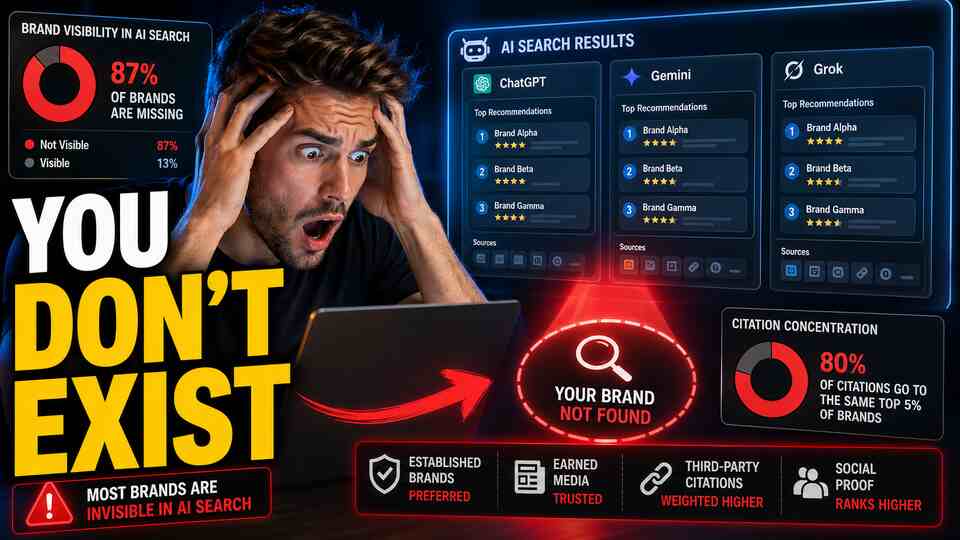
Most brands have no idea they are invisible in AI search. They check Google rankings, monitor social mentions, run the usual playbook. Meanwhile, millions of people are asking ChatGPT, Gemini, and Grok what to buy, which tool to use, or which brand to trust, and for the vast majority of companies, the answer does not include them at all.
This is not a theory. There is a growing body of research showing exactly how bad the visibility gap is, who it hurts most, and why the standard SEO playbook will not fix it.
The core problem: AI engines favor established brands by default
A 2026 analysis of Product Hunt startups found that new brands and early-stage companies rarely appear in AI-generated answers, even when the query is directly relevant to what they offer. The pattern is consistent: AI engines heavily favor brands that already have significant third-party documentation, press coverage, and external references. If you launched in the last two years and have not built up that kind of coverage, you are starting from zero in AI search regardless of how good your product is.
This creates a compounding disadvantage. The brands that already dominate traditional search tend to dominate AI search too, because both favor established authority signals. But in AI search, the gap is sharper because there is no equivalent of a long-tail keyword where a smaller brand can quietly rank.
Where citations actually come from (it is not your website)
One of the most important findings to understand comes from a September 2025 study that analyzed 1,000 queries across ChatGPT, Perplexity, and Gemini. The result: between 70 and 90 percent of citations in AI-generated answers come from earned media and third-party sources. Your own website, your blog posts, your press releases, they barely register.
That is a fundamental shift from how traditional search works. On Google, your domain typically ranks first or near first for branded queries. You control the narrative. In AI search, your own content rarely gets cited. The LLM is synthesizing from what other people have written about you, not what you have written about yourself.
This is why brands that have done a great job building their own content libraries often still show up invisible in AI search. Content marketing built for Google does not automatically translate.
The citation concentration problem
It gets worse if you are not already a major publication or a well-covered brand. A July 2025 study analyzed 366,087 citations from OpenAI responses and found severe concentration: the top 20 sources account for 67.3 percent of all news citations. Reuters.com alone captures 22.8 percent. The Gini coefficient for citation distribution was 0.83, which signals extreme inequality.
For a new or small brand, this means competing for the fraction of citations that major outlets do not already own. And the major outlets write about major brands, not emerging ones.
Understanding how your brand compares to competitors in AI search starts with knowing whether you are getting cited at all, by whom, and in what context. Most brands, when they check for the first time, find the answer is not much.
Even when AI uses your content, it often will not credit you
There is another layer to the problem that most brand managers have not considered. A June 2025 study analyzed roughly 14,000 conversation logs and found that Gemini produces citations in only 8 percent of its answers. More striking: Gemini generates 34 percent of its responses without retrieving any online content at all.
So even in cases where an AI engine has indexed your content and incorporated it into a response, attribution is far from guaranteed. You can be influencing the answer while getting zero credit, zero clicks, and zero visibility.
This is one of the reasons prompt-level tracking matters. BabyPenguin tracks what AI engines actually say about your brand across specific queries, not just whether your URL appears in a source list. You need to know when you are being described, how you are being positioned, and whether you are being named at all.
What actually influences LLM recommendations
A February 2025 study examined cognitive biases embedded in LLM recommendation behavior and found some counterintuitive patterns. Social proof signals (testimonials, review counts, user numbers) consistently boost a brand likelihood of being recommended and its position in ranked outputs.
What is surprising: scarcity and exclusivity framing suppresses AI visibility. On humans, scarcity works. It creates urgency and perceived value. On LLMs, it does the opposite. Brands that frame their product as rare or limited tend to rank lower in AI recommendations. The tactics that convert on a landing page can actively hurt your AI search presence.
The e-commerce data tells a similar story. An MIT study from November 2025 tested 15 common product description tactics across 7,151 consumer queries and 52,165 Amazon products. What works: user intent alignment, competitive differentiation, social proof, and factual accuracy. What does not work: storytelling, which actually hurt product ranking by an average of 4 positions. Narrative-heavy product copy is optimized for humans browsing a page, not for LLMs matching a product to a query.
The arms race problem
Here is where brands often get tripped up when they first start thinking about AI visibility: they look for a set of tactics to implement, hoping to replicate what works for others. The C-SEO Bench study published at NeurIPS 2025 shows why that approach collapses quickly. When all players in a category adopt the same optimization tactics, the gains disappear. Everyone moves up, so no one moves up relative to the others.
The only sustainable strategy is genuine quality differentiation: being actually better documented, better reviewed, more present in earned media across more sources. There is no shortcut that holds once everyone knows about it.
This is also why building AI visibility from scratch requires a different approach than traditional SEO catch-up strategies. You are not trying to rank for terms. You are trying to become the kind of brand that gets mentioned credibly across many independent sources.
International and non-Western brands face a steeper climb
Research from 2026 has documented a systematic underrepresentation problem for non-English brands and brands from non-Western markets. Even when accurate, high-quality information exists about these brands, it often fails to get cited. The training data and citation patterns in major AI engines skew heavily toward English-language, Western sources, which means the baseline visibility gap is larger before these brands even start optimizing.
For global brands, multi-engine coverage and regional citation tracking are essential, not optional. What shows up in ChatGPT and what shows up in Gemini can look very different depending on which sources each engine favors.
What you need to know to fix this
The research is clear about what drives AI visibility: earned media coverage across diverse sources, social proof signals embedded in third-party descriptions, factual accuracy, and genuine differentiation. What it does not tell you is where you stand right now, what your specific gaps are, and which competitors are eating the recommendations you should be getting.
That is the practical problem. You can read every paper on AI citation behavior and still not know whether ChatGPT recommends your brand for the queries that matter to your customers. You do not know if Gemini is describing your product accurately or not at all. You do not know if a competitor is getting cited three times more than you for the same category queries.
BabyPenguin tracks exactly this. It monitors how AI engines respond to the specific prompts your customers are actually using, breaks down which sources get cited when your brand does appear, and shows you how your visibility compares to competitors side by side across ChatGPT, Gemini, Grok, and other engines. The pricing is built for teams that do not have enterprise budgets, because the brands that need this most are usually the ones being squeezed out by the visibility gap.
Understanding how to measure brand lift in AI search starts with having a baseline. Most brands do not have one yet.
The window to act is now
AI search behavior is not static. The models are updated, the citation sources shift, and the competitive landscape in any given category changes as more brands start paying attention to this. The brands that build AI visibility now, while the field is still relatively uncrowded, will be harder to displace once the category matures.
The brands that wait are already behind. The data shows exactly how hard it is to break through once citation concentration sets in and established players have locked up the earned media signals that drive AI recommendations. New entrants face a compounding disadvantage that gets harder to close over time.
The first step is knowing where you actually stand. Not where you think you stand based on Google rankings or website traffic. Where you stand in the answers that AI engines give when someone asks about your category, your use case, or your competitors.
Most brands, when they check for the first time, find out they do not exist at all. Understanding how ChatGPT shopping works and how to get included in those answers is a different problem from traditional SEO, and it requires different tools to solve.