How Small SaaS Brands Can Win AI Recommendations Against Bigger Competitors
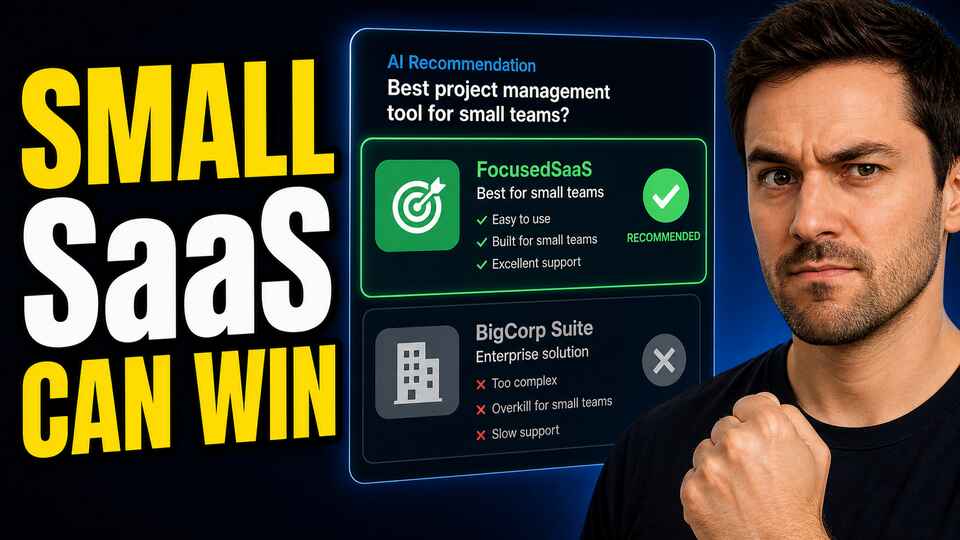
You're not going to out-spend the big players. You're probably not going to out-volume them either. But you can out-focus them, and in AI recommendations, focus wins more than volume does.
This is a tactical playbook. Not strategy fluff. Specific actions, in rough priority order, that smaller SaaS brands can take to build AI visibility in a category dominated by larger competitors.
1. Own a specific query set, not the whole category
The worst thing a smaller brand can do is try to compete on the broadest possible queries. "Best CRM software" is going to return Salesforce, HubSpot, and Pipedrive for the foreseeable future. That's not your battlefield right now.
Your battlefield is the specific queries where you have a genuine claim to being the best answer. "Best CRM for independent financial advisors." "CRM for teams that rely on email heavily." "Simple CRM without a learning curve." These are real queries buyers use. They're also queries where a focused, specific brand can beat a generalist giant.
Map out 30 to 50 prompts in this specific territory. These become your target prompt set. Everything you measure and execute against should be referenced to this list. Prompt-level tracking in AI search explains why this granularity matters and how to structure it.
2. Publish direct-answer content for every target prompt
AI models surface content that directly answers the question being asked. Not content that's tangentially related. Not content that buries the answer in paragraph 8 after a long introduction. Content where the answer is the point.
For each of your target prompts, you should have content that directly and specifically answers that question. If your target prompt is "best project management tool for architecture firms," you want a page that answers exactly that, with specifics about why your tool fits that use case, what features matter most, and what real users in that category experience.
Structure matters. Use clear headings. Give direct answers early. Include specific data points, not vague claims. Write like you're answering a smart colleague's question, not like you're filling a content calendar. GEO for SaaS goes deeper on how to structure content for AI discoverability.
3. Build third-party review presence on the platforms AI models draw from
Your own website is not enough. AI models heavily weight content from independent, third-party sources. G2, Capterra, Trustpilot, Product Hunt, and similar platforms are authoritative in the eyes of AI models. A brand with 300 G2 reviews has a meaningfully different signal profile than one with 30.
This doesn't mean gaming review platforms. It means systematically asking satisfied customers to leave reviews. It means making the review process frictionless. It means responding to existing reviews, which generates more indexed text associated with your brand.
Also target comparison content. "X vs competitor" articles published on third-party review blogs, or contributed as guest posts to relevant publications, create exactly the kind of comparison-framed content that AI models draw on when users ask comparison questions. How to win software comparisons in AI is a useful companion read here.
4. Build a community footprint where your buyers actually talk
Reddit discussions, Slack communities, Discord servers, niche forums, LinkedIn comments. These are places where real buyers discuss real tools in natural language. That content ends up in training data. It's also the kind of organic, user-generated discussion that AI models weight as genuine signal.
You can't fake this. But you can encourage it. Engage authentically in communities where your buyers spend time. Create a community around your product if the user base is large enough to support one. Ask happy users to share their experience in relevant threads. Sponsor niche communities where it's appropriate.
A brand with 50 authentic Reddit mentions, where real users recommend it by name with specific reasons, has more AI-relevant signal than a brand with zero mentions and a perfectly optimized website.
5. Optimize technical discoverability
If your product has an API, document it thoroughly and publicly. If you integrate with popular tools, make sure those integrations are documented on both your site and the integration partner's site. If you have a public roadmap or changelog, publish it. Developer-authored content carries significant authority.
Also make sure your brand is clearly and consistently described across every place you appear online. Your brand name, your category, your primary use case. Consistency across web properties helps AI models build a clean entity profile for your brand. Ambiguity works against you.
6. Track where you're already winning and double down
This is the step most brands skip, and it's probably the highest-leverage thing on this list. Before you build more content, before you run more review campaigns, find out where you're already showing up in AI recommendations.
Most smaller brands are already winning on some prompts. Maybe it's a niche use case. Maybe it's a specific comparison. Maybe it's a question phrased in an unusual way that maps to your positioning. Those existing wins are your template. They show you what's working and where to focus your next efforts.
BabyPenguin tracks your brand across ChatGPT, Gemini, Grok, and other AI engines at the prompt level. Run your 30 to 50 target prompts. See where you appear, where you don't, and where your larger competitors are winning. The prompts where the gap is smallest are your best near-term opportunities. The citation sources driving your competitor's visibility tell you exactly where to build your own presence. The AI visibility measurement framework helps you structure this into an ongoing process rather than a one-time audit.
Track progress, not just activity
Content published is not the same as AI visibility improved. Review volume increased is not the same as recommendations earned. You need to close the loop between the actions you're taking and the actual output: your brand's presence in AI-generated recommendations for your target prompts.
Run your target prompts through BabyPenguin monthly at minimum. Watch whether your AI share of voice is growing on the specific prompts you're investing in. If a tactic isn't moving the needle after 60 days, revisit it. If something is working, do more of it. AI share of voice is the metric that tells you whether the work is paying off.
Bigger competitors have more of almost everything. More budget, more content, more brand recognition, more historical footprint. What they don't have is your focus. A smaller brand that owns 50 specific prompts with depth and precision is building something that a generalist giant will struggle to take away. Start there. Measure it tightly. Expand from the wins you earn.