Markdown vs HTML: Which Format Do AI Crawlers Prefer?
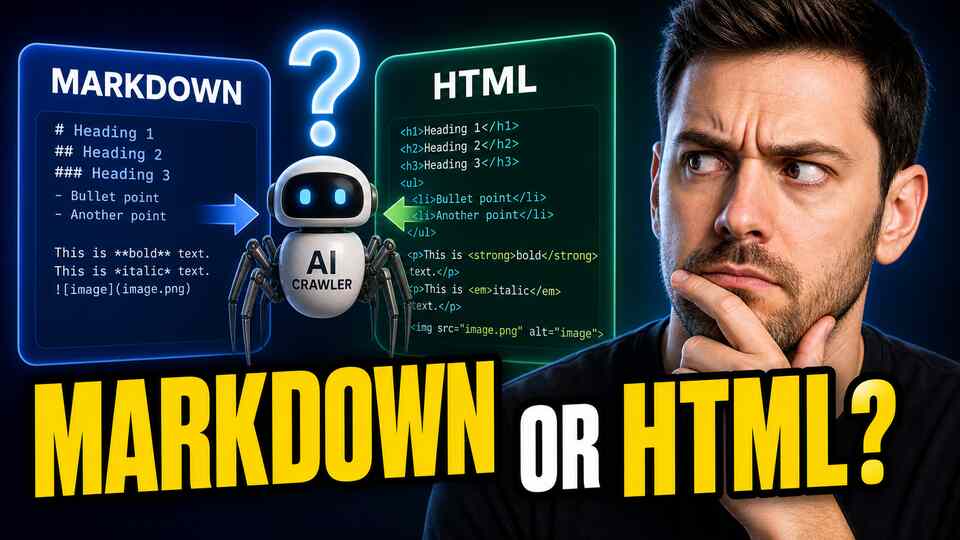
Cloudflare recently announced that its infrastructure now automatically converts HTML pages to Markdown for AI agent requests, reducing token usage by up to 80% in the process. The announcement was largely covered as an infrastructure story, but it carries a more fundamental implication for anyone doing generative engine optimization: the way you structure your HTML has a direct effect on how cleanly it converts to the plain text that AI engines actually process. Format isn't cosmetic. It affects whether AI models can extract your content accurately, and whether they cite it.
The question "should I serve Markdown instead of HTML to AI crawlers?" is understandable but slightly misses the point. The deeper question is: does your HTML produce clean, usable, hierarchically sensible output when any parser, including a Markdown converter or a raw text extractor, processes it? Because that's what AI engines are doing to your content, and most websites aren't optimized for it.
How AI Crawlers Actually Read Your Pages
Understanding the format question requires understanding what AI crawlers actually do when they encounter a web page. They don't read your HTML the way a browser does. They're not rendering CSS, executing JavaScript layout logic, or displaying a visual representation of your page. They're extracting content, and the quality of that extraction depends entirely on how your HTML is structured.
Most AI crawlers and retrieval systems use some form of clean text extraction. This means stripping out navigation elements, footers, sidebars, scripts, and styling, and keeping the primary content: headings, paragraphs, lists, and the prose that constitutes the actual information on the page. The tools used for this extraction, Trafilatura, Readability, BeautifulSoup, and similar libraries, are all essentially trying to produce the same output: a clean, linear representation of what the page is about.
Cloudflare's Markdown for Agents announcement formalizes this process. When an AI agent requests a page through Cloudflare's network, Cloudflare can automatically convert the HTML to Markdown before delivering it. This dramatically reduces the token count of the page, a 20,000 token HTML file might become a 4,000 token Markdown file, making it far more efficient for AI systems to process. The key insight is that Cloudflare isn't changing the content; it's stripping away the presentation layer and keeping only the semantic structure. If your semantic structure is poor, the Markdown output will be poor, and the AI's understanding of your page will be correspondingly degraded.
The SEO Cloaking Concern, and Why It Does Not Apply
When Cloudflare's Markdown-for-Agents feature was announced, some SEOs raised a concern: is serving different content to AI agents than to human users a form of cloaking? Search Engine Land's coverage of the SEO implications addressed this directly.
The answer, in short, is no, and understanding why reveals something important about how AI content processing works. Cloaking in the traditional SEO sense means serving substantively different content to search engine crawlers than to users, typically to manipulate rankings. Cloudflare's Markdown conversion doesn't change the content. It changes the format. The headings, paragraphs, lists, and body text are the same. The navigation bars, CSS classes, and JavaScript frameworks are simply removed because they carry no semantic information for an AI processing the content.
More importantly, Cloudflare's conversion is transparent infrastructure, not publisher-controlled content switching. You don't need to detect AI crawlers and serve them a different version of your page. The format conversion happens at the infrastructure layer, applying to the same underlying content. The practical implication is simple: ensure that the one version you serve, your standard HTML, produces excellent output when cleaned and converted.
The llms.txt Standard: A Different Approach to AI Formatting
Parallel to the question of HTML optimization is the emerging llms.txt standard, a plain text or Markdown file placed at the root of your domain that provides AI crawlers with a structured summary of your site's content and purpose. Where robots.txt tells crawlers what they can and cannot access, llms.txt tells AI agents what your site is and where its most important content lives.
Ahrefs' analysis of the llms.txt standard describes it as an emerging convention rather than a formal standard, but one that's gaining adoption quickly. A well-structured llms.txt file is essentially a Markdown document that introduces your site to an AI agent: here's what we do, here are our most important pages, here's the context you need to understand our content accurately.
The llms.txt approach addresses a specific problem: AI agents browsing your site as part of a research or answer-generation task need to quickly understand what you're about and what content is most relevant. Without a signposting document, an AI agent must infer this from crawling multiple pages, a process that's both slower and less reliable than reading a curated summary. For more on this topic, see what is llms.txt, explained and whether you should use llms.txt.
The llms.txt connection to the format question is direct: the file is inherently a plain text / Markdown document. Its adoption signals that the AI ecosystem is moving toward a model where clean, plain-text-compatible content is explicitly preferred. The HTML-to-Markdown conversion Cloudflare is automating is, in a sense, a technical implementation of the same principle that llms.txt embodies at the site level.
What Breaks When HTML Converts to Markdown
The most useful way to understand the HTML optimization challenge is to think about what fails to convert cleanly, and why. When a complex HTML page is converted to Markdown or plain text, several common structural patterns produce degraded output:
Table-heavy layouts for key information. HTML tables that contain important information, pricing tiers, feature comparisons, specification sheets, often produce poorly structured Markdown output. Tables are one of the most problematic HTML elements for AI text extraction. A pricing table that visually presents three tiers in a clear grid may convert to a confusing flat list or a broken Markdown table that's difficult to parse. If a table contains information you want AI engines to cite accurately, consider whether that information can also be presented in prose or list form alongside the table.
Content embedded in complex nested divs. Some web frameworks produce deeply nested div structures where the actual content is buried inside multiple layers of presentational wrappers. Text extraction algorithms must heuristically identify the "main content" area, and complex nesting makes this harder. Semantic HTML, using actual article, section, main, and aside tags, gives extractors explicit signals about which content is primary.
Key facts presented only as images. Infographics, image-based tables, and screenshots of text are invisible to text extractors. AI engines can't read an image of a pricing table. They can't extract bullet points from an infographic. Any information that's important enough to be cited should be present in text form, even if it's also presented visually.
Navigation and boilerplate mixed with content. Pages where the main content isn't clearly delineated from navigation, sidebar content, and footer boilerplate produce extraction output that includes irrelevant text mixed with relevant content. This dilutes the signal-to-noise ratio of the extracted text and can confuse AI models about what the page is actually about.
Short, underdeveloped paragraphs with excessive heading nesting. Some content structures use h2, h3, h4 headings with only one or two sentences of content under each, producing a structure that looks like an outline rather than substantive prose. AI models prefer content that develops ideas with sufficient depth. This connects to the concept of information gain as a hidden ranking factor. Thin content under deep heading nesting converts to thin Markdown that provides little citation value.
A Practical Checklist for AI-Parser-Friendly HTML
The goal isn't to serve Markdown to AI crawlers. The goal is to ensure your HTML produces clean, hierarchical, information-rich output when any parser processes it. Here's a practical checklist:
- Use semantic HTML tags correctly. Use h2 for major section headings, h3 for subsections, p for paragraphs, ul/li for unordered lists, ol/li for ordered lists, and strong/em for emphasis. Avoid using divs with CSS classes as structural replacements for semantic tags.
- Put the key answer first. Structure content using the answer-first approach: lead with the direct answer, then provide supporting context and detail. Answer-first writing is what LLMs are optimized to extract and cite. This mirrors the inverted pyramid structure that has always served journalists well.
- Keep paragraphs focused and complete. Each paragraph should contain a complete idea. Avoid single-sentence paragraphs except for emphasis. Avoid paragraphs so long that the key point is buried in the middle. Four to six sentences is a good target for most content paragraphs.
- Avoid table-only presentations for critical data. If a table contains information you want AI engines to understand and cite accurately, include a prose or list summary of the same information either above or below the table.
- Ensure all important content is in text form. Don't rely on images, PDFs, or dynamically loaded JavaScript content for information that matters for AI citation. If it's not in indexable text on page load, it may not be extracted.
- Delineate main content clearly. Use a main or article tag to wrap your primary content, and keep navigation, sidebars, and footers in clearly separate structural elements. This helps text extractors identify the primary content area.
- Use descriptive heading text. Headings like "Overview" or "More Information" provide no semantic value to AI parsers. Headings like "How AI Crawlers Process HTML" or "Why Table-Heavy Layouts Hurt AI Extraction" give AI models explicit topical context for each section.
- Consider implementing llms.txt. Adding an llms.txt file to your domain provides AI agents with a curated, plain-text-compatible overview of your site that bypasses the HTML extraction process entirely for site-level orientation. Details are covered in how AI crawlers access your website and making your site easier for AI crawlers.
Does Format Affect Citation Rates? The Evidence
The practical question is whether improving HTML structure to produce cleaner parsed output actually improves AI citation rates. The direct causal link is difficult to measure, there are many variables in why an AI engine cites one source over another. But the indirect evidence is strong.
AI citation analysis consistently shows that well-structured, easily parseable content from authoritative sources is preferred over poorly structured content from equally authoritative sources. Pages that follow clean semantic HTML practices tend to have lower "noise" in their extracted text, which means AI models can more accurately identify what the page is about and extract specific facts for citation. Pages that rely on complex nested layouts, table-heavy presentations, or image-embedded content are more likely to be partially or incorrectly extracted.
The connection to chunking for LLMs and AI retrieval is also direct. When AI retrieval systems break documents into chunks for indexing, the quality of those chunks depends on the structural clarity of the source document. A well-structured HTML page chunks naturally along heading boundaries, producing semantically coherent chunks that match query intent well. A poorly structured page produces irregular chunks that may not align with how users phrase queries about that content.
The Cloudflare announcement, the llms.txt movement, and the broader direction of AI content processing are all pointing in the same direction: clean, semantic, text-first content structure is the format that AI engines process most reliably. You don't need to serve Markdown. You need to write and structure HTML as though a simple Markdown converter is going to process it, and your content needs to still make perfect sense when it does.
Tracking how your content is being parsed, cited, and represented across AI engines requires ongoing measurement rather than one-time optimization. BabyPenguin monitors brand mentions and source citations across ChatGPT, Gemini, and Grok, giving you visibility into whether your structural optimizations are translating into improved citation frequency, and where gaps remain to be closed.