Answer-First Writing: The Format LLMs Love Most
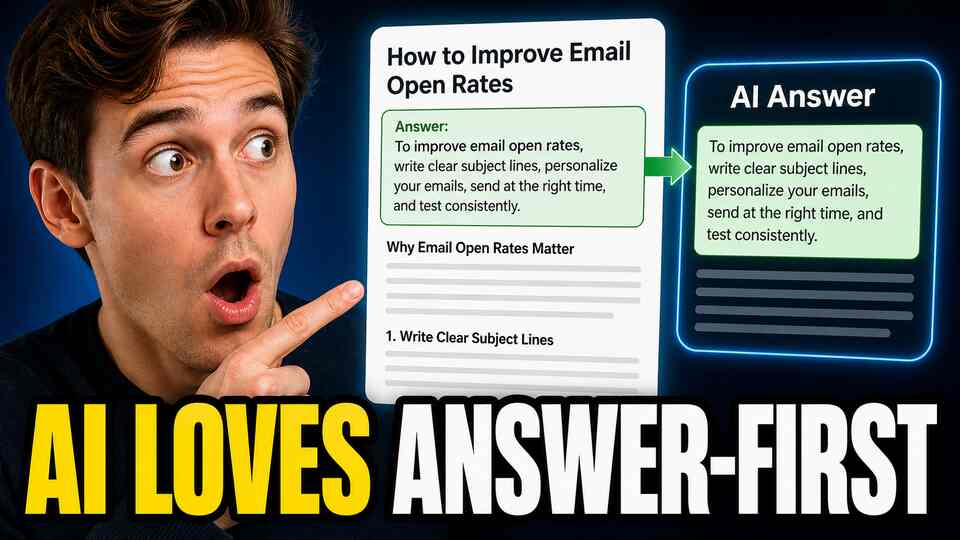
The way most professional writers are trained to open a piece is exactly the way you should not open content for AI. We're taught to set the scene. Build context. Lead the reader gently toward the point. By the time the actual answer arrives, three paragraphs of preamble have done their job.
LLMs hate it. They skip it. They reach for the first sentence that resembles a direct answer, and if they can't find one near the top, they reach for a different page where they can. Answer-first writing is the format that consistently wins citations, and it's a real skill, not just a stylistic preference.
What "answer-first" actually means
Answer-first writing is a structural rule, not a vague principle. The first 40-60 words of every section deliver the answer to the question that section is about. No buildup. No throat-clearing. No "in this article we'll explore." The first sentence of each section is the most quotable sentence in the section, and if you read only that sentence, you should already understand the answer.
Look at the difference:
The buildup version:
When considering content optimization for AI systems, there are many factors to evaluate. The landscape has evolved significantly over the past few years, and marketers are still figuring out which patterns deliver the best results…
The answer-first version:
Long-form content over 2,000 words gets cited about 3x more often than short posts. AI systems favor comprehensive coverage because…
The first version takes 30 words to say nothing. The second delivers a fact in 16 words and immediately gives the AI extractor something to quote. Both versions can include the same supporting context, the difference is the order. Answer first, support second.
Why LLMs reward this pattern so heavily
The reason is mechanical, not stylistic. When an AI engine constructs an answer, it doesn't read your article the way a human does. It scans for extractable claims, short, self-contained statements that can be lifted out of context and still make sense. Buildup paragraphs are useless to that process. Bare facts at the top of a section are perfect.
The data backs this up. One case study documented a featured snippet rate climbing from 8% to 24% over five months after implementing answer-first structure across a content library, alongside a 140% increase in ChatGPT citations from the same content. Same writers, same topics, same publication cadence, only the opening structure of each section changed.
And it tracks with broader citation research. Across the major engines, authoritative neutral sources significantly outperform commercial content, and inside those neutral sources, the pieces that get cited overwhelmingly share one trait: a clean, leading answer in the opening lines.
The fact → interpretation → implication structure
The internal structure of an answer-first paragraph follows three steps:
- Fact. Lead with the observable claim. Numbers if you have them, declarative statements if you don't.
- Interpretation. One or two sentences explaining what the fact means.
- Implication. The actionable takeaway, what the reader should do, decide, or watch for.
Worked example, with each step labeled:
(Fact) Pages with summary paragraphs at the top have 35% higher inclusion rates in AI snippets. (Interpretation) AI extractors prioritize content they can pull as a self-contained unit, and a leading summary is the easiest possible target. (Implication) Add a 1-2 sentence summary directly under each H2 on your most important pages, and expect citation rates to climb within weeks.
Three sentences. Each one earns its place. The first delivers a fact the AI can quote. The second explains the mechanism. The third tells the reader what to do. This is the rhythm of answer-first writing, and once you internalize it, every paragraph you write starts to fit the same shape.
Question-based headings that match how users actually ask
Answer-first writing isn't only about the opening sentences, it's also about the headings that introduce them. Use H2s and H3s phrased as the actual questions users ask. "How do I measure AI visibility?" not "Visibility Measurement." "What is the best CRM for small agencies?" not "CRM Selection."
The reason is the same as for answer-first sentences: AI engines look for content that maps cleanly onto user queries, and a question-shaped heading immediately signals "this section answers that exact question." When the heading mirrors the prompt and the first sentence underneath answers it directly, you've built a perfect citation target.
One nuance: don't make every heading literally a question. Mix in some statement-based headings to keep the page feeling natural to a human reader. The rule is that every section signals a specific problem being resolved, not that every heading ends with a question mark.
Strip the buildup phrases out of your drafts
Most writers' first drafts are full of throat-clearing language they don't realize they're using. The most common offenders:
- "In today's evolving landscape…"
- "There are many factors to consider when…"
- "When it comes to [topic]…"
- "It's important to note that…"
- "In this article, we'll explore…"
- "The truth is…"
- "Let's dive in."
Every one of these phrases pushes the actual answer further down the page. They feel polite and professional in a draft. They're also exactly the kind of content AI engines skip past. Cut them. Replace them with the actual answer they were supposed to be introducing.
Make the opening sentence quotable on its own
A useful test for any answer-first opening: could this sentence be lifted out of the article entirely and still make sense as an answer? If yes, it's working. If no, it needs to be more self-contained.
The fix is usually to fold the missing context directly into the sentence. "It depends on the platform" is not a quotable answer. "Citation rates vary by AI engine: Perplexity cites blogs in 38% of answers, while ChatGPT cites them in only 21%" is. Same idea, different structure, the second version carries enough context inside the sentence to stand alone.
Use specific numbers, not directional language
Vague directional language is the enemy of quotability. "Many users…" "A growing number of brands…" "Often, you'll find…" These phrases have no extraction value because they don't make a checkable claim. AI engines pass over them in favor of statements that include real numbers.
Whenever you can replace a directional phrase with a specific number, do it. "Pages with FAQ sections get cited about 2x more often" beats "Pages with FAQ sections often get cited more frequently." The first one is a quote candidate. The second is filler.
Apply the format section by section, not just at the top
The most common mistake teams make when adopting answer-first writing is fixing only the opening paragraph of each article and leaving the rest unchanged. That's a half-fix.
The right approach is recursive: every H2 section gets its own answer-first opening, every H3 subsection inside it gets its own answer-first opening, and the page reads as a series of self-contained, quotable mini-answers strung together. Each section is a citation target in its own right. A page with eight answer-first sections gives the AI eight different things to quote, and dramatically higher odds of being chosen as the source for at least one of them.
Refresh existing content with this single change
Answer-first writing is one of the highest-leverage retroactive fixes you can apply to an existing content library. You don't have to rewrite anything substantively, you just have to reorder it. Move the answer to the top of each section. Cut the buildup phrases. Replace directional language with specific claims where you can.
This is content surgery that takes a couple of hours per article and frequently doubles or triples citation rates within a few weeks. There are very few SEO investments with that kind of ROI in 2026. If you have a back catalog of well-researched but narratively-structured posts, this is the lowest-effort, highest-return GEO improvement available to you right now.
The rule, in one sentence
Answer first. Explain second. Tell them what to do third. Repeat for every section. Strip out anything that sounds like preamble. That's the format LLMs love most, and once you write a few articles this way, you'll find it's also the format that respects your reader's time the most.
Related: How to Structure Content So AI Models Actually Quote It.