Listicles That Win AI Citations: The Format That Outranks Long-Form
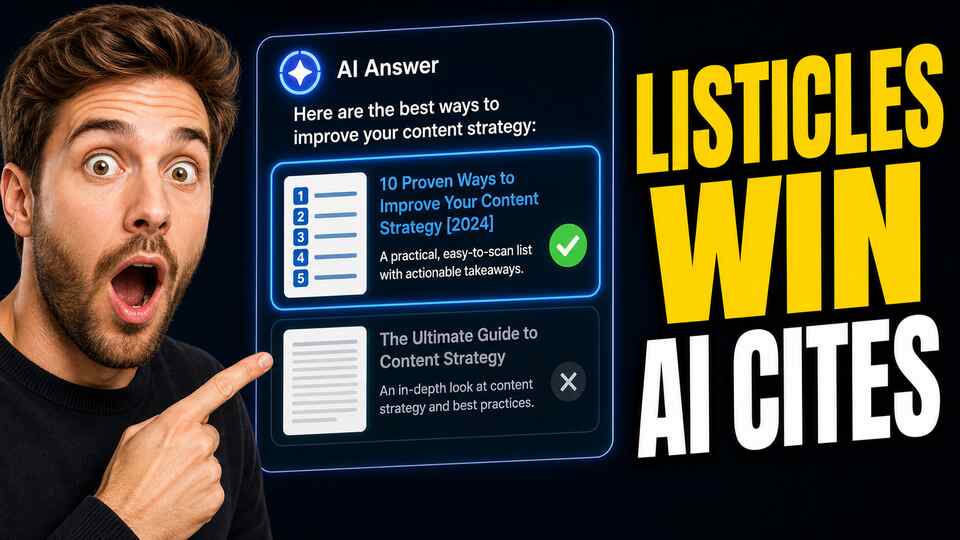
For years, content marketing orthodoxy has said that "real" thought leadership lives in long-form essays and that listicles are the junk-food version, fast to write, fast to consume, and fast to forget. That orthodoxy has aged badly. In AI search, listicles are the format that outperforms almost everything else, and the data is now stark enough that any team ignoring it is leaving citations on the table.
Here's what the numbers say, why listicles work so well for AI extraction, and how to write listicles that actually win.
The data is unambiguous
A study of 75,000 AI answers from Wix Studio's AI Search Lab found that listicles capture 21.9% of all AI citations across ChatGPT, Google AI Mode, and Perplexity, more than any other content format. Articles came in at 16.7%. Product pages at 13.7%. Together, those three formats account for 52% of every citation in the study.
The lead grows even larger when you filter by intent. Listicles capture 40% of commercial-intent citations, nearly double any other format. That's the entire commercial-buying funnel: "best of" queries, "top 10" queries, recommendation prompts, comparison searches. It's where listicles have an outsized advantage.
One critical nuance: third-party listicles dominated 80.9% of citations in professional services categories, compared to only 19.1% for self-promotional rankings. AI engines actively prefer neutral editorial listicles over branded "we are the best" ones. We'll come back to this, it's the single biggest mistake teams make when writing their own listicles.
Why listicles outperform long-form for AI extraction
The reason isn't about user preference or attention spans. It's mechanical. AI engines extract content in chunks, and listicles are pre-chunked by design. Each numbered item is a self-contained unit with a clear identifier, a concise description, and an obvious boundary. The AI doesn't have to parse the structure; the structure is already explicit.
Long-form essays make the AI work much harder. The model has to identify where one idea ends and the next begins, what the canonical sentence is for each idea, and which parts are extractable. The work is harder, the extraction is messier, and the output is less reliable, so the model reaches for the listicle instead.
This is also why listicles dominate commercial-intent answers specifically. Commercial queries reward enumerable answers ("here are the 5 best CRMs"), and a listicle delivers exactly that format with no friction. A long-form essay on the same topic has to be parsed and decomposed before it can answer the same question, and most engines don't bother.
Format every list item as a numbered heading
The single most important formatting rule for AI-extractable listicles: format each list item as a numbered heading at the same heading level (all H2s or all H3s, not mixed). Numbered headings give AI parsers an unambiguous structural signal, this is a list, and these are the items.
Compare:
- ❌ A page with "1. First option," "2. Second option" written as bold paragraph text in body content
- ✅ A page with "<h2>1. First option</h2>" and "<h2>2. Second option</h2>" as actual markup
The visual difference is small. The structural difference is enormous. AI parsers read the second version as a true list with eight or ten distinct items. They read the first version as one long paragraph with numbers in it. Citation rates are dramatically different.
Use repetitive scaffolding for every item
Inside each numbered item, use the same scaffolding for every entry. The pattern that works best for tool and product listicles:
- Name + best-for descriptor in the heading or first sentence ("HubSpot CRM, Best for sales teams that need a free starting tier")
- Pricing as a clean, specific number ("Plans start at $20/user/month")
- Short intro paragraph explaining what it is and who it's for
- Key features as 3-5 bulleted points, each with a bolded label
- Pros and cons as a side-by-side or two-column structure
- Verdict, one final sentence stating who should pick this option
Repeating this exact scaffolding for every entry has two effects. For human readers, it creates predictability, they know where to look for pricing or use cases instantly, regardless of which item they're reading. For AI parsers, it creates extractable consistency, each item maps to the same fields, so an extractor can pull comparable data across all entries.
This is why the most-cited tool listicles all look like they were written from the same template. They were. The template is the citation engine.
Be specific in every list-item title
The single biggest writing mistake in listicles is vague titles. "Plant bulbs" is a useless list item. "Plant spring bulbs like garlic, tulips, and daffodils" tells the reader and the AI exactly what's being recommended.
Specificity in titles serves the AI extraction model directly. Vague titles get truncated to nothing in the extraction; specific titles get pulled intact. As a working rule, every list item title should contain the entity name and a one-phrase qualifier. "10 best CRMs" → "10 best CRMs for small marketing agencies in 2026" carries far more information per word.
Don't force the count
One of the most damaging myths in listicle writing is that you have to hit a specific number, 7, 10, 25, for the format to work. You don't. Padding a listicle to hit an arbitrary count produces weak entries that drag down the credibility of the whole list.
Let the topic determine the count. If you have six genuinely worth-recommending CRMs, write a list of six. If you have twelve, write twelve. The credibility lift from honest, well-curated lists is worth far more than the SEO benefit of hitting a round number.
The exception is the "Top 10" listicle, where the round number is part of the format expectation. In that case, make sure each of your ten entries is actually defensible, anything thinner than the others will weaken the list as a whole.
Stay neutral, even on your own blog
This is the part most teams get wrong. Going back to the data: third-party listicles get cited at 80.9%, while self-promotional rankings get cited at only 19.1%. AI engines actively penalize listicles that read as marketing.
If you're writing a listicle on your own brand's blog, write as if you were a journalist, not a salesperson. Specifically:
- Acknowledge real strengths in every option, including competitors
- List concrete weaknesses for every option, including your own
- Use neutral language ("designed for", "best fit for") rather than marketing language ("the leading", "the most powerful")
- Provide verifiable data, pricing, ratings, user counts, for every item
- Include your own product (if at all) somewhere honest in the list, not at #1 by default
The listicle that reads as honest analysis with a clear methodology will outperform the listicle that reads as a transparent ad. By a lot. The third-party citation gap isn't an accident, it's evidence that AI engines have learned to filter for editorial neutrality.
Order items intentionally
Two ordering patterns work best for AI-extractable listicles:
- Logical order for process-based lists. If your listicle is "10 steps to launch a GEO program," the items have to be in chronological order, because the steps depend on each other.
- Most-valuable first for opinion-based or category lists. If your listicle is "The 8 best CRMs," put the strongest entry at #1 and rank descending. Don't bury the best item at #6 to "build suspense", AI extractors often pull the first few entries preferentially.
Avoid alphabetical order for opinion-based listicles. Alphabetical ordering looks editorially fair but it confuses AI extractors that interpret listicle position as a ranking signal. Order intentionally and explain your criteria.
Group long lists by category
If your list has more than 12-15 items, group them under category headings. "20 best AI tools" becomes "Writing tools (1-5), Image tools (6-10), Coding tools (11-15), Search tools (16-20)." This serves both human scannability and AI parsing, the categories give structural signals that help the engine understand which items are comparable.
This is also how you scale listicles past the limits of a single linear list. A 50-item flat listicle is overwhelming and hard to extract; a 50-item categorized listicle reads like a useful directory.
Add comparison tables alongside the prose
The strongest listicles pair their numbered prose entries with a single comparison table that summarizes the same items in tabular form. The prose entries provide depth; the table provides scan-friendly comparison. AI engines extract both, often citing the table as the primary source for "compare X" prompts and the prose for "best of" prompts.
This dual structure is the most cited shape for tool-category listicles in 2026. Build the listicle. Add the table at the top. Watch the citations climb.
Listicles are infrastructure
If you're building a GEO content strategy from scratch, listicles deserve a permanent slot in the publishing calendar. They take less time to research than long-form essays, they get cited at higher rates, and they cover the highest-intent commercial queries in your category. Pick the 10-15 most important "best of" and "top X" topics in your space and ship one a month for the next year. By the end of it, you'll have a listicle library earning citations across dozens of commercial prompts, exactly the audience that converts.
Long-form has its place. It just isn't where the AI citations are.
Related format guide: Answer-First Writing: The Format LLMs Love Most.