How Do People Discover New Tools Through ChatGPT Recommendations?
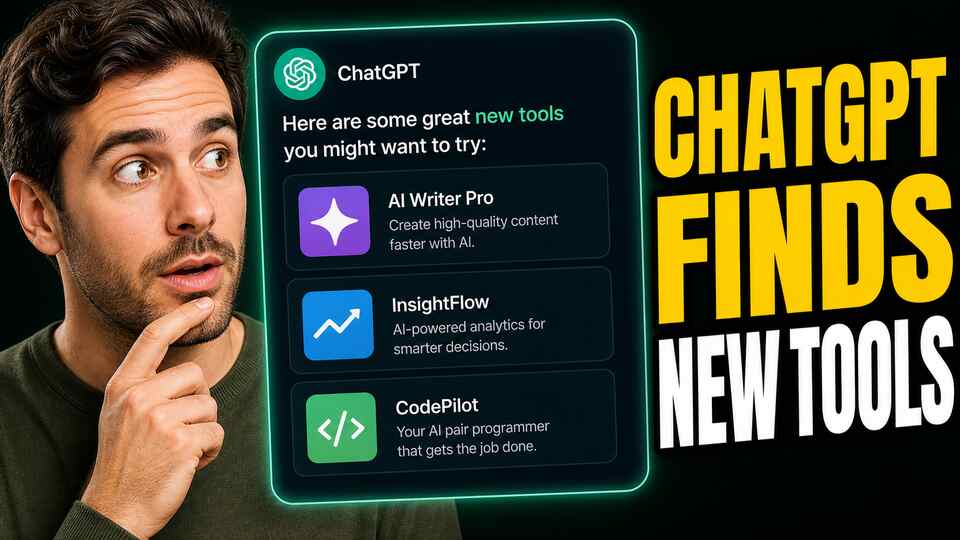
A few years ago, if you wanted to find a new tool, you'd Google it. You'd sift through listicles, sponsored results, and review sites. It took time and it took judgment. Now a large and growing share of that discovery happens in a single conversation with ChatGPT.
Someone types: "What's the best tool for tracking brand mentions in AI?" ChatGPT answers. They click through to one of the brands mentioned. That's the funnel. Simple on the surface, but the mechanics underneath are worth understanding if you want your brand to be in that answer.
The Query Trigger: How It Starts
ChatGPT discovery starts with a problem-aware question. The user knows they have a need and they're asking for a solution. This is high-intent. These aren't people browsing. They want an answer and they're ready to act on it.
The phrasing varies more than you'd expect. "Best tool for X," "what do marketers use for X," "how do I track X," "alternatives to [competitor] for X." Each of these triggers produces a different answer. ChatGPT doesn't have one canonical answer for a topic. It generates a response based on the specific phrasing, context in the conversation, and its training data.
That variability is important. If your brand appears in the answer to "best tool for AI monitoring" but not in "how do I track brand mentions in ChatGPT," you're missing half the funnel. Tracking only one query variant gives you a false sense of coverage.
What Makes ChatGPT Surface a Brand
ChatGPT doesn't have a paid placement system for organic results. It draws on its training data: published articles, reviews, community discussions, documentation, third-party coverage. If your brand appears frequently and credibly in those sources, you're more likely to show up in recommendations.
Frequency matters. If 50 different sources mention your product in the context of AI visibility monitoring, ChatGPT has more signal to work with than if two sources mention you. Volume of credible mentions correlates with recommendation likelihood.
Specificity matters too. Generic mentions are less useful than specific, detailed coverage that demonstrates what the product does, who it's for, and why people choose it. The more signal ChatGPT has about the specifics of your product, the more confidently it can recommend you for specific use cases.
Source authority matters. A mention in a recognized industry publication carries more weight than a mention in a thin affiliate blog. This is closely connected to how E-E-A-T signals influence AI search citations.
The Recommendation Layer: What the User Actually Sees
When ChatGPT answers a tool recommendation query, it typically surfaces 3 to 6 options with brief descriptions. The order matters. The framing matters. Being listed first with a strong, specific description is meaningfully better than being listed fifth with a vague one.
What users see isn't just "Brand X." They see "Brand X is good for teams that need real-time tracking across multiple AI models." That framing shapes whether they click. If ChatGPT's description of your product is outdated, wrong, or bland, that costs you conversions even when you're mentioned.
This is where the depth of prompt-level tracking becomes essential. You need to know not just whether you're mentioned but how you're described, and whether that description is accurate and compelling.
From Recommendation to Traffic: The Conversion Gap
The research on ChatGPT-driven traffic shows meaningful intent. Users who arrive from AI recommendations tend to have lower bounce rates and higher trial conversion rates compared to organic search traffic. They've already been pre-sold by the AI's recommendation. They arrive with context.
But there's a gap. Not every AI recommendation results in a click. Some users read the AI's description and decide without visiting the site. Some ask follow-up questions and get more detail before deciding. This is the zero-click problem in AI search: your brand can be recommended without generating measurable traffic.
The implication is that brand recall in zero-click AI search matters as much as direct traffic attribution. Being mentioned builds familiarity even when it doesn't generate an immediate session.
Where Most Brands Are Invisible
The uncomfortable reality for most companies is that they don't know where they appear in this funnel. They might have a vague sense that "ChatGPT sometimes mentions us" based on someone on the team running a query once. That's not a monitoring program.
The actual gaps are usually at the query variation level. A brand appears in answers to one or two obvious queries but is absent from the longer-tail, more specific questions that higher-intent buyers actually ask. "What do enterprise marketing teams use for AI brand monitoring" produces a different answer than "best AI tracking tool." Both matter. Most brands are only visible in one.
Understanding where your brand mention gaps are in AI search is the first step toward closing them systematically.
How BabyPenguin Maps the Discovery Funnel for Your Brand
BabyPenguin lets you define the full set of queries your target buyers are asking and then shows you, for each query, whether you're in the answer and how you're positioned. You get visibility across ChatGPT, Gemini, Grok, and other major models, so you can see where your coverage is consistent and where it breaks down.
The competitor comparison is especially useful here. For any prompt where you're not appearing, BabyPenguin shows you which competitors are. That tells you exactly where in the discovery funnel you're losing ground and to whom.
The citation source data tells you why. If a competitor is consistently mentioned in a context where you're not, and BabyPenguin shows that they're being cited from a specific authoritative source that you're not covered in, that's an actionable gap. Get covered in that source and you change the input that shapes the AI's output.
Discovery in the ChatGPT era isn't magic. It's the result of a specific set of inputs producing a specific output. Once you understand the mechanics, you can work the funnel deliberately instead of hoping you end up in it by luck.