How to Write Tutorials ChatGPT Will Cite Back to You
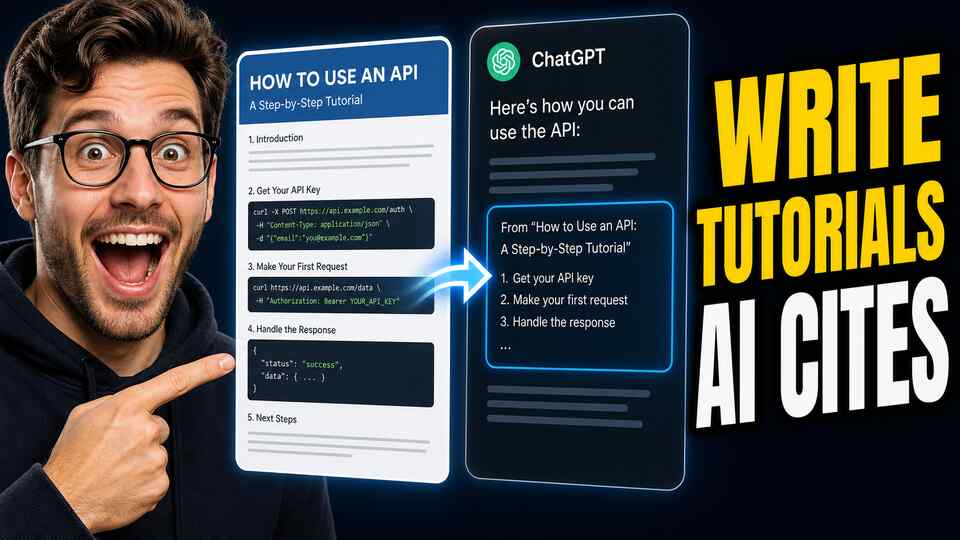
If you've ever asked ChatGPT how to do something, set up GA4, install a Postgres extension, deploy to Cloudflare, and noticed that it gave you what looked like a near-verbatim version of someone's blog post, you've seen the tutorial citation pattern in action. AI engines lean heavily on tutorial content when answering "how do I" questions, and the tutorials they reach for look very different from the ones most marketing teams write.
Here's how to structure tutorials so AI engines don't just read them, they cite them back to users.
Tutorials are uniquely citable, but most are uncitable
The reason tutorials are so heavily cited by AI is structural: they map perfectly onto the most common type of question users ask AI tools. Open any AI search log and a third or more of the queries are some variation of "how do I X?", which is exactly the question a tutorial answers.
The reason most tutorials never get cited despite this is also structural: they're written like blog posts, not like instructions. Long preamble paragraphs about why the topic matters. Personal anecdotes about how the author got into the topic. Interstitial commentary between steps. Prerequisite information buried in the middle. Important caveats hidden at the bottom. None of that survives AI extraction.
The tutorials that get cited are the ones that take "step-by-step" literally, clean numbered steps, each one self-contained, with no narrative connective tissue. Less of a personal voice, more of a technical document. Less "let's get started!" and more "Step 1."
Implement HowTo schema from day one
The first technical decision is schema. HowTo schema is the explicit structured-data type for tutorial content, and it's one of the highest-priority schemas for AI extraction. Use it. Mark up every tutorial on your site with HowTo, and make sure each step in the schema corresponds exactly to a step in the visible content.
The minimum HowTo schema includes the tutorial name, total time, supplies/tools required, and a list of HowToStep entries, each one with a name, text description, and optionally an image. AI engines parse this schema directly, so a tutorial with HowTo markup is unambiguous to an extractor; the same tutorial without it requires guesswork.
This is one of the easiest GEO wins available because the schema costs nothing to add and substantially raises the citation rate of every tutorial it's applied to.
Lead with a clean step list, not a preamble
The structure that works for AI-cited tutorials looks like this:
- One-sentence summary at the very top, what this tutorial teaches, in a single quotable sentence
- A box or callout with: total time, prerequisites, tools needed
- The numbered step list, each step is its own H2 or H3 with the format "Step X: [action]"
- A short verification section, how to confirm the tutorial worked
- Optional: troubleshooting, common errors and fixes
Notice what's not in this structure: a long intro about why the topic matters, the author's backstory, links to other tutorials, embedded video, sidebar content, opinion content, marketing CTAs, related-product mentions. All of those exist in most blog-style tutorials. None of them belong in a tutorial designed for AI citation.
If you're tempted to add personal voice or context, put it in a separate section at the bottom labeled "Why this works" or "Notes", somewhere clearly demarcated from the steps themselves. That way the tutorial part of the page stays clean and extractable, and the editorial part is available for human readers who want it.
Make every step self-contained
The single biggest extraction failure in tutorials is steps that depend on context from earlier steps. AI engines extract steps individually, and they sometimes pull only a few mid-tutorial steps when answering a specific question. If your step says "now do the same thing as step 2 but with the new value," the extracted step is useless without step 2.
Every step needs to be readable in isolation. The fix is to fold the necessary context inline:
- ❌ "Step 5. Run the same command from Step 2."
- ✅ "Step 5. Run
npm install --save-dev jestagain to install Jest in the test environment."
The second version takes one extra clause but it's complete. An AI extractor pulling step 5 in isolation can give the user a useful instruction without needing the rest of the tutorial.
This rule applies to commands, file paths, URLs, parameter names, and configuration values. If a step references "the file from earlier," replace that with the actual file path. If a step says "in the same directory," replace that with the actual directory. Make every step survive being extracted alone.
Use action-verb step names
Each step's name (the H2 or H3 text) should start with an action verb in the imperative mood. Not "Configuration of GA4" but "Step 3: Configure GA4 to track LLM traffic." Not "About environment variables" but "Step 4: Set the environment variables in your deployment." Not "Verifying it works" but "Step 7: Verify the connection by running the test suite."
Action-verb step names do two things at once. They tell human readers immediately what the step accomplishes. They give AI extractors an unambiguous label for what each step is, which dramatically improves the AI's ability to match the right step to the right user question.
Include the actual code, commands, and screenshots
Tutorials that show real code, real terminal commands, and real screenshots get cited at far higher rates than tutorials that describe these things in prose. The reason is that AI extractors can pull a code block intact and present it to the user, but they can't reliably reconstruct code from a textual description.
If a step involves a command, show the command in a code block. If a step involves a config file, show the config file in a code block. If a step involves a UI action, include a screenshot, and add descriptive alt text that names what the screenshot shows ("GA4 admin panel showing the data streams configuration with the API key field highlighted").
Code blocks should be tagged with their language for syntax highlighting and parsing. AI engines are increasingly able to identify code language from code-fence metadata, and this signals the difference between "this is a JavaScript snippet" and "this is generic text."
Front-load failure modes and prerequisites
One pattern that strongly improves citation rates is putting the prerequisites and known failure modes at the top of the tutorial, not the bottom. AI engines often answer "how do I X?" with a tutorial summary that leads with the prerequisites, and if the tutorial buries them, the AI either misses them or skips your tutorial entirely in favor of one that doesn't.
The format that works:
Before you start, you'll need:
- Node.js 20+ installed
- A Cloudflare account with Workers enabled
- The Wrangler CLI (run
npm install -g wranglerto install)Common gotchas:
- The deployment fails silently if your
wrangler.tomlis missing thecompatibility_datefield- Workers can't access env variables until you've run
wrangler secret put
Both blocks live above the actual steps. Both are extractable as standalone units. Both are exactly the kind of content AI engines pull when a user is debugging or planning the same task.
Include a verification step
The most overlooked element of citable tutorials is the verification step at the end. Most blog tutorials end with "you're done!" The cited tutorials end with: "To verify the setup worked, run X and check that the output matches Y." This is exactly what users want when they're following a tutorial, confirmation that they did it right, and AI engines pick up on it.
A verification step also functions as a quality signal. Tutorials with verification steps demonstrate that the author actually executed the process and knows what success looks like. Tutorials without one are often theoretical and prone to errors. AI extractors learn this distinction and prefer the verified ones.
Add a troubleshooting section in Q&A format
If your tutorial has known failure modes, add a troubleshooting section at the bottom in Q&A format. "Why am I getting [error message]?" → "Because [reason]. To fix it, do [action]." Use FAQPage schema for this section if you can.
This gives your tutorial a second wave of citation potential. AI engines pull these Q&A entries when answering troubleshooting prompts, "why is my GA4 setup not tracking LLM traffic?", and your tutorial becomes the cited source for both the original how-to question and the downstream debugging questions.
Update tutorials when reality changes
Tutorials decay faster than almost any other content type. APIs change, UIs get redesigned, command flags get renamed, package versions move. A tutorial that was perfectly accurate eight months ago can be subtly wrong today, and users following it will hit errors that aren't documented.
Schedule a quarterly review of every tutorial. For each one, actually run the steps in a fresh environment. If anything has changed, update the tutorial and bump the "last updated" date prominently. AI engines weight recently-updated tutorials more heavily, and a "last updated" date close to today is a strong signal that the tutorial still works.
Tutorials are first-party authority
The reason tutorials are such a powerful GEO investment is that they're one of the few content types where you genuinely have first-party authority. Nobody can write a credible tutorial on how to use your product better than you can. Nobody can write a more authoritative debugging guide for your platform's quirks. AI engines reward this kind of first-party knowledge with citations, especially in technical and how-to categories.
Build the schema. Lead with the steps. Make every step self-contained. Show the code. Add the prerequisites. Verify the result. Add the troubleshooting Q&A. Refresh quarterly. That's the tutorial AI engines cite, and it's also the tutorial users actually finish.
For the full ChatGPT optimization playbook: How to Rank Inside ChatGPT: A Step-by-Step Playbook.