Word of Mouth in the LLM Era: How to Track and Influence It
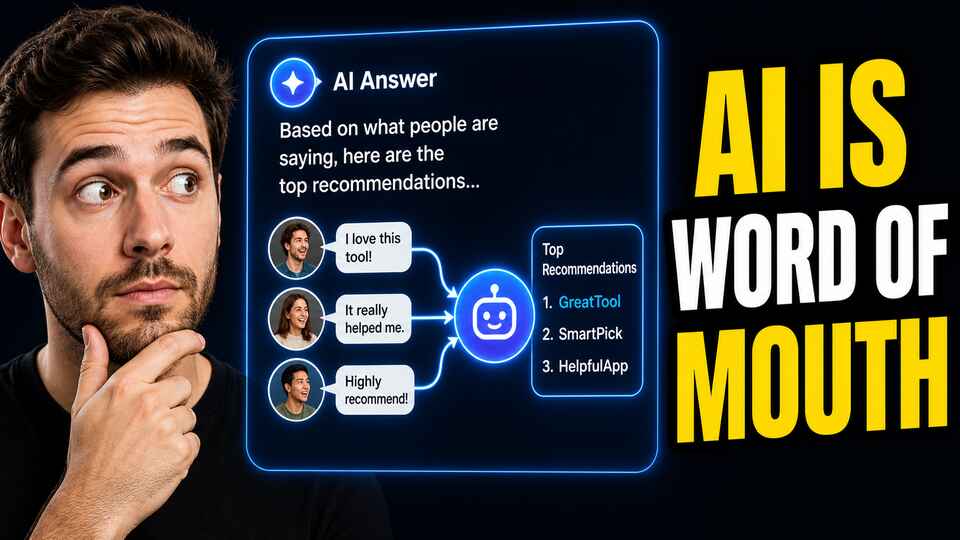
Word of mouth has always been the most trusted form of marketing. People believe other people more than they believe brands. That's not new. What's new is the mechanism: a growing share of that peer-like trust is now being channeled through AI assistants that synthesize recommendations at scale.
When someone asks ChatGPT "what's the best AI monitoring tool," they're not consulting a search engine. They're asking for a synthesized opinion. And that's exactly how they receive it: as a confident, direct recommendation, not a list of links to evaluate.
The brand that shows up in that answer wins the moment. The brand that doesn't exist in that answer loses a buyer who was actively looking for them, without ever knowing it happened.
How LLMs Form Their Understanding of Your Brand
Large language models don't have opinions in the human sense. But they do have something functionally similar: a weighted synthesis of everything they've been trained on that relates to your brand. When a user asks for a recommendation, the model generates a response based on patterns in that training data.
The inputs that shape this synthesized view are specific and traceable:
- Third-party reviews and comparisons. G2, Capterra, Reddit, and similar platforms are heavily weighted because they represent aggregated user sentiment. If 200 reviews describe your product as reliable and easy to use, that signal makes it into the model's understanding of your brand.
- Community discussions. Reddit threads, Slack communities, LinkedIn posts, Hacker News comments. These sources carry a "real users talking" signal that LLMs weight as authentic peer conversation.
- Authoritative content. Industry publications, analyst reports, reputable blogs. This content shapes how the model categorizes your brand within a competitive landscape.
- Your own published content. Documentation, case studies, thought leadership. This tells the model what you do and for whom, in your own words.
The practical implication: the AI's word of mouth about your brand is downstream of actual human word of mouth. It's a synthesis. If the underlying conversation about your brand is positive, specific, and widespread, the AI's recommendation will reflect that.
This is why digital PR strategy for AI citations has become a serious discipline. Getting coverage in the right places isn't just about backlinks anymore. It's about feeding the inputs that shape AI recommendations.
Old Word of Mouth vs New Word of Mouth
Traditional WOM worked through networks. One person recommended your product to five people. Those five told others. The reach was real but slow, and it was limited to actual users and their actual networks.
AI-mediated word of mouth works differently. The AI synthesizes the collective opinion of potentially thousands of sources and delivers it to a single user in a single moment. The reach is instant and the scale is massive, but the AI isn't a user. It's reflecting what others have said.
This creates an interesting accountability gap. If the collective body of writing about your brand is inaccurate, outdated, or incomplete, the AI's recommendation will be too. You can have an excellent product that ChatGPT describes poorly because the content ecosystem around your brand hasn't caught up.
That's a solvable problem, but only if you know it exists. Understanding how the consensus layer shapes AI recommendations is a prerequisite for influencing it.
How to Influence LLM Word of Mouth
The levers are more concrete than most marketers expect.
Build the review base. Reviews on G2, Capterra, and Trustpilot are high-signal inputs for LLMs. Not just star ratings: detailed, specific reviews that describe what the product does well, for whom, and in what context. A hundred reviews saying "great tool" are less valuable than fifty reviews describing specific use cases in detail.
Earn third-party coverage. Press mentions, analyst write-ups, inclusion in "best of" roundups from credible sources. These function as third-party endorsements that LLMs treat as more authoritative than self-published content.
Create specific, detailed content. Thin content doesn't move the needle. Detailed guides, case studies with real numbers, comparison content that explains your positioning versus alternatives: these give LLMs something substantive to draw on when forming recommendations.
Seed community discussion. Authentic participation in communities where your buyers hang out. When real users mention your product in community contexts, those mentions become training data over time.
Building a GEO content strategy ties all of these levers into a coherent program rather than a scattered set of one-off tactics.
How to Track It
Influence without measurement is guesswork. You can run the playbook above for six months and have no idea whether it's moving the needle in the outputs that matter: what AI assistants actually say about your brand when buyers ask.
BabyPenguin closes that loop. You define the queries that represent real buyer intent in your category. BabyPenguin runs those queries across ChatGPT, Gemini, Grok, and other models and logs the results over time. You can see your mention rate trend, how your framing in AI responses changes as you build more coverage, and which specific sources are being cited when your brand comes up.
The citation analysis is particularly useful for tracking influence efforts. If you earn a feature in a major industry publication and, two months later, BabyPenguin shows that publication appearing in citations when your brand is mentioned, you have direct evidence that the coverage is working. You're not guessing. You're measuring.
The side-by-side competitor view shows you how your AI word of mouth compares to the brands you're competing with. This kind of tracking connects directly to understanding your AI share of voice, the metric that quantifies how much of the AI recommendation space your brand occupies versus your competitors.
The Bottom Line
LLMs have become one of the most important word of mouth channels in B2B and B2C purchasing, and most brands are managing it the way marketers managed social media in 2009: aware that something important is happening but not yet systematic about it.
The brands that build a monitoring and influence program now will have a measurable advantage in AI share of voice within 12 months. The ones that wait will spend that time catching up to competitors who moved earlier.
The inputs are manageable. The tracking is available. There's no good reason to leave this to chance.