How to Write Product Descriptions AI Will Reuse Verbatim
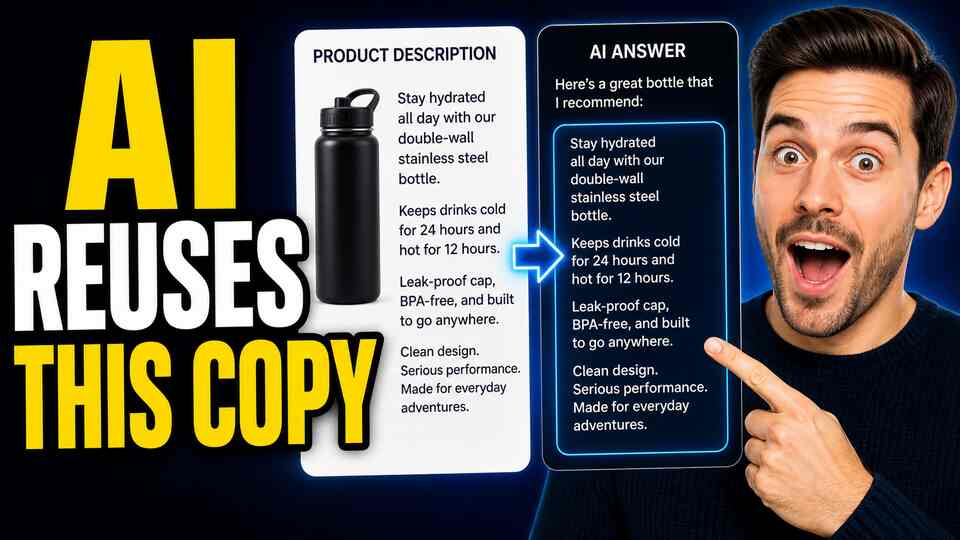
The dream for any ecommerce or SaaS team is for their product description to be the answer the AI gives. The user asks ChatGPT "what does [your product] do?" and the AI replies with a sentence, or a paragraph, that's almost a direct quote from your own product page. Done well, this gives the buyer an accurate, brand-consistent answer that you wrote yourself, instead of an inventive paraphrase that misses the point.
Done badly, the AI either skips your product copy entirely (because it isn't extractable) or quotes the wrong sentence (because the canonical claim is buried). Here's how to write product descriptions in a way that maximizes the chances of verbatim reuse.
Why product copy is the highest-leverage AI shopping surface
One Search Engine Land guide on AI-driven shopping discovery makes the architectural point directly: AI shopping assistants pull information primarily from "core product copy where AI systems are most likely to pull from", not from reviews, not from FAQs, not from support tickets. The product description is the canonical source.
This is structurally important. It means the product description is doing more work in AI shopping than almost any other content type. A great product page can be cited verbatim by ChatGPT Shopping, Microsoft Copilot, Perplexity, and Gemini, all from the same well-written description. A weak product page leaves money on the table across every AI shopping surface simultaneously.
Use the full character allowance
The Search Engine Land guide on optimizing for ChatGPT Shopping flags one specific opportunity: "truncating a field is leaving relevance on the table." ChatGPT Shopping allows descriptions up to 5,000 characters. Most ecommerce product descriptions use 200-500. The gap is enormous.
The guide treats descriptions like SEO title tags: "use the space strategically rather than wastefully." Every character is another chance to match the phrasing a shopper will use in their AI prompt. If you're writing 200 characters where 5,000 are available, you're capturing maybe 4% of the AI matching opportunity.
The fix isn't to pad with marketing fluff to fill space. It's to add real, useful information that addresses the constraints buyers actually care about. Each sentence is another extraction candidate.
Write for constraints, not features
The biggest mistake in ecommerce copy is feature-listing instead of constraint-answering. The Search Engine Land AI shopping guide is explicit: PDPs should be written for "constraint matching instead of browsing."
Compare:
Feature-listing copy (rarely cited verbatim):
Premium leather construction. Multiple compartments. Laptop sleeve. Padded straps. Available in three colors.
Constraint-answering copy (frequently cited verbatim):
Fits 14-inch laptops, including 13-inch MacBook Pro and standard Dell XPS sizes. Padded laptop sleeve protects against drops up to 3 feet. Side compartments hold a water bottle and a paperback book without bulging. Designed for daily commuters who carry a laptop, charger, and one or two notebooks. Not recommended as a travel bag for trips longer than 2 nights.
The first version describes the product. The second version answers the questions a real buyer would ask before purchasing. Each claim in the second version is concrete enough to be quoted directly, "Fits 14-inch laptops" is a complete answer to "will this fit my MacBook?" An AI extractor reading this description has discrete, quotable answers for each common buyer concern.
Lead with low-perplexity sentences
One Search Engine Journal article on winning at GEO highlights a useful pattern: "add product text with low perplexity (predictable and well-structured)". Low-perplexity text is text that an AI model finds easy to predict, clear declarative sentences, conventional structure, named entities, no creative metaphors or unusual phrasings.
This isn't about being boring. It's about being unambiguous. A sentence like "The XYZ-500 is a wireless mechanical keyboard with hot-swappable switches" is low-perplexity, every word is concrete, every claim is checkable, the structure is conventional. A sentence like "The XYZ-500 redefines what a typing experience can be" is high-perplexity, the words are abstract, the claim is unverifiable, the structure is marketing-speak.
AI engines extract low-perplexity sentences much more reliably than high-perplexity ones. Replace marketing flourishes with concrete declarative statements wherever possible.
Structure descriptions as discrete, extractable blocks
The single biggest structural improvement for product descriptions is breaking them into discrete blocks rather than flowing paragraphs. The pattern that works:
- Lead sentence: one-sentence canonical description ("[Product] is a [category] for [audience] that [primary benefit]")
- Specifications block: dimensions, weight, materials, compatibility, as a bulleted list
- Use cases block: 3-5 specific scenarios where the product is the right pick
- Constraints answered block: "Fits X. Doesn't fit Y." "Works with X. Not compatible with Y." "Ideal for X. Not recommended for Y."
- Inclusion list: what's actually in the box or included in the offering
Each block is its own extraction candidate. The AI can pull the whole description as one block, or it can pull just the specifications block when answering a "what are the dimensions of X?" prompt, or just the constraints block when answering a "will X work for Y?" prompt. The block structure multiplies the citation surface area.
Use natural conversational phrasing
The Search Engine Land ChatGPT Shopping guide reinforces a key principle: descriptions should be written "for clarity and intent, not keyword stuffing." The shift is away from short, keyword-stuffed product copy toward longer, conversational, attribute-focused descriptions that match how shoppers actually phrase queries.
The mental test: if a real shopper asked you about this product over the phone, what would you tell them? That's the kind of language that gets cited verbatim. Not "premium quality," but "the leather softens after about two weeks of daily use." Not "versatile design," but "fits in a desk drawer or a backpack side pocket." Real, specific, conversational, useful.
Include the named entities AI extractors look for
Product descriptions that name specific brands, models, sizes, and compatibility targets get cited at higher rates than vague descriptions. Instead of "fits most laptops," say "fits 13-inch MacBook Air, 14-inch MacBook Pro, and most Dell XPS 13/15 models." Instead of "compatible with major streaming services," say "compatible with Netflix, Disney+, HBO Max, and Apple TV+."
Named entities give AI engines the verbatim phrases they need to answer compatibility prompts. "Does it work with my Dell XPS?" gets a clean yes/no answer if your description names the Dell XPS. It doesn't if your description says "works with major laptop brands."
Match the AI prompt phrasing
The ChatGPT Shopping guide emphasizes that the goal is to match "the phrasing a shopper will use in ChatGPT." This is different from matching keywords, it's matching the natural-language form of the question.
To find the right phrasing:
- Read your product reviews and note how customers describe the product in their own words
- Read your support tickets for the questions buyers ask before purchase
- Search ChatGPT for prompts about your product category and observe the language the AI uses in its answers
- Use the actual customer language in your product description, not the marketing copy your team usually writes
Write the way buyers ask, not the way marketers describe.
Maintain consistency between description, schema, and feed
One pattern that consistently improves verbatim reuse is consistency across surfaces. The text in your product description, the values in your Product schema, and the data in your product feed should all agree. AI engines verify across these surfaces, and discrepancies cause downgrades.
The audit:
- Is the product name the same in the description, schema name field, and feed title?
- Is the price the same across the description, schema offers field, and feed price?
- Are the dimensions the same in the description body and schema property?
- Is the brand the same across all surfaces?
Consistent data across all surfaces tells AI engines this product information is reliable. Inconsistent data tells them not to trust any of it.
Refresh descriptions when reality changes
Product descriptions go stale faster than most teams realize. Pricing shifts. New colorways launch. Compatibility lists expand. Materials change. Sizing gets updated. Each change should propagate to the description within hours, not weeks. Stale descriptions are one of the most common causes of AI shopping assistants getting product details wrong.
Build description updates into your product launch and inventory workflows. Treat the description as live data, not as a one-time copy task.
Verbatim reuse is the goal, but extractability is the path
The ultimate test of a great AI-friendly product description isn't whether it sounds good. It's whether an AI engine can lift discrete sentences from it and use them as direct answers to buyer questions. Every sentence should be extractable on its own. Every claim should be specific enough to be quoted. Every constraint should be answered explicitly.
Use the full character allowance. Write for constraints, not features. Use low-perplexity declarative sentences. Structure as discrete extractable blocks. Use conversational phrasing that mirrors real buyer language. Include named entities. Maintain consistency across surfaces. Refresh when reality changes.
The descriptions that follow these patterns get reused verbatim by ChatGPT Shopping, Microsoft Copilot, Gemini, and Perplexity. The descriptions that don't get paraphrased badly, hallucinated, or skipped entirely. Same product, same buyer demand, very different outcomes.