How to Adapt Your SEO Content for ChatGPT Search
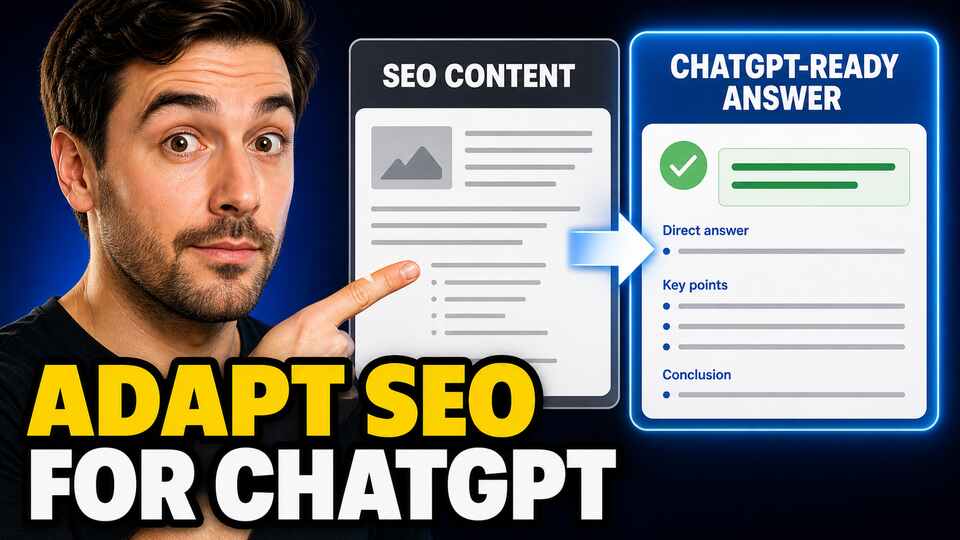
Most marketing teams have spent years building libraries of SEO-optimized content, pages that rank well in Google, capture organic traffic, and convert. Now they're being told they also need to rank in ChatGPT. The temptation is to start over with fresh "AI-first" content. The smarter move is to adapt the existing library. Most of it is already mostly there.
Here's how to take SEO content that's already winning and convert it into content ChatGPT actually reaches for, without scrapping the work you've already done.
The gap between Google rankings and ChatGPT citations
The first thing to understand is that the gap between Google success and ChatGPT success is real but smaller than people assume. Semrush's analysis of pet brand Petlibro's AI visibility found that "85% of Petlibro's AI-cited pages also rank for at least one keyword in Google search." The overlap is significant, 85% of the citation candidates are already Google-rankable content.
But it's not 100%. That 15% gap matters. Some pages that rank well in Google never appear in ChatGPT, and some pages that ChatGPT cites don't rank in Google. The reasons cluster around structural differences, which is exactly what this article covers.
The Search Engine Land foundational GEO article puts the underlying tension directly: "While strong rankings signal authority, AI models don't always pull from the top SERP results." Authority is a necessary but not sufficient condition. ChatGPT layers structural and extraction requirements on top of the authority requirement.
Step 1: Audit which of your existing pages already get cited
Before adapting anything, audit your current AI visibility. For your top 100 highest-traffic pages, run the relevant questions through ChatGPT and check whether your content is cited. You'll see a pattern emerge:
- Pages that get cited consistently, these are your AI winners. Don't change them; learn from them. What structural patterns do they share?
- Pages that get cited occasionally, these are your near-misses. They're the highest-leverage adaptation targets, because the underlying authority is already there.
- Pages that don't get cited at all, these are your structural failures. They might rank well in Google but they're not extractable in the form ChatGPT needs.
Focus your adaptation effort on the second group first. They're the closest to working, and small structural fixes often produce visible citation lift within weeks.
Step 2: Add answer-first paragraphs under every H2
The single highest-leverage adaptation for any SEO-optimized page is adding a clean 40-60 word answer paragraph immediately under each H2. SEO-optimized content typically buries the answer 2-3 paragraphs into each section. ChatGPT extracts the first paragraph under each heading.
The fix is mechanical:
- For each H2 in the article, identify the canonical answer to the question that section addresses
- Write that answer as a direct, self-contained paragraph of 40-60 words
- Place it as the first paragraph under the heading, before any narrative buildup
- Leave the existing supporting content where it is
This is 5-15 minutes of work per page. It typically delivers more citation lift than any other single adaptation because the AI extractor now finds a clean, complete answer right where it looks first.
Step 3: Convert noun-phrase headings into questions
SEO writing convention favors short noun-phrase headings that contain the target keyword: "API Authentication," "Pricing Comparison," "Common Errors." Question-shaped headings perform better in ChatGPT because they match how users actually phrase prompts.
The conversion is mechanical:
- "API Authentication" → "How do I authenticate API requests?"
- "Pricing Comparison" → "How much does each plan cost?"
- "Common Errors" → "What are the most common errors and how do I fix them?"
This also helps your traditional SEO, Google increasingly understands question-shaped headings as conversational query matches, so the change pays off in both channels.
Step 4: Make every section self-contained
One Search Engine Land observation explains the structural gap directly: "AI systems extract specific passages from your content to construct answers." When the AI extracts a section, it extracts that section in isolation, without the rest of the article for context. Sections that depend on earlier context become useless when extracted.
The fix is to read each section in isolation and fold the missing context inline:
- Replace "as we discussed above" with the actual claim from above
- Replace pronouns ("it," "they") with the specific entity name
- Restate the subject of the section in the opening sentence so the section is self-contained
- Remove forward references like "as we'll see in the next section"
This makes each section longer and slightly more repetitive, which feels wrong to SEO writers. It also makes each section dramatically more extractable, which is the entire point.
Step 5: Convert dense prose into structured formats where appropriate
SEO content often defaults to flowing prose because it reads well to humans and meets Google's word-count expectations. ChatGPT extracts more cleanly from structured formats, bulleted lists, numbered steps, comparison tables, FAQ blocks.
For each existing piece of content, identify sections where the underlying information is enumerable or comparable:
- Lists of features → bullets, not prose paragraphs
- Step-by-step processes → numbered lists with action verbs
- Comparisons across options → tables with explicit columns
- Common questions → explicit FAQ blocks with FAQPage schema
Don't restructure everything. Restructure the parts that are inherently structured but currently buried in prose. This typically takes 20-40 minutes per article and produces noticeable extraction improvements.
Step 6: Add specific numbers and named entities
SEO content often uses vague directional language ("many users," "frequently," "several options"). ChatGPT extracts specific facts much more reliably than vague claims. Replace directional language with specific numbers and named entities wherever possible:
- "Many users" → "76% of users" (with the source)
- "Several options" → "3 main options: X, Y, and Z"
- "Most common error" → "the 'invalid token' error, which accounts for about 60% of support tickets"
This is both an SEO and AI optimization. Specific facts get cited more reliably and they read as more credible to human visitors.
Step 7: Update freshness signals
Per the SEL article: "Between 40 and 60% of cited sources change from month to month" in AI systems. ChatGPT favors freshly updated content much more aggressively than Google does. SEO content from 2023 that you haven't touched in two years has fallen out of the citation pool, even if it's still ranking well in Google.
For each adapted page:
- Verify all statistics and update any that have changed
- Replace stale screenshots
- Update pricing, plan details, or any other fields that have moved
- Bump the dateModified field in your Article schema
- Display the updated date prominently on the page
This is the freshness signal that keeps the page in the citation pool. Skip it and the structural improvements get undone within months.
Step 8: Diversify your content beyond your own site
The Search Engine Land guide makes one important strategic point that SEO teams often miss: "strategic presence across platforms where AI tools discover information" matters more for ChatGPT than for traditional Google rankings. ChatGPT pulls from Reddit threads, YouTube videos, industry publications, review sites, not just from your own site.
Adapting your existing site content is necessary but not sufficient. Some of your AI visibility lift will come from earned mentions on other platforms, not from the content you control. Plan for both:
- Adapt your existing site content (this article's focus)
- Pursue earned mentions on Reddit, YouTube, industry blogs, and review sites in parallel
The two efforts compound. On-site adaptations make your owned content extractable. Off-site mentions expand the citation pool that points back to you.
Don't abandon your SEO investment
The most important caveat: adaptation isn't replacement. Your existing SEO content is already doing real work, driving organic traffic, capturing search demand, supporting conversions. The adaptation work compounds on top of that. Don't strip out keyword optimization. Don't remove structured navigation. Don't sacrifice traditional ranking for the sake of AI extractability.
SEO foundation. AI structural layer on top. Same content, optimized for two audiences instead of one.
The adaptation playbook in summary
Audit which existing pages already get cited. Add answer-first paragraphs under every H2. Convert noun-phrase headings into questions. Make each section self-contained. Convert dense prose into structured formats where the content is enumerable. Add specific numbers and named entities. Update freshness signals. Pursue parallel earned coverage off-site.
None of this requires throwing out your existing SEO work. All of it builds on top. The content library you already have is mostly the right starting point, it just needs structural surgery to be extractable in the form ChatGPT and other AI engines can actually use.
For the full ChatGPT ranking playbook, see How to Rank Inside ChatGPT: A Step-by-Step Playbook.