GEO for Enterprise Brands: A Roadmap for Large Marketing Teams
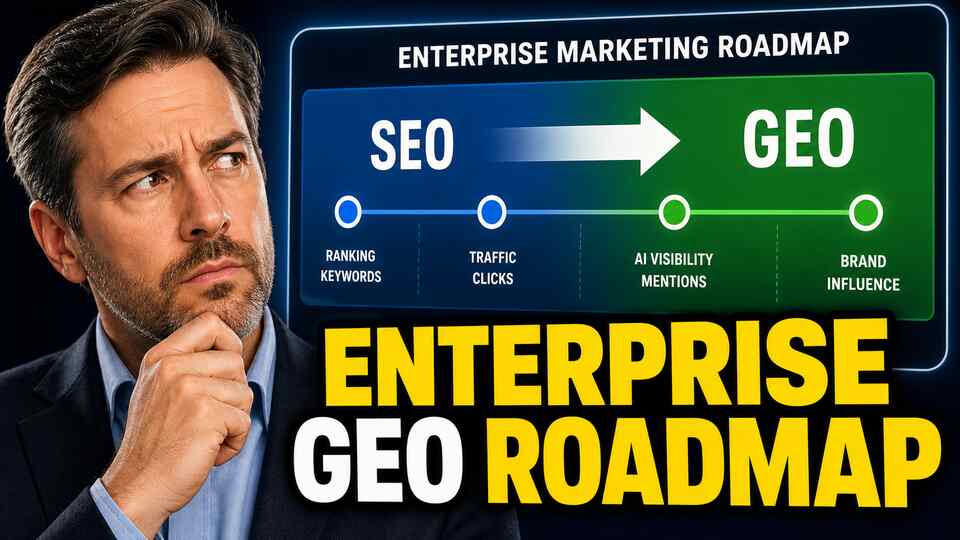
Enterprise marketing teams face GEO with a different set of constraints than smaller organizations. They have larger budgets and more resources, but also more bureaucracy. They have established brand authority, but also legacy content libraries that are hard to refactor. They have multiple stakeholders, multiple regions, and multiple product lines, and any GEO program that ignores this complexity ends up trying to apply small-team tactics at enterprise scale, where they don't work.
This is the roadmap for enterprise GEO in 2026, built around the operational realities that large marketing teams actually have to handle.
GEO is cross-functional by definition
The single most important enterprise insight comes from the Search Engine Land 2026 GEO guide: "Generative engine optimization isn't just the content team's job. It lives at the intersection of content marketing, SEO, digital PR, and product marketing."
For enterprise teams, this means a GEO program owned by a single function will fail. The work touches:
- Content marketing, for the actual writing and publishing
- SEO, for the traditional ranking foundation that AI engines depend on
- Digital PR, for earned coverage in authoritative third-party sources
- Product marketing, for the brand and product positioning that gets reflected in AI answers
- Web engineering, for the technical infrastructure (server-side rendering, schema, sitemaps)
- Brand, for entity consistency across all surfaces
- Compliance and legal, especially in regulated industries
The enterprise GEO program needs explicit ownership across all of these functions. Pick a single accountable owner (usually in SEO or content marketing), but build the program as a cross-functional initiative with stakeholders from each contributing function.
Phase 1: Audit and assess the baseline
Before publishing or optimizing anything, enterprise teams need a clear baseline. The audit should establish:
- Where you currently stand in AI visibility across the major engines (ChatGPT, Gemini, Perplexity, Copilot, Grok)
- Which prompts you're winning, which you're losing, and which competitors are dominating in your category
- Which sources AI engines are currently citing for the topics you care about
- Where your content has structural gaps, missing schema, broken hierarchy, JavaScript-rendered body content
- Where your entity data is inconsistent across your own site, LinkedIn, Wikipedia, Wikidata, and other authoritative sources
One Search Engine Journal piece on GEO strategies frames it directly: "You can't optimize what you don't measure." The recommendation is to list 10-15 customer questions, run them through ChatGPT, Perplexity, and Gemini, and monitor which competitors get cited instead.
For enterprise teams, this audit should be more comprehensive, 100+ prompts spanning your full category, with results documented in a baseline report that becomes the reference point for all subsequent measurement.
Phase 2: Maintain and strengthen the SEO foundation
The same SEJ guidance reinforces the foundational point: traditional search rankings remain critical because "AI engines frequently pull from top-ranking Google results." For enterprise teams, this means continuing to invest in quality content, backlinks, and technical SEO while layering GEO tactics on top.
The enterprise SEO priorities that matter most for GEO:
- Top 10 ranking for your most important category and brand queries
- Domain authority built through earned media and authoritative coverage
- Technical SEO health including server-side rendering, schema markup, clean sitemaps
- Internal linking with clear topical clusters reinforcing brand authority
- Content freshness on the highest-value pages, refreshed on a real cadence
The enterprise advantage here is real: legacy domain authority compounds. Brands that have invested in SEO for years have a durable head start on GEO that smaller competitors can't easily replicate.
Phase 3: Optimize content structure across the library
Enterprise content libraries often span thousands or tens of thousands of pages. Optimizing them all at once is impossible, and unnecessary. The right approach is prioritization:
- Identify the top 100 pages by traffic, by AI citation potential, or by business value
- Audit each one for answer-first writing, question-shaped headings, schema markup, and entity consistency
- Apply structural fixes systematically, answer capsules under each H2, semantic HTML, schema validation, freshness updates
- Track citation behavior on each refreshed page to verify the changes are producing visibility lift
- Expand the program to the next 100 pages once the first batch is performing
For each page, the structural priorities are: clear, specific claims backed by data or expertise; structure organized around customer questions; schema markup including Organization, Person, Article, Product, and FAQPage where relevant; and topical authority built across content clusters rather than scattered posts.
Phase 4: Build measurement infrastructure
Enterprise GEO programs require enterprise-grade measurement infrastructure. The metrics that matter:
- Citation frequency across the major AI engines for your tracked prompt set
- Share of voice against named competitors in your category
- Sentiment accuracy, are AI engines describing your brand positively, neutrally, or negatively?
- AI-referred traffic tracked through GA4 with the regex segmentation that captures AI engines as a discrete channel
- Bot crawl activity from server logs showing GPTBot, ClaudeBot, OAI-SearchBot, and PerplexityBot fetching your pages
- Branded search lift as a leading indicator of AI-driven brand awareness
- Content freshness coverage, what percentage of high-value pages have been refreshed in the last 6 months?
Build these metrics into a weekly dashboard that the GEO team reviews together. The pattern over weeks tells you what's working and what isn't, and gives you the data you need to defend GEO investment to leadership.
Phase 5: Invest in digital PR and earned media
The Search Engine Land guide is direct: "Digital PR and thought leadership aren't just brand plays anymore. They're direct GEO levers." For enterprise brands, this means treating earned media as a load-bearing GEO tactic, not as a brand-only function.
The exercise: identify the 20-30 most authoritative publications, analysts, and platforms that AI engines currently cite for your category. Build relationships with each one. Pursue earned coverage through:
- Original research and proprietary data nobody else has
- Expert quotes and contributed articles from your senior team
- Customer case studies that the publication can use
- Industry analysis and trend reports
- Speaking opportunities and thought leadership content
Each successful placement compounds. Earned media from authoritative sources becomes the citation infrastructure AI engines reach for when constructing answers about your category.
Phase 6: Get featured in the listicles AI engines actually cite
The same SEJ guide identifies one specific tactic that disproportionately matters for enterprise visibility: "a single placement in a well-ranking listicle can get your brand recommended across ChatGPT, Perplexity, and Google AI Overviews simultaneously."
The exercise: identify which "best of" articles AI engines already cite for your most important commercial prompts, then pitch placements to those publishers. For enterprise brands, the path includes:
- Identifying the publishers whose listicles drive AI commercial answers
- Building real relationships with the editors and writers who maintain those listicles
- Providing genuine commercial reasons for inclusion (free trials, exclusive data, expert access)
- Maintaining your G2, Capterra, TrustRadius, and Gartner Peer Insights profiles aggressively
- Earning inclusion through honest editorial value, not just outreach pressure
For enterprise brands with established product positions, this is often the highest-leverage GEO investment available. It's also one of the slowest, because real publisher relationships take months to build.
Phase 7: Establish authentic Reddit and community presence
The SEJ guide identifies Reddit specifically as a GEO use point: brands should participate authentically in relevant subreddits before mentioning products, since "AI engines weigh authentic, nuanced mentions far more heavily than obvious self-promotion."
For enterprise teams, this is genuinely hard. Authentic community presence can't be faked, can't be scaled mechanically, and can't be delegated to a junior intern who doesn't understand the community's norms. The pattern that works:
- Identify the 5-10 communities (Reddit, Discord, Slack, vertical forums) where your audience actually hangs out
- Designate real team members, usually senior practitioners or product specialists, to participate authentically over time
- Answer questions helpfully without spam
- Build a presence that reflects genuine expertise rather than marketing posture
- Allow product mentions only after the team member has built credibility through helpful contributions
The investment is slow and measured in months, not weeks. But authentic community presence is one of the most durable forms of AI visibility, because the citations are organic and impossible for competitors to displace through traditional SEO tactics.
Phase 8: Iterate and scale based on what works
The Search Engine Land framework treats GEO as an iterative cyclical discipline rather than a one-time program. For enterprise teams specifically:
- Identify high-performing content that's actually getting cited and analyze why
- Repurpose successful patterns across formats, turn a high-performing blog post into a video, a podcast, a slide deck, an internal training resource
- Apply learnings to new content, make the patterns that work replicable across the production team
- Retire content that isn't working rather than letting it dilute topical authority
- Re-baseline annually as AI engines and competitors evolve
This cycle, audit, optimize, measure, iterate, becomes the operating rhythm of the enterprise GEO program. It's not glamorous. It compounds over years.
The enterprise GEO playbook
Build cross-functional ownership across content, SEO, digital PR, product marketing, web engineering, brand, and compliance. Audit the baseline thoroughly with a 100+ prompt tracking set. Maintain and strengthen the traditional SEO foundation. Optimize content structure systematically across the highest-value 100-500 pages. Build enterprise-grade measurement infrastructure tracking citation frequency, share of voice, sentiment, AI traffic, bot crawls, and branded search lift. Invest in digital PR and earned media as a load-bearing tactic. Get featured in third-party listicles. Establish authentic community presence. Iterate annually.
All of it requires the operational discipline that enterprise teams already apply to other marketing functions. The enterprise advantage in GEO is real, but it's not automatic. It accrues to teams that treat AI visibility as serious, measurable, cross-functional infrastructure. Not to teams that bolt it onto existing SEO programs as an afterthought. Enterprise GEO is a multi-year program, and the right time to start is now.