How to Use Expert Quotes to Get Cited by AI Models
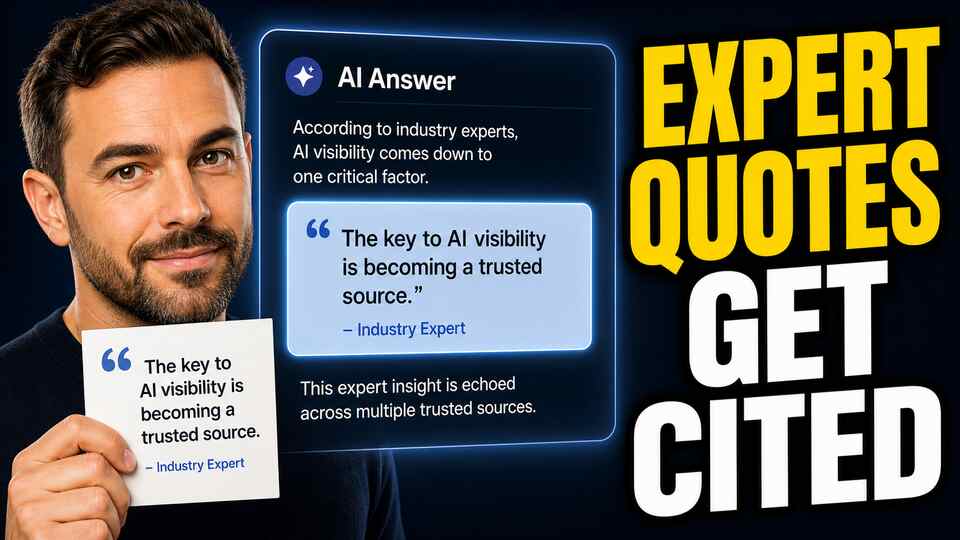
One of the underappreciated patterns in AI citation behavior is how heavily AI engines reach for content with named expert quotes inside it. Not paraphrased opinions. Not anonymous "industry experts say." Direct quotations, with the speaker's name, title, and affiliation right next to the words. AI models are trained to recognize quoted material as a structurally distinct kind of evidence, and they cite it differently than they cite ordinary prose.
If your content doesn't include expert quotes, you're missing one of the easiest GEO wins available. Here's how to source them, format them, and use them in a way that actually drives citations.
Why expert quotes get cited so reliably
AI models learn during training that quoted material represents established facts or attributable expert opinions. A sentence in quotation marks, followed by a named source, looks structurally different from surrounding prose, and the model treats it as a citation-worthy unit on its own, separate from the article that contains it.
This creates a useful feature for content creators. A well-formatted expert quote becomes its own quotable atom inside your article. The AI can extract just the quote, just the speaker's name and credentials, and just the surrounding context, and present that as an answer to a related user prompt. Your article becomes the citation source not because it's well-written, but because it contains a discrete block of evidence the AI can reuse.
This is also why expert quotes work as a credibility signal. AI engines that detect named, credentialed quoted sources score the containing article as more authoritative. Articles with three or four well-structured expert quotes routinely outperform otherwise-equivalent articles without them, sometimes by a wide margin.
Source quotes from real experts, not generic "experts say"
The single biggest mistake in expert-quote usage is fake or anonymous expertise. "Experts say AI search will reshape SEO" is not a quote. It's a rhetorical device with no extractable value. AI engines ignore it. So do thoughtful readers.
The discipline is to source real, named, credentialed people. Three approaches work:
- Interview subject matter experts directly. Reach out to industry practitioners, academics, or thought leaders in your space and ask them three or four questions for an article you're writing. Most will say yes, especially if you offer to link back to their work. A 15-minute call produces multiple usable quotes.
- Pull quotations from published interviews, research papers, or official statements. If a direct interview isn't feasible, find existing on-the-record statements from credible figures and quote them with proper attribution and a link to the original source.
- Quote internal experts from your own team. Your CEO, head of engineering, head of customer success, named experts inside your company are valid sources, especially when they have subject-matter authority. Internal expert quotes work as long as they're genuinely from a real person with real credentials, not a marketing team's invention.
Whichever approach you use, the rule is the same: real names, real titles, real credentials. No generic "experts" or anonymous "industry insiders."
Format quotes for AI extraction
The structural format that maximizes citation rate looks like this:
"Pages with expert quotes earn 41% more AI citations than pages without them, because the quoted material gives engines a discrete unit they can extract and attribute," said Dr. Maria Hernandez, head of AI research at Acme Labs.
Notice the structure:
- The quote itself in quotation marks, containing a specific claim (ideally with a number)
- "Said" as the attribution verb (the most extractable verb for quote attribution)
- Full name of the speaker
- Job title and affiliation immediately after the name
That format gives the AI extractor everything it needs in one block: a claim, a speaker, a title, and an affiliation. The AI can reuse the entire block as a complete piece of evidence, with full attribution, without needing to look at the rest of the article.
Avoid these common variations that hurt extraction:
- ❌ "Experts agree…" (no named speaker)
- ❌ "According to one source…" (vague attribution)
- ❌ Maria says: "The numbers are clear." (first-name only, no credentials)
- ❌ Quote without surrounding attribution at all
Keep it consistent. Every quote in your article should follow the same structure: opening quotation, attribution verb, full name, title, affiliation.
Pair quotes with contextual data
The strongest expert quotes don't stand alone, they're paired with supporting numbers or context that the AI can pull alongside the quote itself. Compare:
Weak:
"AI search is changing how people find information," said Maria Hernandez, head of research at Acme Labs.
Strong:
"AI search is changing how people find information," said Maria Hernandez, head of research at Acme Labs. "Our latest study found that 38% of users now start with ChatGPT instead of Google for product research, up from 11% just 18 months ago."
The strong version gives the AI extractor a complete block: an expert claim, a study reference, a specific number, a comparative trend. All of that can be pulled together as a single citation. The weak version provides nothing concrete the AI can use.
The pattern: expert claim → data point → comparative context. Three sentences, one quote, complete extractable evidence.
Quote the right kind of person
Not all expert sources are equally citable. The hierarchy AI engines roughly follow:
- Academic researchers with publications in their field
- Senior practitioners at well-known companies (CTO of Stripe, VP Engineering at Notion)
- Authors of well-cited public studies or reports
- Founders of relevant startups in the category
- Independent consultants and analysts with public bodies of work
The lower you go on this list, the harder it is to get a quote weighted as authoritative. The good news: combining one or two top-tier sources with two or three mid-tier sources in the same article creates a credibility composite that performs nearly as well as a top-tier-only article, while being far easier to source.
Use quotes to mark your strongest claims
Inside any article, the writer's voice has limited authority. The expert's voice has more. The strategic use of expert quotes is to put your most important claims into the experts' mouths, where they carry the credibility weight your own byline can't.
For each major claim in your article, ask: would this be more powerful as the writer's assertion, or as a direct quote from a named source? If the claim is controversial, novel, or central to your argument, attribute it to an expert. If the claim is obvious or supporting, the writer's voice is fine.
This isn't dishonest, it's standard editorial practice in journalism. The difference is that you're now using it deliberately as a GEO tactic, not just as a stylistic convention.
Always link to the source
Every expert quote should link to the source the quote came from, the person's bio page, the published interview, the research paper, the company website. The link does two things:
- Verifies the quote for any reader who wants to check it. AI engines weight verifiable quotes more heavily than unverifiable ones.
- Connects the entity for the AI's Knowledge Graph. Linking to Maria Hernandez's bio at Acme Labs reinforces that the quoted speaker is the entity Wikidata identifies as Maria Hernandez (Acme Labs). That entity disambiguation is itself a citation signal.
Skipping the link is the most common formatting mistake. It looks polished to a copyeditor but strips out signal AI engines actively look for.
Three to five quotes per long-form article
The right density for a 1,500-2,000 word article is about 3-5 quoted blocks. Fewer than 3 and the article doesn't get the credibility lift. More than 5 and the quotes start to drown out the writer's analysis, making the article feel like a quote-stuffed press release.
Distribute the quotes across the article: one near the top, two or three in the middle sections, one near the conclusion. Each quote should be tied to a specific claim or section, not floating decoratively in the margins.
Use schema to mark up the speakers
For maximum AI extractability, mark up the quoted speakers with Person schema in JSON-LD. The Person schema entries should include name, jobTitle, affiliation, and (critically) sameAs links to the speaker's authoritative profiles, LinkedIn, Wikipedia, personal site, Google Scholar.
This tells AI engines explicitly that the quoted speaker is a real, identifiable person with verifiable credentials. It's the same entity disambiguation logic that powers definition pages, applied to the experts you quote.
Quotes are infrastructure, not decoration
The shift in mindset that makes this tactic work is treating expert quotes as load-bearing infrastructure rather than decorative quote marks scattered through the text. Each quote is a discrete citation candidate. Each quote carries credibility the writer's voice doesn't. Each quote is a hook AI engines latch onto when constructing answers.
Source real experts. Format the quotes consistently. Pair them with data. Link to the sources. Mark up the speakers with schema. Distribute three to five per article. That's the format that turns expert quotes from a stylistic flourish into a measurable citation driver, and it's the cheapest credibility lift available to anyone willing to send a few interview requests.