Entity-Rich Content: The Real Foundation of AI Visibility
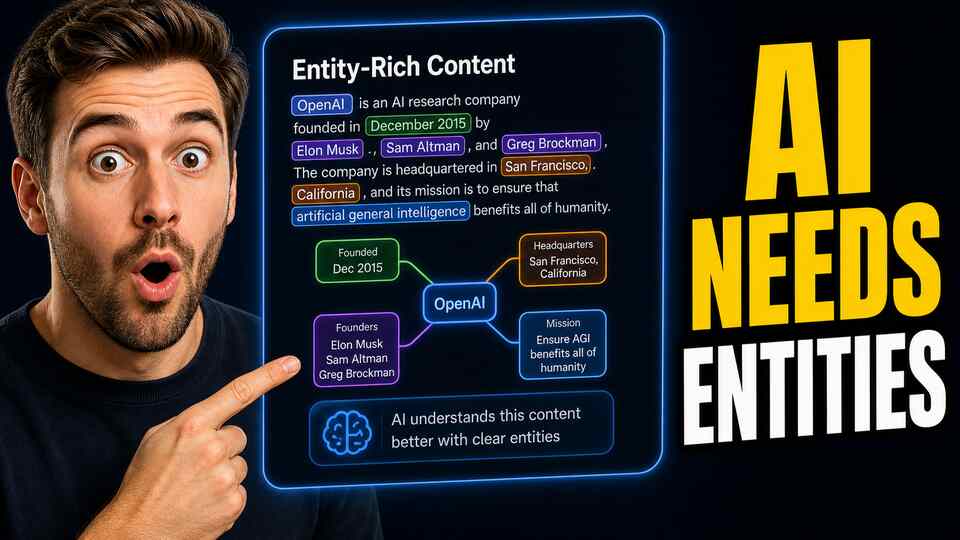
Most GEO advice talks about content. Format. Schema. Publishing cadence. All of that matters. But underneath all of it sits a quieter, more foundational concept that almost nobody writes about plainly: entities. If your content isn't entity-rich, none of the other GEO tactics work as well as they should. If it is, almost every other tactic compounds.
This is the part of GEO that feels abstract until it suddenly explains why two visually identical pages get cited at completely different rates. Here's what entities actually are, why they're foundational, and how to build entity-rich content that AI engines reliably find and reuse.
What "entity" actually means
An entity is a named thing, a person, a place, a product, a company, a concept, that exists independently in the world and that AI systems can identify, disambiguate, and connect to other entities. Search engines treat entities as the atomic units of meaning in their Knowledge Graphs. They're distinct from keywords. Where keyword optimization tried to match strings of text to queries, entity optimization tries to map your content to the same canonical things AI systems already know about.
"Notion" is an entity. "Productivity software" is a concept that contains many entities. "Founded in 2013 by Ivan Zhao" is a set of relationships between entities (Notion → founded → 2013, Notion → founded by → Ivan Zhao). When AI engines construct answers, they reach for entities and entity relationships first, and the surrounding prose second.
If your content names the right entities clearly, with the right relationships, you're describing something the AI system can map onto its existing model of the world. If your content uses vague references, "the platform," "this tool," "the company", you're describing nothing. The AI has nothing to anchor on.
Three core pillars of entity-rich content
The discipline of entity-first content optimization rests on three principles that reinforce each other:
1. Precision. Every page should be unambiguously about one canonical entity. The title, H1, opening paragraph, and schema markup should all align around the same named thing. A page about "Notion" should not also be about "Coda" or "Obsidian" except in clearly marked comparison sections, and even then, the canonical entity for the page should be obvious.
The failure mode is fragmentation. When titles, headings, and schema disagree, when the H1 says "best note-taking apps," the schema says "Article about Notion," and the body wanders through five different products, the AI system can't decide what the page is about. The entity signal fragments across multiple weaker matches, and the page underperforms compared to a precision-focused alternative.
2. Coverage. Your site as a whole should represent the entities that define your niche. Think of it as building a mini Knowledge Graph where each node (page) reinforces your overall topical authority. If you write about CRMs but only cover three of the twelve major CRM products, your topical coverage is thin and AI systems won't trust you as a category authority. If you cover all twelve, with depth, your site becomes a reference resource that the AI returns to repeatedly.
3. Connectivity. Entities gain strength through their connections. Internal links that explicitly connect related entities, schema relationships that link organizations to people to products, and cross-references that show how concepts relate to each other, all of these strengthen the AI system's mental model of how your content fits together. A page in isolation is a weak signal. A page in a well-linked entity network is a strong one.
Identify the canonical entity before you write the page
The biggest mistake most writers make is starting with a topic instead of an entity. "I want to write about marketing automation" is a topic. "I want to write about HubSpot's marketing automation features" is an entity-anchored page. The first leads to vague, fragmented content. The second leads to precise, citable content.
Before drafting any major page, name the canonical entity it's about. Write that entity name down at the top of the brief. Then make sure:
- The page title contains the entity name
- The H1 contains the entity name
- The first sentence contains the entity name
- The schema markup explicitly identifies the entity (Organization, Product, Person, etc.) with all required properties filled in
- Every section that talks about the entity uses the full canonical name, not a pronoun or vague reference
Consistency across these signals tells the AI engine, unambiguously, "this page is about [entity X]." Inconsistency confuses the pipeline and your entity gets fragmented across multiple weaker signals.
Use full names, not pronouns or shorthand
One of the simplest entity-rich writing rules, and the one most writers find hardest to follow, is using the full canonical name of an entity every time, instead of pronouns or generic shorthand.
Compare:
- ❌ "The platform offers a free tier. It includes up to 5 users. The company recently raised $200M to expand it."
- ✅ "Notion offers a free tier with up to 5 users. Notion recently raised $200M to expand the platform."
The first version reads as fluent prose to a human, but to an AI extractor it's almost useless. Three sentences, none of which are clearly about a named entity in isolation. The second version repeats the entity name twice, which is structurally clunky to a copyeditor but exactly what AI parsers want. Each sentence is independently extractable. Each sentence anchors back to the canonical entity.
This rule fights every habit a journalist or marketer has been trained into. It's also one of the highest-impact changes you can make to existing content. Pages where pronouns and shorthand are systematically replaced with entity names see noticeable lifts in citation rates, sometimes dramatic ones.
Structure entity relationships explicitly
Entity-rich content names not just the entities themselves, but the relationships between them. Instead of "Notion is a productivity tool," write "Notion is a workspace tool that combines documents, databases, and project tracking, founded in 2013 by Ivan Zhao and headquartered in San Francisco."
That second version contains six entity relationships in one sentence:
- Notion → is a → workspace tool
- Notion → combines → documents
- Notion → combines → databases
- Notion → combines → project tracking
- Notion → founded by → Ivan Zhao
- Notion → headquartered in → San Francisco
Every one of those relationships is a hook for an AI extractor answering a related question. "When was Notion founded?" "Who founded Notion?" "Where is Notion headquartered?" "What does Notion do?" One dense sentence answers all of them, because all of them are explicit entity relationships.
Use schema to make entities machine-readable
Schema markup is the way you tell AI engines explicitly which entities are on your page. The schema types that matter most for entity-rich content are:
- Organization, for company entities, with name, founding date, founder, headquarters, sameAs links to social profiles
- Person, for individual entities, with name, jobTitle, worksFor, sameAs to authoritative profiles
- Product, for product entities, with name, manufacturer, description, brand
- Place, for location entities
- DefinedTerm, for concept entities (especially in glossaries)
The single most important field across all of these is sameAs, which links your entity to its canonical identifier on Wikipedia, Wikidata, official websites, and authoritative profiles. A sameAs link to Wikidata is essentially a declaration that "this is the entity Wikidata identifies as Q123456", and it's the strongest possible signal that you're talking about the same canonical thing the AI system already knows.
Most schema implementations skip sameAs. Don't. It's the field that does the most work for the least effort.
Build internal links between related entities
Entity-rich content lives in an entity network. When you mention an entity that has its own page on your site, a product, a person, a concept, link to it. Link descriptively, with the entity name as the anchor text. Link reciprocally, so related pages reinforce each other's authority.
This is how you build the mini Knowledge Graph that lifts your whole site's topical authority. A single page about a product is a node. A network of interlinked pages, product → competitors → category → industry → use cases, is a graph. AI systems crawl graphs more readily than isolated pages, and they treat the graph as a higher-authority source than any individual page within it.
Cover the entities that define your niche
The coverage pillar means asking, for any niche you serve: what are the 30-50 entities that define this category, and which of them does my site cover? If your site covers 5 of them, you have a content gap. If your site covers 45 of them, you're a category authority.
The exercise to run: list every major brand, every major product, every major person, every major concept, and every major event in your niche. Map each one to the page on your site that covers it. The empty cells are your content roadmap, entities you should cover next, in order of importance.
Entities are the foundation, not the polish
The mistake most teams make is treating entity optimization as something you bolt onto content after writing it. It isn't. Entity-rich content starts with the entity choice, names it precisely throughout, structures the relationships explicitly, marks them up with schema, and links them into a wider network. Format, length, and structure all sit on top of the entity layer.
Get the entity layer right and the rest of your GEO work compounds. Get it wrong and the rest of your work has nothing to anchor to. AI engines don't index pages, they index entities. Build for the entities, not just the keywords. The citations follow.