Citation Rate Benchmarks: Which Brands Get Cited Most by AI
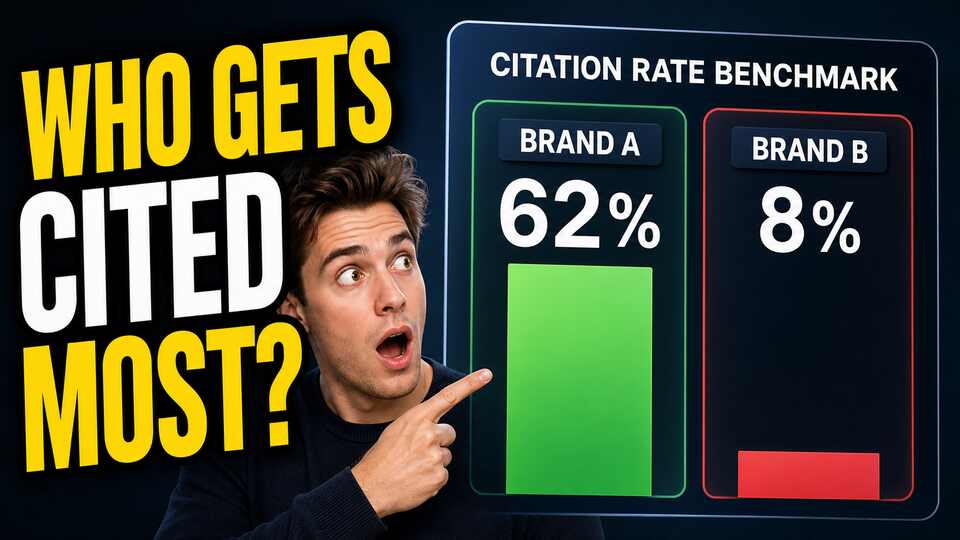
Not all brands are equal in the eyes of AI. Two competitors in the same category, selling to the same buyers, can have citation rates that differ by a factor of 30 or more. One brand shows up repeatedly across ChatGPT, Gemini, and Grok when users ask category questions. The other is invisible. The gap isn't random, it's driven by measurable factors, and it's widening as AI search becomes the dominant discovery channel for buyers who've already made up their minds before they open a vendor website.
BabyPenguin tracks brand mentions, citations, and sources across the major AI platforms. Looking at patterns from the llm_result_brands dataset, which logs citations across ChatGPT, Gemini, and Grok for thousands of tracked prompts, some clear benchmarks have emerged. This is the first time we're publishing those patterns publicly.
The 10–40× Citation Gap
The most striking finding in our dataset is the range of citation rates within the same product category. In competitive SaaS categories, project management, CRM, marketing automation, the most-cited brand typically receives between 10 and 40 times more citations than the median brand in the same space. This isn't a small edge. It's the difference between being part of the conversation and being completely absent from it.
This pattern holds across categories. In the SEO software space, a handful of names dominate nearly every AI-generated answer while dozens of legitimate competitors never appear. In the HR software category, the same three or four brands appear across platforms regardless of how the question is phrased. In cybersecurity tools, certain vendors are effectively synonymous with their category in AI responses.
The gap isn't simply a proxy for market share or ad spend. Several well-funded brands with large customer bases show relatively weak citation rates, while some smaller, more content-forward companies punch far above their revenue weight. What drives the difference is something more specific.
Which Industries Get Cited Most
SaaS tools and marketing software consistently dominate AI citation counts across all platforms we track. This isn't surprising: these categories have produced enormous volumes of comparison content, review pages, and third-party analysis that AI models were trained on. When a user asks "what's the best CRM for a startup," the AI has thousands of data points to draw from. The brands that show up most in that training data, and in the live web content that retrieval-augmented AI systems index, are the ones that get cited.
Categories with high citation density include:
- Marketing and analytics software, SEO tools, email platforms, social media management, attribution tools
- Developer tools and infrastructure, cloud platforms, monitoring tools, CI/CD platforms, API tools
- Sales and CRM software, particularly in "best CRM for [persona]" style prompts
- Productivity and project management, especially in prompts about team workflows
- Cybersecurity and compliance tools, AI answers in this space are highly citation-dense
Categories with lower citation density tend to be those with fewer independent review sources, more fragmented buyer education content, or where AI models express uncertainty and hedge with fewer brand recommendations. Local services, highly regulated industries, and niche manufacturing categories all show lower citation volumes per prompt.
This matches what Yext found in their analysis of 6.8 million citations across 1.6 million queries: certain brand categories are structurally over-represented in AI outputs relative to their web presence, simply because they've accumulated more signals that AI systems trust.
Which Platforms Cite Brands Most
Not all AI platforms behave identically when it comes to brand citation. Our tracking data shows meaningful differences in citation density by platform.
Perplexity consistently cites the most brands per response. Its retrieval-augmented architecture fetches live sources and surfaces them as explicit citations, every response comes with a list of attributed sources. Brands appear not just in the answer text but in the citation sidebar. For marketers tracking AI share of voice, Perplexity is where brand mentions are most measurable and most granular.
ChatGPT (especially in its default mode without web browsing) is more conservative about naming specific brands. It tends to describe categories, explain criteria, and then name a short list of well-known options rather than citing a long tail of tools. Citation rates in ChatGPT are lower per response, but the brands that do get mentioned have extremely high visibility, appearing in the top slot of the most common evaluation queries.
Gemini sits between the two. It cites brands with moderate frequency, tends to pull from Google's own index signals, and shows a measurable bias toward brands that rank well in traditional search. Brands with strong SEO foundations tend to do better in Gemini than in other platforms. Our data on how Gemini surfaces brands is covered in more depth in our dedicated Gemini sourcing guide.
Grok (X's AI) shows the most volatility in our dataset, citation patterns are less consistent across similar prompts, which may reflect its ongoing development and training updates.
What Determines Citation Frequency
Three factors consistently predict whether a brand will be cited frequently or rarely in AI responses:
1. Brand authority and entity recognition
AI models have an internal representation of how well-known and trustworthy a brand is. This is sometimes called entity authority, the degree to which a brand name is a recognized, unambiguous entity in the model's knowledge. Brands that appear consistently across many sources, that have Wikipedia entries, that are covered in industry press, and that have strong structured data signals tend to have higher entity recognition. This makes the model more likely to surface them as answers. We cover the mechanics of entity consistency and knowledge graph signals in detail if you want to dig into this further.
2. Third-party coverage and review depth
AI models are heavily influenced by what independent sources say about a brand. Review sites, comparison articles, analyst reports, and community discussions (including Reddit threads and forum posts) all contribute signal. A Princeton research paper on Generative Engine Optimization identified third-party source coverage as one of the strongest predictors of citation frequency, brands mentioned across many independent sites get cited far more than brands whose information primarily lives on their own domains.
3. Content structure and answer-readiness
AI models prefer content that's structured to answer specific questions. Brands whose content includes concise definitions, feature comparisons, use-case explanations, and direct answers to evaluation queries are more likely to get extracted and cited. Content that buries its key points in narrative prose, or that requires significant reading to extract the core answer, performs worse. This is why answer-first writing has become a core technique in Generative Engine Optimization.
The Citation Leaderboard Concept
One of the most useful mental models for AI visibility is what we call the citation leaderboard, the implicit ranking of brands within a category as AI systems experience it. Unlike a Google search results page, this ranking is invisible. There's no page-one result you can check. You have to actively prompt AI models across a representative set of queries and track which brands appear, how often, and in what framing.
In our dataset, citation leaderboards within categories tend to show a power-law distribution: the top brand in a category might receive 35–45% of all citations across tracked prompts, the second-place brand gets 15–20%, the third gets 8–12%, and everything below that drops into single digits. The long tail of brands in a category collectively share the remaining crumbs.
This distribution has direct revenue implications. Buyers who use AI as a research tool, asking ChatGPT "what's the best [product type] for my situation", are selecting from the brands that appear in that leaderboard. If your brand is invisible, you're not in the consideration set before the buyer ever visits a vendor website.
A Semrush study analyzing 230,000 prompts and over 100 million citations showed that citation distribution across domains follows the same pattern at the domain level: a small number of domains capture the vast majority of AI citations. The same concentration applies at the brand level within categories.
How to Benchmark Your Own Citation Rate
Tracking your own citation rate requires a systematic approach. Ad-hoc testing, typing a few prompts into ChatGPT and seeing if your brand appears, is not reliable enough to make strategic decisions from. Citation rates vary by prompt phrasing, by the day, and by platform. You need a consistent prompt library run repeatedly across platforms to get meaningful data.
The core methodology looks like this:
- Build a prompt library covering your category's most common evaluation queries, "best [product type] for [use case]," "[product type] comparison," "[your category] tools," and similar.
- Run those prompts across ChatGPT, Gemini, and Grok on a regular schedule.
- Log every brand mentioned in every response, noting position and context.
- Calculate your citation rate (mentions ÷ total prompts run) and compare it to competitors.
- Track changes over time as you publish new content and earn new third-party coverage.
This is exactly what BabyPenguin automates. Rather than manually running hundreds of prompts and building spreadsheets to track the results, the platform runs the prompts, extracts brand mentions, and shows you your citation rate across platforms over time, alongside your competitors' citation rates. You can see how to track brand mentions in ChatGPT and how to track AI citations over time for more on the methodology.
What Moves Citation Rates
The good news is that citation rates aren't fixed. Brands that invest in third-party coverage, getting mentioned in industry publications, earning review site placements, participating authentically in community discussions, see measurable citation rate improvements over 60–90 day windows in our data.
Content structure changes can also move citation rates. When brands publish content that's more directly answer-ready, definitions, comparisons, use-case breakdowns, original data, AI models are more likely to extract and cite it. Original research in particular multiplies AI visibility because it gives AI models a unique data point they can't get elsewhere.
Technical signals matter less than many marketers assume. Schema markup helps at the margin, as does a clean llms.txt file, but these are small factors compared to the content quality and third-party coverage signals that actually drive citation frequency.
The brands winning the AI citation leaderboard in their categories right now built that position over months of consistent effort. The gap between them and their competitors is already large, and it will keep growing as AI search adoption increases and the models become more confident in their category knowledge. Understanding where you stand is the first step.
If you want to see your brand's citation rate across ChatGPT, Gemini, and Grok, and benchmark it against competitors, BabyPenguin tracks this automatically. You get a real-time view of your AI share of voice, which prompts you appear in, and how your position is changing over time.