Does ChatGPT Recommend Your App When People Ask for the Best Tool in Your Category?
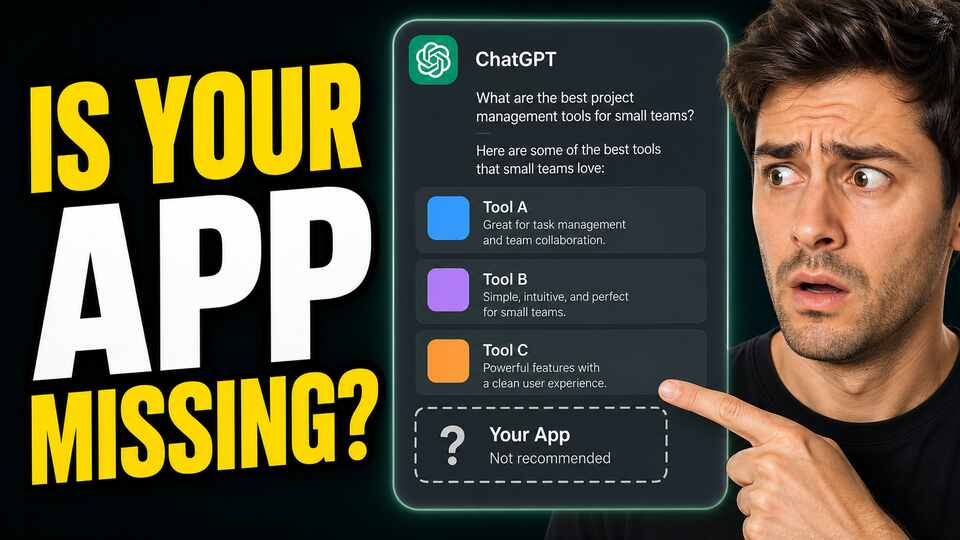
You open ChatGPT and type: "What's the best tool for [your category]?" Your product doesn't appear. Not even close to the top. You've been building for two years, you have real customers, and yet the AI that millions of people now use to make buying decisions has no idea you exist.
This is one of the most common and disorienting moments product marketers are having right now. Here's why it happens, and what you can actually do about it.
How ChatGPT Decides What to Recommend
ChatGPT doesn't have a database of "approved tools." It generates recommendations based on patterns learned from text during training, supplemented in some cases by browsing or retrieval. That training data includes product documentation, comparison articles, Reddit threads, Hacker News discussions, GitHub repositories, review sites like G2 and Capterra, and editorial content from tech publications.
The model isn't ranking products by quality. It's surfacing names that appeared frequently, in authoritative sources, in contexts that match the user's query. If your product name appeared 50 times in training data and a competitor's appeared 5,000 times, the math is not in your favor, regardless of which product is actually better.
There's also the query-matching problem. ChatGPT is very sensitive to how a question is framed. "Best project management tool for remote teams" pulls different results than "project management software for async work." Your product might appear for one phrasing and be completely absent from another. This is why testing a single query tells you almost nothing.
Why Good Products Get Skipped
The most common reason a product doesn't show up for category queries is simple: there isn't enough third-party content about it in the right places.
Your own website and product docs matter, but they're just one signal. What LLMs weigh more heavily is what others say about you. That means:
- Independent comparison articles ("X vs Y vs Z")
- Reviews on sites like G2, Capterra, Product Hunt, and Trustpilot
- Community discussions on Reddit, Hacker News, and Discord servers
- Mentions in newsletters and industry blogs
- Tutorials, case studies, or integrations written by third parties
If most of your content ecosystem is your own marketing copy, ChatGPT sees you as a source talking about itself. That's a weak signal. You need independent sources talking about your product in the same language your customers use when asking for recommendations.
Another factor: specificity. Generic category pages ("We're the best CRM") don't help. Content that ties your product to specific use cases, industries, or job titles is more likely to match the specific queries users actually type.
What You Can Do to Actually Appear
The goal is to become well-represented across the content sources that LLMs draw from. This isn't a single tactic. It's a compounding content strategy.
Build your documentation properly. Your product's public-facing documentation should clearly define your use cases, who it's for, what problems it solves, and how it compares to alternatives. Vague positioning doesn't help the model understand what you do well enough to recommend you for the right queries. Specific, detailed, well-structured docs are a foundation.
Earn reviews on third-party platforms. G2, Capterra, Trustpilot, and Product Hunt reviews are indexed and carry weight. A product with 200 genuine reviews across these platforms has a much stronger signal than a product with a great website and 12 reviews. Ask customers. Make it easy. Follow up.
Get into comparison content. Articles that compare tools in your category are some of the highest-value assets for LLM visibility. If you're not in those roundups, you need to be. That means pitching journalists, offering review access to bloggers and newsletter writers, and making sure your product is easy to evaluate quickly.
Show up in communities. Reddit, Hacker News, and niche Slack and Discord communities are heavily represented in LLM training data. When people genuinely recommend your product in these spaces, that creates durable signal. You can't fake community adoption, but you can build it intentionally through founder participation, transparent communication, and solving real problems publicly.
Create use-case-specific content. If your product serves marketing teams, legal departments, and freelancers, write dedicated content for each. "Best tool for freelance project tracking" is a very different query from "best project management software for agencies." You need to be present for both.
For a deeper dive on the broader strategy, the generative engine optimization guide covers how to build AI visibility systematically across all the major engines, not just ChatGPT.
The Tracking Problem
Here's where most teams get stuck. They publish more content, earn more reviews, get into a few comparison articles, and then have no idea if any of it is working. They test a couple of queries manually every few weeks and call it "monitoring." That's not monitoring. That's guessing.
The challenge is that ChatGPT's recommendations aren't static. They vary by query phrasing, by model version, by context, and over time as the underlying model changes. A manual spot-check tells you almost nothing about your actual visibility across the range of queries your potential customers are typing.
This is exactly the problem BabyPenguin was built to solve. It tracks your brand's visibility across ChatGPT, Gemini, Grok, and other AI engines at the prompt level, meaning you can see exactly which query phrasings are returning your brand and which aren't. You can compare your mention rate against specific competitors. You can see which citation sources are being referenced when your product does appear.
When you publish a new comparison article or run a review campaign, BabyPenguin shows you whether those efforts are actually moving your mention rate. Without that feedback loop, you're optimizing blind.
Set Realistic Expectations
Building AI visibility is a slow process. The content ecosystem that feeds LLM recommendations takes months to build, and model training cycles mean that new content doesn't translate to new mentions overnight. Some estimates put training data cutoffs at 6 to 12 months behind the current model release.
That's not an argument to wait. It's an argument to start now, track consistently, and build compounding content signals over time. The brands that start this work today will have a significant advantage in 12 months when their competitors finally notice the problem.
If you're not showing up when people ask ChatGPT about your category, it's almost certainly a content ecosystem problem, not a product problem. The good news is that content ecosystems can be built. The key is knowing whether your efforts are working, and for that, you need data, not gut checks.
Start tracking your AI visibility with BabyPenguin and get a clear picture of where you stand across every major AI engine from day one.