How to Improve How AI Answers Branded Prompts About You
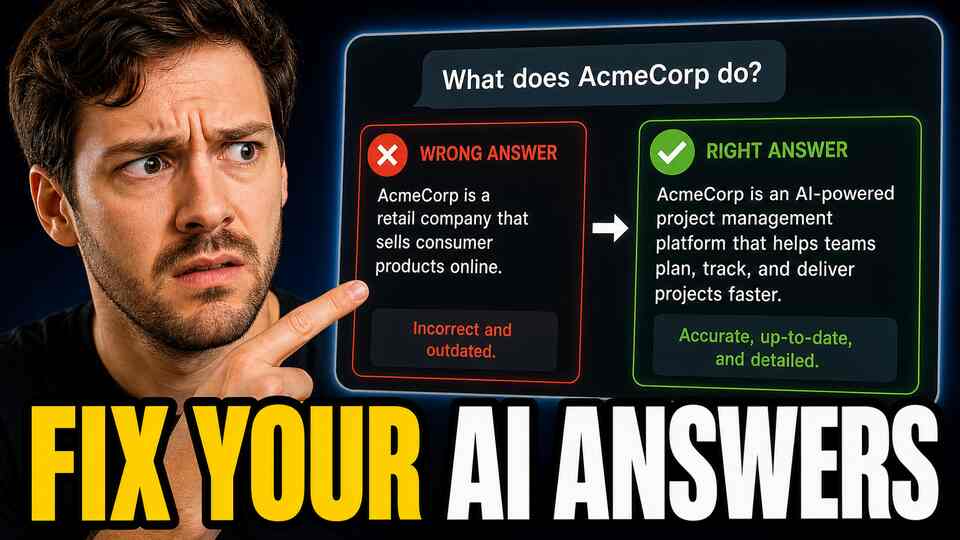
"What is [your company]?" is the question every founder secretly hopes the AI will get right. It usually doesn't. Or it does, partially. Or it confuses you with a competitor. Or it cites a four-year-old TechCrunch article as the canonical description of what your company does today, and you find out about it when a customer quotes the wrong description back to you on a sales call.
Improving how AI engines answer branded prompts is one of the most directly controllable forms of AI visibility, because the entities being asked about are entities you control. Here's how to do it properly.
Why branded prompts deserve their own optimization track
Most GEO advice focuses on category and comparison prompts ("best CRM," "X vs Y"). Branded prompts, "what is [your brand]?", "is [your brand] legit?", "who founded [your brand]?", "is [your brand] better than [competitor]?", behave differently and deserve their own playbook.
First, the user is already aware of you. They're not in discovery mode, they're in evaluation mode. The AI's answer is the deciding factor for whether they take the next step. Second, the AI's answer is almost entirely determined by the structured information it has about your brand entity, not by topic-level content or category authority. Branded prompts reward entity hygiene more than they reward content marketing.
The "comprehension budget" concept
One Search Engine Land article on entity authority for AI search introduces a useful concept: AI systems operate on a "comprehension budget", the expensive GPU cycles needed to understand content during inference. When a brand has strong entity authority through structured data, it reduces that computational burden. The article puts the implication directly: "the most efficient entity is the one most likely to be cited."
The corollary is uncomfortable: if your brand requires the AI to do expensive inference work to figure out what you are (because your data is fragmented, contradictory, or thin), the AI is more likely to hallucinate, omit you, or get the answer wrong. Inconsistent brand data forces AI into costly inference loops, and the cost shows up in answer quality.
This is why entity hygiene matters more for branded prompts than for any other prompt type. The cleaner your entity signals, the cheaper the AI's comprehension cost, the more confident and accurate its branded answers become.
Step 1: Eliminate entity drift
The first step is the unglamorous one: eliminate entity drift by auditing that your website data matches Google Business Profile, LinkedIn, Crunchbase, Wikipedia, and other authoritative sources.
The audit:
- Pull every fact about your brand from your homepage, About page, and product pages
- Compare each fact against your external profiles (Google Business Profile, LinkedIn company page, Crunchbase, Wikipedia, Wikidata)
- Flag every inconsistency, different founder names, different founding years, different addresses, different taglines, different product descriptions
- Pick canonical versions of each fact
- Update all the outliers to match the canonical versions
Most companies have at least 5-10 inconsistencies after a real audit. Some have dozens. Each one is a small reason for AI engines to second-guess themselves when answering questions about you. Fixing them is unglamorous, time-consuming, and one of the highest-leverage things you can do for branded prompt accuracy.
Step 2: Use precise Schema.org types beyond generic tags
The next step is moving from generic schema markup to precise, deeply nested entity definitions. The SEL guide is direct: use precise Schema.org types beyond generic tags, implement deep nesting so AI understands product-organization-brand relationships.
This means:
- Organization schema with all required fields populated, name, description, founding date, founders (linked to Person nodes), headquarters (linked to PostalAddress), logo, contact information
- Person schema for your founders, executives, and notable team members, with worksFor linking back to the Organization
- Product schema for your products, with brand linking back to the Organization
- The whole graph connected via @id and @graph references, so AI parsers can walk from one entity to another and end up with a complete picture of your brand
Deep nesting is the key word. A flat Organization schema with no connections to anything else is much weaker than the same schema connected to Person, Product, and Place nodes through explicit references. The graph is what AI engines parse most cleanly.
Step 3: Link to trusted external sources via sameAs
The single most underused field in brand schema is sameAs, the property that lets you explicitly link your entity to its authoritative external profiles. Wikipedia. Wikidata. LinkedIn. Crunchbase. GitHub. Twitter/X. Your official social profiles. Your Bloomberg or Forbes profile if applicable.
The SEL guide highlights this directly: link to trusted external sources using sameAs properties pointing to Wikipedia, Wikidata, or LinkedIn to signal authority. Each sameAs link is a declaration: "the entity in this schema is the same entity those authoritative sources recognize." It's the strongest possible disambiguation signal you can give an AI engine.
A complete Organization schema for branded prompt optimization should have at least 4-6 sameAs links to authoritative external profiles. Most brand schemas have zero. Adding them is a 30-minute job and a substantial improvement.
Step 4: Make sure your Wikipedia and Wikidata entries are accurate
For branded prompts specifically, Wikipedia and Wikidata are disproportionately important. AI engines treat Wikipedia as one of the most authoritative sources for "what is X?" type questions, and they treat Wikidata as the canonical machine-readable index of named entities. If your brand has a Wikipedia entry, that entry is probably the canonical source AI engines reach for when answering about you.
The work to do:
- Audit your Wikipedia entry for accuracy, completeness, and freshness. Don't edit it yourself if you're affiliated with the brand, that violates Wikipedia's policies. Do flag inaccuracies to the talk page or work with a Wikipedia editor.
- Audit your Wikidata entry for the same. Wikidata edits are more permissive and are explicitly machine-readable. Make sure your founding date, founders, headquarters, and key product information are correct.
- If you don't have a Wikipedia entry, evaluate whether your brand meets the notability standards. If yes, work with experienced editors to create one. If no, focus on Wikidata, Crunchbase, and your own brand pages instead.
This is one of the highest-leverage external entity investments you can make for branded prompt accuracy.
Step 5: Maintain a complete, current LinkedIn company page
LinkedIn is disproportionately weighted in branded prompts because it's owned by Microsoft, and therefore directly integrated into Copilot's understanding of business entities. A complete, current LinkedIn company page with active updates, employee profiles, and recent posts gives AI engines a strong signal about your brand's current state.
The fields to keep current:
- Company description (matching your canonical brand description)
- Industry and specialties
- Headquarters location
- Company size (employee count)
- Founded year
- Website URL
- Recent posts demonstrating active operation
- Employee profiles linked to the company
This is one of the cheapest entity investments and one of the most under-maintained. Audit your LinkedIn company page quarterly.
Step 6: Implement schema actions for transactional intent
The SEL article includes one forward-looking recommendation: implement schema actions (BuyAction, ReserveAction) so AI agents can execute transactions around your brand. Schema actions tell AI engines what users can do with your brand, not just what facts about it exist.
For branded prompts specifically, this matters when users ask things like "where can I buy [your product]?" or "how do I sign up for [your service]?" Schema actions give the AI a direct, machine-readable answer to these prompts.
Implement the actions most relevant to your business. For SaaS: SubscribeAction for signups. For ecommerce: BuyAction for purchases. For services: ReserveAction or ContactAction. Each one is an incremental improvement to how AI engines handle action-oriented branded prompts.
Step 7: Operationalize validation and update propagation
The last step is the operational discipline that prevents entity drift from creeping back in. The SEL guide recommends "operationalize validation through automated schema checks and IndexNow to push updates in real time."
This means:
- Automated schema validation on every deployment, schema errors should be caught in CI before going live
- Linked data integrity checks, verifying that @id references resolve, sameAs links return 200s, and required fields are populated
- IndexNow integration for pushing brand data updates to search engines (and indirectly to AI engines) as soon as they happen
- Quarterly entity drift audits as a recurring calendar item, not a one-time project
Entity hygiene is an ongoing operational discipline, not a one-time setup. Teams that treat it that way maintain consistent, accurate branded answers. Teams that treat it as a project drift back into inconsistency within a few months.
Track branded prompt accuracy as a KPI
Beyond all the structural work, the metric that matters is whether the AI's branded answers about you are actually accurate. Build a tracking set of 20-30 branded prompts and run them through ChatGPT, Gemini, and Perplexity weekly:
- "What is [your brand]?"
- "Who founded [your brand]?"
- "What does [your brand] do?"
- "Where is [your brand] headquartered?"
- "How much does [your brand]'s product cost?"
- "Is [your brand] better than [competitor]?"
- "Is [your brand] legit?"
- "Who are [your brand]'s competitors?"
For each answer, score it on accuracy. Flag every inaccuracy. Investigate the source, usually an outdated Wikipedia entry, a stale third-party article, or a fragmented entity signal somewhere. Fix the source. Wait for the AI engines to refresh. Re-test.
The branded prompt playbook
Audit your entity data for drift. Fix every inconsistency. Implement deeply nested schema with @id references. Add sameAs links to your authoritative external profiles. Audit your Wikipedia and Wikidata entries. Maintain a current LinkedIn company page. Add schema actions for transactional intent. Operationalize validation as ongoing discipline. Track branded prompt accuracy weekly.
None of this is exotic. All of it is unglamorous entity hygiene. The brands that take it seriously start getting accurate, confident, well-cited branded answers within a few weeks of the structural work. The brands that don't keep watching the AI invent things about them, and wondering why the answers never get better.
Start with the audit first: How to Audit How AI Models Talk About Your Brand.