How to Structure Content So AI Models Actually Quote It
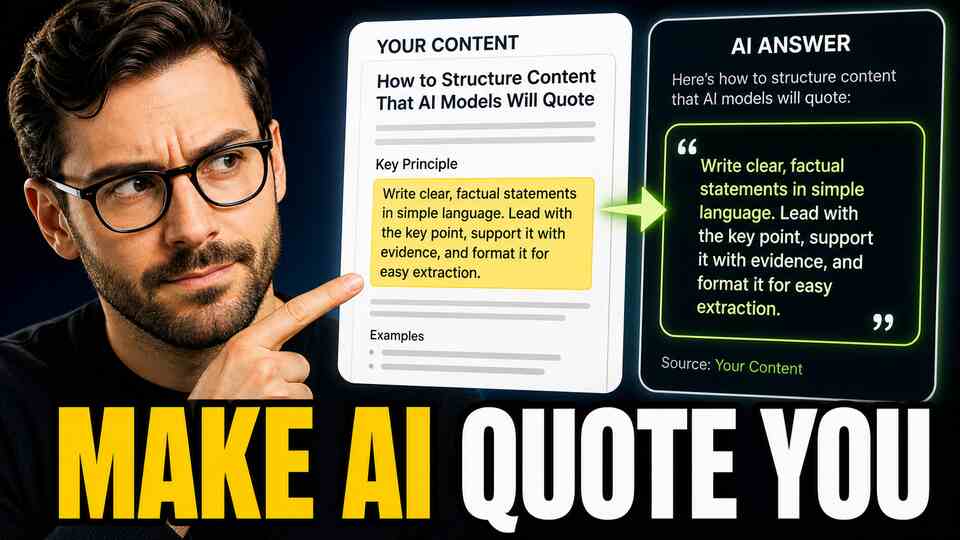
There's a strange thing about content that AI models cite: it doesn't look like the content most marketing teams are taught to write. It's shorter at the top. It's denser in the middle. It avoids links in exactly the places SEOs would put them. And it leads with a single, clean, quotable sentence that most editors would call "too blunt for a hook."
If you want to be quoted by AI, you have to write for the way AI extracts. That means understanding the structural patterns it favors and rebuilding your content around them.
Build every page around an "answer capsule"
The single most important structural element in AI-quoted content is what some researchers now call an answer capsule, a self-contained explanation of roughly 120-150 characters (about 20-25 words), placed immediately after a heading, that resolves the user's question in one direct sentence.
This isn't theoretical. An audit of nearly 2 million sessions found that 72.4% of cited blog posts contained an identifiable answer capsule. Posts without one almost never got quoted. The capsule is the structural feature AI engines latch onto when extracting an answer, without it, your content has nothing for the model to pull cleanly.
An answer capsule looks like this:
What is AI visibility?
AI visibility measures how often your brand appears in AI-generated answers across ChatGPT, Gemini, Perplexity, and similar engines.
Question heading. Single direct sentence under it. No qualifying clauses, no narrative ramp, no "in this article we'll explore." The answer is the first thing the user (and the model) sees, and it stands alone if it's pulled out of context.
Every major page on your site should have at least one of these capsules near the top. The most-cited pages have several, one for the headline question and additional ones under each major H2.
Don't put links inside your answer capsules
Here's a counterintuitive finding from the same dataset: more than nine in ten cited capsules contained no links at all. The breakdown is striking, about 91% had no links, 5.2% had only internal links, and 3.5% had only external links.
The pattern is clear. AI models prefer to extract concise, self-contained blocks of text without hyperlinks, because hyperlinks fragment the extraction and complicate attribution. If your editorial style is to drop links into every other sentence, your "best" paragraphs are quietly being passed over for less linked alternatives.
The fix isn't to strip links from your content entirely. Keep links out of the capsule itself. Put your links in the body paragraphs that follow the capsule, not inside the capsule. That single change can move a page from "never cited" to "frequently cited" without rewriting any of the actual content.
Lead with original data when you have it
The same study that identified answer capsules found that 52.2% of cited posts featured either original data or brand-owned insight. And the highest-performing configuration of all, 34.3% of cited posts, combined an answer capsule with original data.
That's the gold standard for AI-quotable content: a clean answer capsule, followed immediately by original numbers, percentages, or insights nobody else has. Models prefer this combination because it gives them both the answer they can quote and the credibility signal they need to trust it.
If you have first-party data, lead with it. "We analyzed 12,000 customer interactions and found that 68% of users…" beats "Many users tend to…" by orders of magnitude in citation outcomes. Vague directional language gets ignored. Specific percentages get quoted.
Use the formats AI engines extract most cleanly
Beyond capsules, the formatting choices that drive citation rates the most are:
- Numbered lists, extracted intact and cited frequently. One analysis found numbered lists make up roughly half of top citations.
- Tables, comparison and reference tables get cited at significantly higher rates than equivalent prose. A page with a clean table is several times more likely to be quoted than the same content written in paragraphs.
- Bullet points, for any content listing three or more related items, bullets outperform inline lists by a wide margin.
- Definition blocks, short, isolated paragraphs that define a single term, often introduced by a question heading.
- Comparison frames, explicit "X vs Y" structures with named criteria, scoring, or tradeoff statements.
The general rule: data in tables, lists in lists, definitions in definition blocks. Don't bury this kind of information in paragraphs. The prose forms that humans enjoy reading are the same forms AI engines find hardest to extract.
Front-load the answer in every section
Inside each section of the page, the rule is the same as for the page overall: lead with the answer. Place the response in the first 40-60 words of each section, so the AI extractor can grab it without parsing introductory context.
The fact-first structure that performs best looks like this: fact → interpretation → implication. Present the data or claim explicitly, then explain what it means, then explain what to do about it. Models prioritize what's explicit, measurable, and verifiable, and they cite the explicit parts before the interpretive ones. Make sure the explicit parts come first.
Implement schema markup that signals structure
The structural choices above only get half their potential value without schema markup that tells AI engines explicitly what they're looking at. The schema types that matter most for quote-friendly content are:
- Article for editorial pieces
- FAQPage for any page with question-and-answer sections (which is most of them)
- HowTo for step-by-step guides
- SpeakableSpecification for the answer capsules themselves, this directly signals to voice-and-AI surfaces which parts of the page are meant to be read aloud
The implementation rule: every FAQPage answer should be 70 words or fewer, with the direct answer in the first one or two sentences and supporting details in bullets after. This is the format both schema validators and AI extractors understand best.
Length matters more than people think
One persistent myth in GEO content advice is that AI engines prefer short content. The data says the opposite. Long-form, comprehensive content tends to get cited more, but only if it has the structural elements above. A 2,000-word article without an answer capsule will lose to a 600-word article with one. A 2,000-word article with multiple capsules, tables, and original data will outperform almost anything else in its category.
The right target for serious GEO content is roughly 2,000 words, structured around 5-8 question headings, each with its own answer capsule, with at least one comparison table or original data block per page. That's the format that compounds.
Refresh the structure of your existing content
If you already have a content library, the highest-leverage GEO move you can make isn't writing new content, it's restructuring what you already have. Most existing blog posts can be made dramatically more quotable with three small edits:
- Add a one-sentence answer capsule directly under the H1, before any narrative setup
- Add answer capsules under each H2
- Move any links currently inside those capsule sentences down into the body paragraphs that follow
No rewrites. No new research. No new content production. Just structural surgery on what's already published. Pages restructured this way often start getting cited within a few weeks of the change, because the underlying authority and topic relevance was always there, only the extraction-friendly format was missing.
Write for two readers
The mental shift that makes all of this work is recognizing that every page now has two audiences: the human reader, who values flow and storytelling and emotional hooks, and the AI extractor, which values clarity, density, and quotable structure.
You don't have to choose between them. Answer capsules are also great human openings. Tables are easier for humans to scan than dense paragraphs. Question headings help human readers navigate. Original data delights both audiences. The patterns AI engines reward turn out to be the patterns thoughtful readers also reward, just more disciplined than the conventions most marketing content currently follows.
Structure for the AI. The humans benefit too.