Long-Term Brand Building in the AI Era: New Metrics That Matter
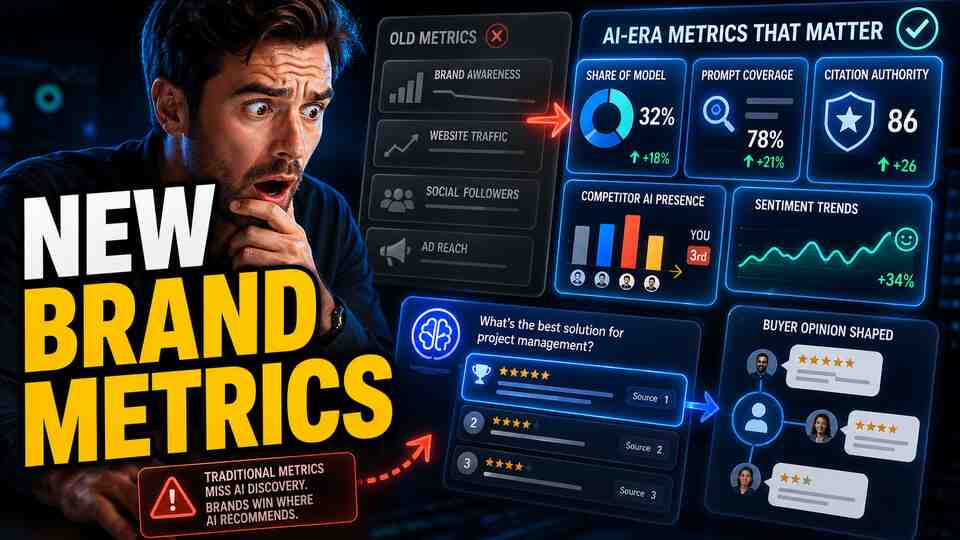
If you're building your 2025 marketing strategy and relying on the same brand metrics you used in 2022, you're measuring the wrong things. Not because the old metrics stopped mattering entirely, but because a significant and growing share of buyer discovery now happens in a channel those metrics don't capture at all.
AI assistants are part of how buyers research categories, evaluate options, and form opinions before they ever visit your website. The metrics that reflect your brand's strength in that channel don't exist in your analytics dashboard, your SEO tool, or your share-of-voice report. You need new metrics, and you need a clear view of what they mean for long-term brand building.
Where Traditional Brand Metrics Fall Short
The classic brand metrics are still relevant. Share of search (branded search volume relative to competitors) tells you something real about top-of-mind awareness. Domain authority and backlink profiles reflect content credibility. Share of voice in paid channels tells you about media investment relative to the category. These aren't useless.
But consider what they miss. A buyer asks Gemini: "What project management tools are best suited for creative agencies?" Gemini produces an answer. If your brand is mentioned prominently, you've influenced that buyer's consideration set. If your competitor is mentioned instead, they got that placement for free.
None of that interaction shows up in your share of search data. It doesn't show up in your domain authority. It won't appear in your paid share of voice. The traditional metrics are measuring your visibility in channels where buyers go after they've already formed opinions. AI is increasingly where opinions form in the first place.
Share of Model: The New Share of Voice
Share of Model is straightforward to define: out of all the AI-generated answers produced for queries in your category, how often does your brand appear? If there are 100 relevant prompts buyers might ask across a given month, and your brand shows up in 34 of them, your Share of Model is 34%. If your closest competitor shows up in 58, they're winning the AI channel decisively.
This metric has the same strategic value as share of voice in traditional media, with one important difference: you're not buying placements. You're earning them through content quality, citation authority, and the depth of your brand's representation on the web. That makes it a better signal of genuine brand strength, not just budget size.
Tracking Share of Model requires running consistent prompts across AI engines and recording the output. Tools that track AI citations give you this data systematically, so you have a real number to report rather than a gut feeling.
Prompt Coverage: Are You Present Across the Buyer Journey?
Share of Model is a top-line number. Prompt coverage adds the funnel dimension. The question isn't just how often you appear, but whether you appear at the right stages of the buyer journey.
Category-level awareness queries ("what is demand generation software") are where you build familiarity. Comparison queries ("Acme vs. Competitor B for enterprise teams") are where you win or lose consideration. High-intent evaluation queries ("best demand gen tool for a 20-person team with a $50k budget") are where you close the loop.
A brand with strong prompt coverage appears meaningfully at all three stages. Many brands appear at one or two but have significant gaps. A company with strong thought leadership content might dominate awareness-stage prompts but disappear on comparison queries because they've never earned citations on head-to-head analysis content. That's a specific, fixable gap.
Mapping your prompt coverage by funnel stage is one of the most useful strategic exercises a CMO can do with their content team. It tells you exactly where to invest next. Understanding which AI queries you're winning vs. losing is the tactical version of this same analysis.
Citation Authority: Which Sources Does AI Trust for Your Category?
When AI engines recommend a brand, they're drawing on sources they consider authoritative for that topic. Understanding which sources those are, and whether your brand is present on them, is what we call citation authority.
Citation authority isn't about having the most backlinks. It's about being mentioned and covered by the specific sources AI engines weight heavily for your category. For B2B SaaS, this often includes G2, Capterra, major industry blogs, LinkedIn articles from recognized practitioners, and mainstream tech publications. For consumer brands, it might be different publishers entirely.
The strategic implication is direct: identify which sources AI engines cite when they discuss your category, and make sure your brand is well-represented on those sources. This is different from traditional link-building, which focuses on domain authority broadly. Citation authority work is targeted at the specific sources that move your AI visibility needle.
BabyPenguin's citation source analysis shows you exactly which URLs and domains AI engines are citing when they discuss your category and your competitors. That data tells you where to focus your PR, partnership, and content syndication efforts to maximum effect.
Competitive AI Presence: Know Where You Stand Relative to the Field
Brand building is inherently relative. You're not just growing your own visibility; you're competing for a finite share of attention in a category. The same is true in AI. Your Share of Model only means something in context. 34% looks strong if your closest competitor is at 20%. It looks weak if they're at 60%.
Monitoring competitor AI presence is now a core brand strategy function, not a nice-to-have. You need to know when a competitor's AI visibility is growing rapidly, which new query categories they're winning, and whether they're earning coverage from sources you haven't targeted yet.
This is the kind of competitive intelligence that used to require expensive analyst reports or large research teams. With the right tracking in place, you can have it on a rolling basis. Improving your own brand mentions in AI is the other side of this coin: knowing where competitors are strong tells you exactly where to invest to close the gap.
Building a Brand Dashboard for the AI Era
The CMO building a 2025 strategy should be tracking these metrics alongside the traditional ones:
- Share of Model: Monthly, tracked across your top 50-100 category prompts
- Prompt coverage by funnel stage: What percentage of awareness, comparison, and evaluation queries do you appear in?
- Competitor AI presence: Side-by-side comparison of your Share of Model vs. 2-3 key competitors
- Citation source coverage: Are you present on the sources AI engines cite most for your category?
- Sentiment trend: Are mentions positive, neutral, or flagged with concerns? Is this improving over time?
BabyPenguin is built to track all of these metrics in one place. You define your prompts, the platform runs them across ChatGPT, Gemini, Grok, and other major AI engines, and the dashboard gives you the trend data to report on brand health in the AI channel alongside your traditional metrics.
The brands that build this measurement capability now, while the channel is still developing, will have a significant advantage in 2026 and beyond. AI-driven discovery is going to keep growing. The only question is whether you'll have visibility into your position when it matters most.
For the full picture of how AI brand visibility connects to your broader marketing strategy, the GEO guide covers the mechanics of how AI engines decide what to recommend and how to systematically improve your position.