Zero-Click AI Search: How to Win When Users Never Visit Your Site
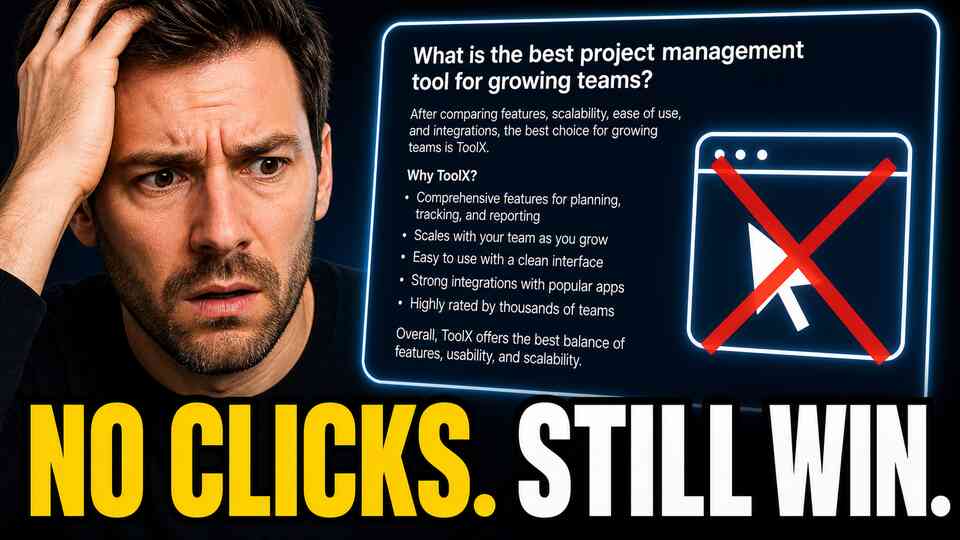
The most uncomfortable truth in AI search is that the most valuable answer is often the one nobody clicks. The user asks ChatGPT a question, the AI gives a complete answer, the user is satisfied, and they never visit the source. Your content provided real value. Your traffic dashboard shows nothing. Welcome to zero-click AI search, and welcome to a measurement model where most teams are quietly underperforming because they can't see the work their content is actually doing.
Here's how to think about and optimize for zero-click AI search, including what to measure when traditional clicks aren't the right unit anymore.
The math has shifted
The Writesonic guide on zero-click search puts the scale of the change directly: "zero-click searches now account for 65% of all Google queries in 2024," with mobile seeing even higher rates at 75%. By March 2025, the number had grown: "27.2% of U.S. searches resulted in no clicks," a significant year-over-year increase.
That's just Google. Add ChatGPT, Perplexity, Gemini, and Copilot, all explicitly designed to answer questions without sending users to source sites, and the share of "answers that don't produce clicks" gets dramatically larger. For some categories, the majority of valuable AI interactions are zero-click by design.
Similarweb data reinforces the pattern: "a less-than-60% click rate on Google search results overall as of 2024," with AI Overviews compressing the number further. Early heatmap data shows "users linger longer on the AI Overview section, reducing attention paid to blue links below." The behavioral shift is real, measurable, and accelerating.
Visibility has become the success unit, not clicks
The mental model shift that makes zero-click optimization tractable is recognizing that visibility itself is the unit of value, not clicks. Traditional SEO measured success in sessions and CTR. AI search measures success in citations, mentions, and share of voice, outcomes that happen whether or not the user clicks through.
The Search Engine Land foundational GEO article frames the shift clearly: AI-generated answers are "assembled from content" that users may never visit. The goal becomes making your brand discoverable and citable by AI systems through structured content, multi-platform presence, and clear attribution signals, rather than optimizing primarily for click-through rates.
This isn't a consolation prize. Visibility has measurable downstream effects: branded search lift, direct conversions, sales calls where prospects mention having "seen you" in an AI answer, and the slow accumulation of brand awareness in the buyer population. None of these show up in clicks. All of them are real value.
Step 1: Vet your keywords for click potential before optimizing
The Writesonic zero-click guide makes a counterintuitive recommendation worth taking seriously: skip queries yielding direct answer boxes or knowledge panels when you're optimizing for click-driven goals. Users with those queries won't need your site. Instead, target keywords that show snippets or People Also Ask boxes where curiosity can drive follow-up clicks.
This is the opposite of legacy SEO advice (which said "go after every keyword"). The new advice is to be strategic about which queries you optimize for click-through and which you optimize for visibility-only impact. They require different content and different success metrics.
For visibility-only queries, your content should be designed to be the answer the AI extracts and quotes, with the goal of brand exposure rather than traffic. For click-driven queries, your content should leave the user wanting more, interesting enough that they click through despite the AI's summary.
Step 2: Format content for snippet and answer-box extraction
Even in a zero-click world, the content patterns that win extraction haven't changed. The Writesonic guide recommends:
- Question-based H2 or H3 headers followed by 40-60 word answers directly below
- Lists and tables for enumerable content
- Clean semantic HTML that AI parsers can read
- Modular sections answering distinct sub-questions, each one extractable on its own
This is the same answer-first writing rule that drives every other AI visibility tactic. It matters even more for zero-click optimization because the extracted answer is the value delivery, not a teaser for the click.
Step 3: Build FAQ blocks that map to People Also Ask
The zero-click guide flags one specific tactic as high-leverage: "build FAQ blocks that map to PAA boxes" by finding actual People Also Ask questions in Google and creating subheadings that match those queries with brief, direct answers.
People Also Ask is one of Google's most prominent zero-click features, and the questions in the PAA box often expand into AI Overview content. Mapping your FAQ structure to PAA questions in your category gives you a direct path into the AI answer surface, and the questions are right there in the SERP, telling you exactly what to write about.
The exercise: for each major topic on your site, search Google and list the PAA questions. Build FAQ blocks on the relevant pages that answer those questions in 40-60 word direct responses. Wrap them in FAQPage schema. Watch the visibility increase even when the click count doesn't.
Step 4: Implement schema for zero-click features
The schema types that matter most for zero-click optimization:
- FAQPage, for any question-and-answer content, with the schema mirroring visible content exactly
- HowTo, for step-by-step content that often appears in AI Overviews
- Organization, with sameAs links for entity disambiguation
- SpeakableSpecification, for content meant to be read aloud by voice assistants
Schema tells AI engines explicitly which parts of your content are eligible for extraction, and AI engines pull schema-marked content into zero-click answers more reliably than unmarked content.
Step 5: Diversify traffic sources beyond Google
One of the most pragmatic recommendations: diversify traffic sources away from Google dependency. The reasoning isn't paranoid, it's strategic. As more queries become zero-click, the traffic value of any single channel drops. Brands that depend on Google for 80% of their traffic are exposed to the AI-driven decline in click-through rates. Brands with diversified channels are less exposed.
The channels that matter for diversification:
- Email marketing, direct relationships with subscribers, immune to algorithm changes
- YouTube, second-largest search engine, also feeds AI engines (Google AI Overviews specifically)
- Direct branded search, built through the brand awareness that AI visibility creates
- Communities and forums, Reddit, Discord, Slack groups where your audience actually hangs out
- Earned media, coverage in publications your audience reads
Each one is its own optimization track. The principle is that no single channel should be load-bearing enough that a 30% click drop would tank your business.
Step 6: Track the metrics that actually capture zero-click value
The Writesonic guide identifies the measurement gap directly: "You're still being discovered, but you can't see it in GA4 or Search Console." The traditional analytics tools show clicks, sessions, and bounce rates, none of which capture zero-click value.
The metrics to track instead:
- AI citation rate, how often your brand or content is cited across the major AI engines for your tracked prompts
- Featured snippet share, how many of your target queries you own the snippet for
- People Also Ask presence, whether your content is used in PAA expansions
- Branded search lift, week-over-week change in branded query volume from Google Search Console (the strongest leading indicator that AI visibility is generating brand awareness)
- AI crawler activity, server log analysis showing GPTBot, ClaudeBot, PerplexityBot fetching your pages
- Self-reported attribution, adding "How did you hear about us?" to signup forms with AI options
None of these are visible in default GA4. All of them are necessary if you want to defend GEO investment against leadership skepticism in a world where traditional click metrics are quietly declining.
Step 7: Build E-E-A-T authority signals
Zero-click visibility depends on being trusted enough by AI engines to be the cited source. The trust signals that matter most:
- Detailed author bios with verifiable credentials
- Expert collaborations and quoted sources
- Topical focus rather than scattered coverage
- Quality backlinks from credible domains
- Original research and first-party data
- Transparent business information
For YMYL (Your Money Your Life) categories, finance, health, legal, these signals matter even more. AI engines apply higher trust standards to those categories because the consequences of bad answers are higher.
Embrace the channel, don't fight it
Stop fighting zero-click and start treating it as a real visibility channel with its own success metrics. Measure success through "featured snippet share, PAA presence, AI crawler behavior, and brand searches" rather than clicks alone, and accept that some of your most valuable AI interactions will never produce a session in your analytics.
Vet your keywords. Format for snippet extraction. Build FAQ blocks that map to PAA. Implement zero-click-friendly schema. Diversify your traffic sources. Track citation metrics, not just clicks. Build authority signals. Visibility is the value, even when traffic isn't, and the teams that internalize this start winning in AI search.