Why Is My Competitor Recommended by AI Instead of Me?
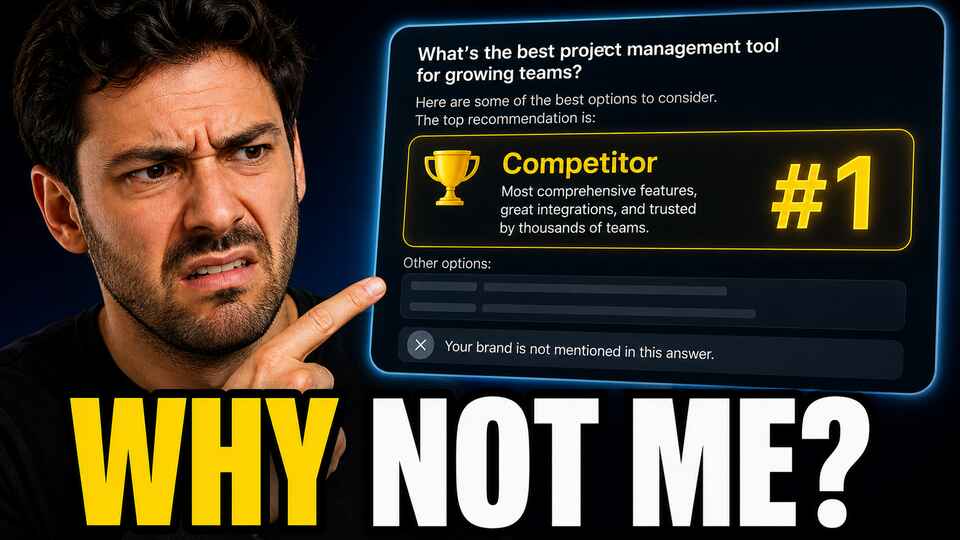
You run a search on ChatGPT. You ask it to recommend tools in your category. Your competitor's name comes up three times. Yours doesn't come up at all.
This is happening to a lot of brands right now, and most of them don't know why. They assume it's about SEO, or marketing budget, or some black box they can't see into. The reality is more specific than that, and once you understand it, it's fixable.
AI recommendations aren't random
When ChatGPT, Gemini, or Grok recommends a brand, it's drawing on a combination of signals that got baked into its training data. These models learned from enormous amounts of text on the internet. The brands that showed up most often, in the most authoritative contexts, with the clearest signals of what they do, became recognizable to the model.
Your competitor didn't get recommended because they have a better product. They got recommended because their brand has a stronger footprint in the places AI models learned from.
Five reasons your competitor is winning AI recommendations
1. They have more third-party coverage. AI models weight content from independent sources heavily. Review sites like G2, Capterra, and Trustpilot. Press mentions in industry publications. Reddit threads where real users discuss their experience. Analyst reports. Comparison articles on SaaS review blogs. If your competitor has 400 G2 reviews and you have 40, that difference is visible to AI models.
2. Their content directly answers questions people ask. Models like ChatGPT were trained to be helpful, which means they learned to favor content that directly answers specific questions. If your competitor has published content like "how to do X in under 10 minutes" and you've published "Our Platform Overview," the competitor's content is structurally better suited to being cited by an AI. How ChatGPT picks sources goes deeper on this specific dynamic.
3. They have clearer entity recognition. AI models understand the world through entities: named brands, products, people, categories. If your brand name is ambiguous, generic, or rarely appears alongside your product category, models may not have a clear signal for what you are and what you do. Your competitor, if they've been consistent about how they describe themselves across the web, has a cleaner entity profile.
4. Their training data footprint is larger. This is just volume. How many times did your brand appear in the text the model was trained on? Press releases, case studies, forum discussions, documentation, mentions in other tools' ecosystems. Bigger footprint means higher probability of appearing in outputs.
5. They've been mentioned in comparison contexts. Phrases like "X vs Y" or "alternatives to Z" are especially powerful. When users ask AI models for comparisons or alternatives, the model draws on content that was itself structured as a comparison. If your competitor appears in 20 "best tools" listicles and you appear in two, that asymmetry shows up in AI outputs.
What you can actually do about it
The first step is understanding exactly where the gap is. Not all AI recommendations work the same way. A model might recommend your competitor for some prompts but not others. You might already be winning in a niche you don't know about. Brand mention gaps in AI search explains how to find these specific gaps systematically.
Once you know where you're losing, you can work on the right levers. That usually means a combination of:
- Building out third-party review presence on the platforms AI models draw from
- Publishing content structured around specific questions your buyers are asking
- Getting mentioned in comparison and alternatives content
- Tightening the consistency of how you describe your brand and category across the web
None of this is fast. But it's also not mysterious. It's a gap that can be measured, tracked, and closed over time.
Why you need to track more than one AI engine
One mistake brands make is checking one AI tool once and drawing conclusions. ChatGPT, Gemini, and Grok don't all give the same answers. A competitor might dominate ChatGPT but be nearly absent from Gemini. Your brand might show up in Grok for a niche prompt that you didn't even know was generating traffic.
Understanding your position across all major AI engines, across the specific prompts your buyers are using, is the only way to get a real picture. AI share of voice is the metric that captures this: your brand's presence as a proportion of total AI recommendations in your category.
The diagnostic step most brands skip
Most brands that discover they're invisible in AI recommendations jump straight to producing more content. Sometimes that's the right move. But sometimes they're already producing enough content. The problem is that it's not the right content, or it's not getting picked up by the right third-party sources, or the brand's entity definition is fuzzy.
Before you execute, you need to diagnose. That means running the specific prompts your buyers use across multiple AI engines, tracking which sources get cited when your competitor is recommended, and identifying the exact gaps in your content and third-party coverage.
BabyPenguin was built specifically for this. It tracks your brand across ChatGPT, Gemini, Grok, and other AI engines at the prompt level, shows you exactly which prompts your competitor is winning, and breaks down which citation sources are driving their recommendations. Instead of guessing why you're invisible, you get a clear answer. And you get to track whether your efforts are actually closing the gap. The framework for measuring AI visibility walks through how to structure this kind of ongoing tracking.
Your competitor didn't accidentally end up in AI answers. They have a footprint you can study, measure, and eventually beat.