Why Does Your Competitor Get Recommended by ChatGPT More Than You?
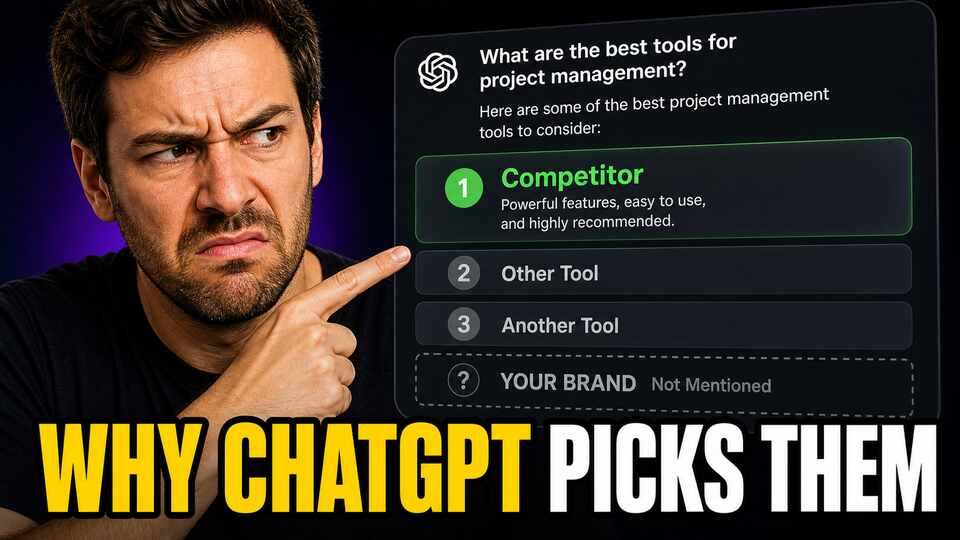
Ask ChatGPT to recommend a project management tool, a CRM, a cybersecurity platform, or almost any software category, and it will give you a short list of names with confidence. If your competitor is on that list and you're not, it's worth understanding why, specifically.
ChatGPT doesn't browse the web in real time for most of its recommendations (though it can with browsing enabled). Primarily, it's drawing on patterns from its training data, reinforced by user feedback, shaped by what it learned about which sources are authoritative. Each of these factors is something you can actually influence.
How ChatGPT learned what to recommend
The model was trained on enormous amounts of text: web pages, forums, documentation, articles, reviews, and discussion threads, among other things. During that training, it learned associations between brand names and the contexts they appear in. A brand that appeared frequently, in positive contexts, alongside clear descriptions of what it does, became a stronger signal in the model.
Then came reinforcement from human feedback. OpenAI had people evaluate ChatGPT's responses and rate them. Responses that named specific, well-known tools were likely rated as more helpful than vague answers. That feedback loop further reinforced which brands the model tends to recommend. How ChatGPT picks sources covers this process in more detail.
The specific signals that matter most
Volume of mentions in authoritative contexts. This is the base layer. If your competitor's name appeared in tens of thousands of web pages, forum threads, and articles before the training cutoff, and your brand appeared in hundreds, the model has stronger signal for your competitor. It's not just about your own website. It's about everywhere your brand appears across the web.
Third-party endorsements. ChatGPT weights content from review platforms, independent comparison sites, and editorial coverage more than it weights brand-owned content. A G2 review that says "we switched from X to your competitor and increased output by 30%" is more signal-rich to a model than your own case study saying the same thing. The same is true for press coverage, analyst mentions, and community discussions.
Direct-answer content structure. ChatGPT was trained to be helpful. It gravitates toward content that directly answers questions. If your competitor has published 50 articles structured around specific how-to questions your buyers ask, and you've published 50 articles about your features, the competitor's content aligns better with how ChatGPT generates responses. This is one of the core ideas behind generative engine optimization.
Category-level presence in comparison content. When users ask ChatGPT "what's the best tool for X" or "X vs Y," the model draws on content that was itself framed as comparisons and recommendations. If your competitor appears in 30 "best of" listicles and comparison articles and you appear in 3, that asymmetry gets baked into outputs.
What prompt-level tracking reveals
Here's where it gets specific, and where most brands are flying blind. ChatGPT doesn't recommend the same brands for every prompt. The recommendations shift depending on how the question is framed, what category it's asking about, and what context is in the conversation.
Your competitor might be winning on "best CRM for enterprise" but barely showing up on "best CRM for startups." You might already be winning on a niche prompt and not know it. Without tracking the actual prompts your buyers use, you're working with a partial picture. Prompt-level tracking in AI search explains why this granularity matters so much.
BabyPenguin runs your priority prompts across ChatGPT and other AI engines on a regular cadence. You see exactly which prompts your competitor is winning, what sources are being cited when they show up, and how your visibility shifts over time as you execute on changes. It's the difference between knowing you have a problem and knowing exactly where the problem is.
The citation source question
When ChatGPT recommends your competitor, it's often drawing on specific sources that you can actually identify. Maybe it's a particular review on G2. A comparison article on a software review blog. A Reddit thread from 18 months ago. A Product Hunt listing.
Understanding which sources are driving your competitor's recommendations is critical because it tells you where to focus. If the gap is mostly G2 reviews, you invest in G2. If it's press coverage, you invest in PR. If it's comparison content, you create or earn more of it.
This is exactly what BabyPenguin's citation source analysis is built to show. Not just that your competitor is winning, but which specific third-party sources are driving their AI presence. Pair that with benchmarking competitors in AI search and you have a clear picture of both the gap and the path to closing it.
The competitive gap is measurable
Most brands treat their AI visibility problem as vague and unsolvable. It's neither. The gap between you and your competitor is measurable. It has specific causes. Those causes point to specific actions.
The brands that figure this out first in their category will be hard to dislodge. The ones that wait will find the gap harder to close every month. AI recommendations create a compounding effect: the brands that appear in recommendations get more users, more reviews, more mentions, which leads to more AI recommendations. Getting into that cycle earlier matters.
Start by knowing exactly where you stand. Track the prompts your buyers use, see where your competitor is winning, and work backward from the sources driving their visibility. That's the diagnosis. BabyPenguin handles the tracking. You handle the execution.