How to Track Brand Mention Gaps in AI Search
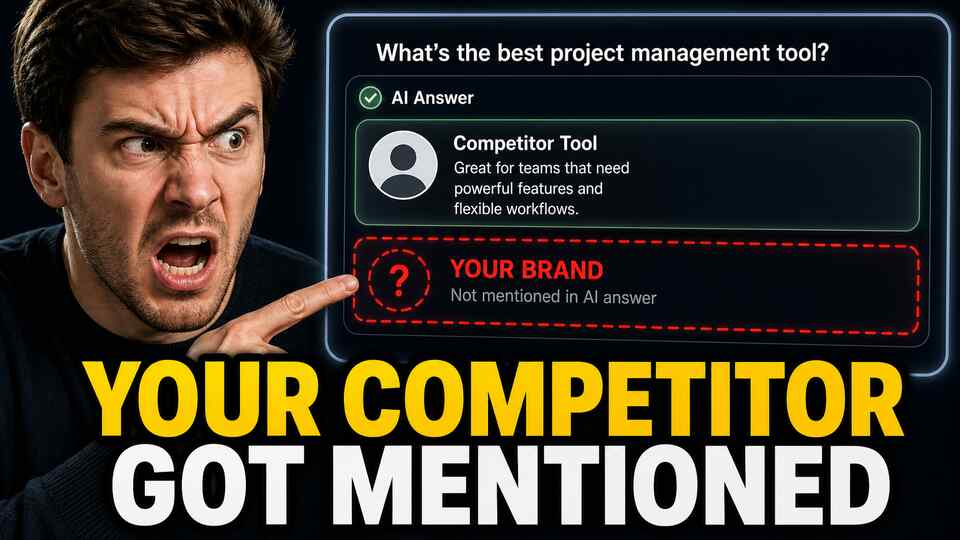
Every query where a competitor appears in an AI answer and you don't is a mention gap, and it's costing you. Not abstractly, not theoretically, but in the specific moment when a potential buyer asks ChatGPT which tools to consider, which agencies to shortlist, or which approach is best for their problem. If your competitors are named in that answer and you aren't, the buyer's consideration set is already formed before they've visited a single website. Tracking and systematically closing mention gaps is one of the highest-ROI activities in generative engine optimization, precisely because the stakes are so concrete and the opportunities so actionable.
A mention gap analysis answers a specific question: for the queries that matter in your category, who is getting mentioned and how often, and where are you absent? Done well, it transforms AI visibility from an abstract concern into a prioritized list of content and coverage investments you can actually act on.
Understanding the Difference Between Mention Gaps and Citation Gaps
Before building your tracking methodology, it's important to distinguish two related but separate problems.
A mention gap exists when a query in your category produces an AI answer that names competitors but doesn't name you. The AI knows your competitors exist and recommends them, it either doesn't know about your brand or doesn't consider it relevant enough to include. Closing a mention gap requires building the brand awareness, topical authority, and content coverage that causes AI models to recognize you as a relevant option in the category.
A citation gap exists when your brand name appears in an AI answer, but none of your owned assets, your website, your blog, your research, are cited as sources. You're mentioned, but the sources cited are competitors' content or third-party articles about you. Closing a citation gap requires building citeable content that AI engines prefer as source material.
Both gaps matter, but they require different remedies. Mention gaps come first: if you're not being mentioned at all, citation gaps are a secondary problem. This guide focuses primarily on mention gaps, the earlier and more fundamental problem for most brands working on AI share of voice.
Step 1: Build Your Query Set
The foundation of mention gap analysis is a comprehensive query set, the 50 to 200 prompts most likely to trigger AI responses in your category. Building this set well is more important than any subsequent step, because gaps you don't test for are gaps you'll never discover.
Your query set should cover four structural query types that capture different stages of buyer intent:
Category discovery queries: "What are the best [product category] tools?" / "What is [category]?" / "How does [category] work?" These queries capture buyers at the awareness stage who may not yet know what they're looking for.
Use-case specific queries: "Best [product category] for [specific use case or buyer type]?" / "How do [specific role] use [category]?" These capture buyers with defined problems looking for relevant solutions.
Comparison and evaluation queries: "[Competitor A] vs [Competitor B]" / "Alternatives to [Competitor]" / "How to choose [product category]" These capture buyers in active evaluation who are comparing options, the highest-intent segment.
Problem-awareness queries: "How do I [solve problem your category addresses]?" / "Why is [pain point your product addresses]?" These capture buyers who haven't yet framed their need as a category purchase but are experiencing the problem you solve.
For each query type, generate multiple variations. AI engines produce different outputs for subtle prompt variations, and your mention rate may differ significantly across them. "Best project management tools for remote teams" and "project management software for distributed companies" are semantically similar but may produce meaningfully different citation patterns. Prompt-level tracking matters more than most practitioners realize.
Start with 50 queries if you're new to this process. The goal is breadth across query types, not exhaustive coverage of every possible variation. You can expand the set as patterns emerge.
Step 2: Run Prompts and Record Results Systematically
Running your query set manually is feasible at small scale but becomes unwieldy above 50 queries per platform. At minimum, run queries across the three primary AI platforms: ChatGPT, Gemini, and Grok (and Perplexity if relevant to your category, it has distinct citation patterns that can diverge from the others).
For each prompt-platform combination, record:
- Every brand mentioned by name in the response
- The position each brand appears in (first mention, second mention, etc.)
- Whether the brand is recommended positively, neutrally, or negatively
- Which sources are cited (URLs, if the platform provides them)
- The date of the query run
This is more granular than most brands track, but the detail matters. A brand mentioned first in a list of three recommendations has meaningfully different value than the same brand mentioned as an afterthought in a longer list. Tracking AI citations over time requires this level of granularity to be actionable.
The Search Engine Land guide to GEO monitoring provides a solid methodological framework for systematizing this data collection, including recommendations on query batching and platform-specific considerations.
Step 3: Map Mention Rates by Query and Competitor
Once you have raw data, the analysis step is straightforward: calculate a mention rate for each brand (including yours) across each query and query cluster.
Mention rate = (number of times brand is mentioned across N query runs) / N. Run each query at least 3–5 times to account for response variability, AI engines produce non-deterministic outputs, so single-run data overstates precision.
Your output at this stage should be a matrix: queries on one axis, brands on the other, mention rates in the cells. This matrix immediately reveals your gap profile. Queries where competitors show 50–80% mention rates and you show 0–10% are your most significant mention gaps.
Group queries into clusters by topic or intent type. A cluster of five comparison queries might all show the same gap pattern, that's actionable information about a category of content to build, rather than five disconnected data points.
Step 4: Identify Your Gaps
Not all gaps are created equal. A query where you have 0% mention rate and a dominant competitor has 90% mention rate represents a different opportunity than a query where everyone has 20% mention rates and there's no established leader.
The most immediately actionable gaps are those where:
- You have 0% or near-zero mention rate
- At least one competitor has 30%+ mention rate (signaling the query type does cite brands in your category)
- The query maps to a stage of the buying journey where being mentioned matters (evaluation and comparison queries typically have higher buyer intent than awareness queries)
Secondary priority gaps are those where you're mentioned but underrepresented relative to your actual market position, queries where a smaller competitor consistently appears before you despite your larger presence or stronger product.
The Princeton GEO research provides useful theoretical grounding for understanding why these gaps form and what content characteristics correlate with higher mention rates. Their analysis of AI citation selection factors is directly relevant to understanding why competitors appear in specific query categories while you don't.
Step 5: Prioritize Gaps by Strategic Value
Prioritization is where many mention gap programs stall. Without a clear framework, teams either try to address every gap simultaneously (spreading effort too thin) or focus on the wrong gaps (choosing easy wins over high-value opportunities).
A practical prioritization framework scores each gap cluster on three dimensions:
Query intent value: Evaluation and comparison queries score highest, buyers asking these are actively considering purchases. Awareness queries score lower; appearing in them builds brand recognition but drives less immediate consideration.
Gap magnitude: The larger the gap between your mention rate and the leading competitor's, the more opportunity exists. A 0% vs 70% gap on a high-intent query is your highest priority target.
Content feasibility: Some gaps are closable with content you can produce in weeks; others require third-party coverage or entity authority that takes months to build. Weight your near-term roadmap toward feasible, high-value gaps, then build the longer-term coverage plan in parallel.
The Search Engine Journal GEO strategies guide offers additional prioritization frameworks, including how to weight gaps differently based on platform-specific citation patterns. A gap on ChatGPT and Gemini simultaneously may outprioritize a larger gap on a single platform.
Step 6: Build a Content and Coverage Plan to Close Priority Gaps
Different gap types require different closure strategies. The three most common gap patterns each have distinct remedies:
Knowledge gaps: AI engines don't mention you because they lack sufficient information about your brand. The fix is entity-building: more comprehensive owned content about what you do and who you serve, structured data markup, consistent descriptions across all platforms, and third-party mentions that validate your category positioning. Entity-rich content and entity consistency are the foundational investments here.
Authority gaps: AI engines know about your brand but don't consider it authoritative enough to cite alongside established competitors. The fix requires building credibility signals: original research that gets cited, media coverage from authoritative publications, expert voices associated with your brand, and content that other authoritative sources link to or quote. How trust and authority work in AI systems explains the mechanism in detail.
Coverage gaps: You have strong entity recognition and authority, but specific query subtopics aren't covered in your content ecosystem. A buyer asking "best [category] for enterprise security compliance" may not find you because you've never produced content specifically addressing that use case. The fix is targeted content creation: articles, landing pages, and third-party coverage that address the specific angle of the gap query.
Most brands face all three gap types simultaneously in different parts of their query set. Your content plan should map each priority gap to the appropriate closure strategy rather than applying a one-size-fits-all approach.
The Role of Third-Party Content in Closing Mention Gaps
One of the most consistent findings in AI citation research is that third-party content, reviews, comparisons, editorial coverage, drives brand mentions more reliably than owned content alone. When AI engines decide which brands to name in a category query, they're not primarily consulting the brands' own websites. They're drawing on the broader ecosystem of content that discusses, compares, and evaluates brands in that category.
This means closing mention gaps requires investment in the earned and third-party content ecosystem, not just your own publishing. Strategies that contribute meaningfully include: getting your product reviewed on authoritative comparison platforms (G2, Capterra, industry-specific review sites), pitching guest articles or expert commentary to trade publications that cover your category, generating earned media coverage that positions your brand as a category participant, and building relationships with analysts and independent experts who produce content your target AI engines cite.
The competitive benchmarking process feeds naturally into this analysis, when you examine why competitors appear in gaps where you don't, you frequently find they have stronger third-party coverage ecosystems rather than fundamentally better owned content.
How Often to Re-Run Gap Analysis
AI citation patterns aren't static. Model updates, new training data, changes in the competitive content landscape, and shifts in how queries are phrased all affect mention rates over time. A gap analysis that was accurate in January may be partially outdated by March.
At minimum, run a full gap analysis monthly. This cadence is frequent enough to detect meaningful changes in mention rates and to evaluate whether your content and coverage investments are moving the needle. More frequent tracking, weekly or bi-weekly for your highest-priority query clusters, allows faster iteration on gap-closure tactics.
Track your gap metrics over time, not just in point-in-time snapshots. A mention rate trend tells you more than a single data point: a gap that's narrowing confirms your strategy is working; a gap that's widening signals a competitor is accelerating away from you and requires a response.
From Gap Analysis to Ongoing Monitoring
Mention gap analysis is most powerful when it's not a one-time audit but an ongoing monitoring practice. The brands that win in AI search over the next few years will be those that maintain systematic visibility into how they're represented across AI platforms, identify gaps as they emerge rather than after they've compounded, and act on that data quickly enough to stay ahead of competitors.
This is a fundamentally different operating model from traditional SEO monitoring, it requires query-level tracking across multiple AI platforms, not just keyword ranking data from a single search engine. The infrastructure to do this at scale, for a large enough query set to be meaningful, is exactly what purpose-built GEO tracking tools provide. BabyPenguin tracks brand mentions, citations, and source appearances across ChatGPT, Gemini, and Grok, giving teams the data they need to identify mention gaps, monitor competitors, and measure whether their GEO investments are actually closing the gaps that matter.