How to Write Definition Pages That AI Can Cite Word-for-Word
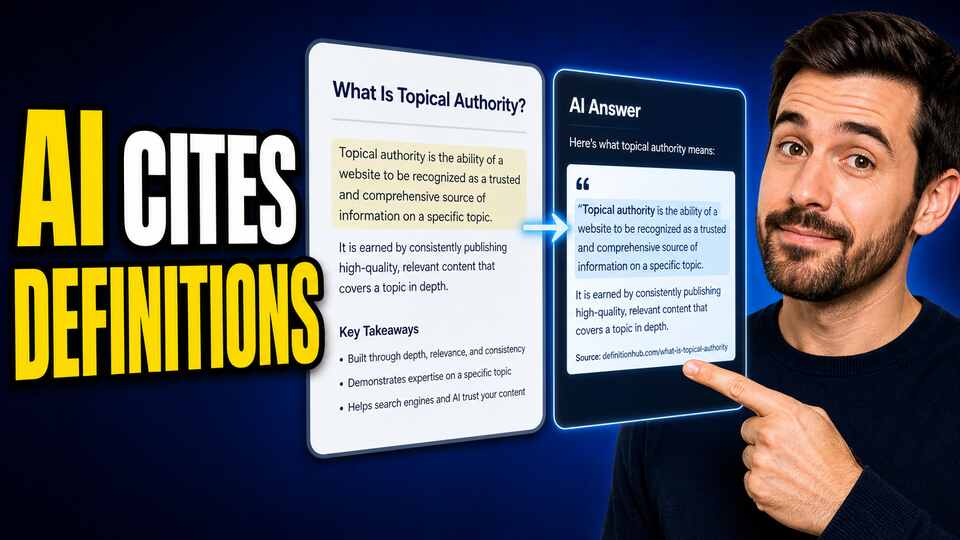
The most cited piece of content in any category is almost never a thought-leadership essay or a long-form guide. It's the definition page. The unglamorous, single-purpose entry that explains what a term means in two sentences and then steps out of the way.
Go look at how AI engines answer "what is X?" prompts in your space. You'll see the same handful of definition pages cited over and over, Wikipedia, dictionary entries, academic glossaries, and a small number of well-structured brand glossaries from companies that figured out the format early. The rest of the internet's content gets passed over for these clean, quotable definitions.
This is the lowest-effort, highest-leverage content type you can write for AI search. Here's how to do it properly.
Why definition pages get cited so heavily
The mechanics are simple. When a user asks an AI engine "what is generative engine optimization?", the engine looks for content that resolves the question in the smallest possible number of words, with the highest possible authority signal. A definition page is purpose-built for that. Its first sentence is the answer. The rest of the page is supporting context the AI can pull selectively if it needs more.
The format is also uniquely robust to AI extraction because it eliminates the failure modes that hurt other content types. There's no narrative ramp to skip past. There are no marketing claims to filter out. There's no surrounding context the answer depends on. A well-written definition page is essentially one giant answer capsule.
That's why the same handful of glossary domains, Wikipedia, dictionary sites, a few SEO and academic glossaries, show up as the cited source for thousands of "what is X?" prompts across every category. The format compounds.
Lead with a one-sentence definition
The most important sentence on any definition page is the first one. It must:
- Define the term in a single sentence
- Be self-contained, readable without any other context on the page
- Avoid jargon you haven't defined yet
- Be quotable as-is by an AI engine extracting an answer
A worked example. The Conductor glossary entry for "Generative Engine Optimization" opens with: "GEO is the process of optimizing content to increase visibility and citations within AI-powered search experiences like AI Overviews and LLMs."
One sentence. Names the entity. Names what it does. Names where it does it. An AI extractor reading that sentence has a complete, citable answer immediately, without parsing any other content on the page. That's the standard you're aiming for in your own definition pages.
Use the BLUF structure
Definition pages should follow what military and intelligence writers call BLUF, Bottom Line Up Front. Put the core answer in the first sentence or paragraph, rather than building up to it. The expanded context comes after, not before.
The structure that works best:
- One-sentence definition at the very top, ideally in a boxed or highlighted format
- Expanded explanation in a section titled with the question form ("What is X?")
- Key characteristics or components as a short bulleted list
- Examples, at least two concrete real-world examples
- Related terms with cross-links to other glossary entries
- Optional: how it differs from related concepts (e.g. "GEO vs SEO")
This is the format Wikipedia uses, the format Conductor and Animalz use for their glossaries, and the format AI engines pull from most reliably. Don't reinvent it. Copy it.
Make the definition box visually distinct
One small but high-leverage trick: put your one-sentence definition in a visually distinct box at the top of the page, bordered, shaded, or set in a quote block. This serves two purposes:
- It signals to human readers that "this is the answer"
- It signals structurally to AI parsers that this content is the canonical definition, separate from the surrounding explanatory text
The boxed-definition pattern is a hallmark of the most-cited glossary pages on the internet. It's not strictly necessary, AI engines can still find a well-written first sentence without the box, but it raises the citation rate noticeably, and it's almost free to implement.
Define entities by SVO sentence structure
Inside the definition itself, use Subject-Verb-Object sentence structure with explicit, named entities. Compare:
- ❌ "It's a way to think about how things show up in AI search results."
- ✅ "Generative Engine Optimization is the practice of structuring content so that AI engines like ChatGPT, Perplexity, and Google AI Overviews retrieve, cite, and accurately represent your brand."
The second version names the subject (GEO), the verb (is the practice of structuring), and a specific list of objects (ChatGPT, Perplexity, Google AI Overviews). Every part of the sentence is concrete and quotable. The first version is filler that no AI engine would ever cite.
Apply this rule to every definition: name the thing, name what it does, name what it interacts with. Pronouns and vague references are the enemy.
Avoid marketing language entirely
Definition pages get cited because they read as neutral reference material. The moment a definition reads as a sales pitch, the citation rate collapses. AI engines downgrade commercial-sounding content for definition queries, because the user is looking for unbiased understanding, not a recommendation.
The forbidden phrases on a definition page:
- "Industry-leading"
- "The most powerful"
- "Used by top brands"
- "Try it free"
- "Our solution"
- Any sentence that mentions your brand more than once
If you're writing a definition for your own company's glossary, write as if you were a Wikipedia editor, neutral, factual, citation-worthy. Save the brand voice for landing pages and blog posts. Definition pages have one job, and selling isn't it.
Cross-link to related terms
The strongest definition pages aren't standalone, they're nodes in a glossary network. Each entry links to two to five related terms within the same glossary, building an internal web that AI engines crawl as a connected reference source.
This matters for two reasons. First, it dramatically improves how AI parsers understand the entity relationships in your category. A definition of "GEO" that links to "AEO," "LLM," and "share of voice" tells the AI that these concepts belong to the same domain. Second, it creates semantic structure that elevates the whole glossary's authority, a single isolated definition is fragile; a well-linked glossary is durable.
Keep each entry short
The temptation with a glossary entry is to turn it into a 2,000-word essay on the term. Resist. The entries that get cited most respect the "definition" framing: 200-500 words, leading with the one-sentence answer, expanding only enough to provide useful context, then stopping.
If you find yourself writing more than 500 words on a single term, that's usually a sign the topic deserves its own long-form article, not a glossary entry. Keep the glossary entry tight, link out to the full-length article, and let each format do its job.
Implement DefinedTerm or Article schema
The most appropriate schema markup for definition pages is one of:
- DefinedTerm, explicit schema.org type for glossary entries, paired with a DefinedTermSet for the parent glossary
- Article, fallback for definition pages styled as short editorial entries
- FAQPage, useful if the page includes additional related questions beyond the main definition
DefinedTerm schema is underused but specifically built for this content type. It tells AI engines unambiguously that the page is a glossary entry for a specific term, which is exactly the signal they're looking for when answering "what is X?" prompts.
Build a real glossary, not just one definition
A single definition page is useful. A glossary of 30-50 connected definitions covering every important term in your category is transformative. Every term you define becomes a citation candidate for every "what is X?" prompt in your space, and the network effect compounds as the glossary grows.
The right approach: pick the 10-15 most important terms in your category and write definition pages for each one in the next sprint. Then add 5 more per month for as long as you can sustain it. Within 6 months you'll have a glossary that's earning citations across dozens of prompts, at a fraction of the effort of producing the equivalent volume in long-form articles.
The unsexy content that wins the most
Definition pages don't get bylines. They don't go viral. They don't get shared on LinkedIn. They're quietly some of the highest-ROI content you can publish for AI search, because they map exactly to how AI engines answer the most common type of question users ask: "what is this thing?"
Build the glossary. Lead every entry with a quotable sentence. Cross-link them. Add the schema. Let the network of small, clean definitions become the foundation of your AI visibility, exactly the way Wikipedia became the foundation of everyone else's.