How to Monitor Brand Word of Mouth in AI Assistants
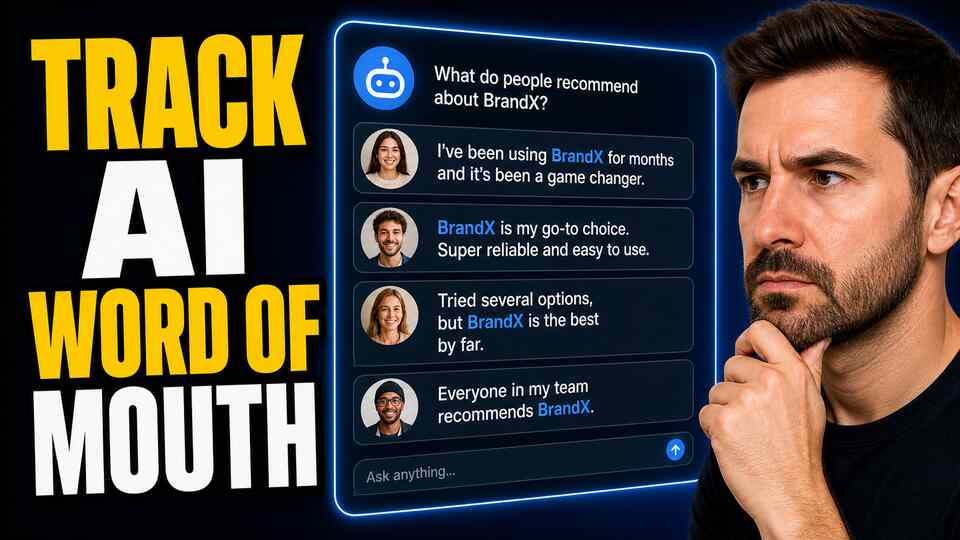
Word of mouth used to be a person telling a friend. "You should try this tool, it worked for us." Slow, organic, hard to track, but powerful. Now there's a new version: someone types a question into ChatGPT and gets a recommendation. That recommendation reaches millions of people every day, and unlike a friend's advice, you have no way to overhear it.
This is the new word of mouth. It's faster, it scales infinitely, and for most brands, it's completely invisible.
Why AI Recommendations Function Like Word of Mouth
When people ask ChatGPT "what's the best project management tool for a remote team" or "which AI monitoring platform should I use," they're not searching. They're asking for a recommendation. The psychology is closer to asking a trusted colleague than running a Google search.
And they act on it accordingly. Studies on AI-assisted discovery show that users treat AI recommendations with higher trust than sponsored search results, often with trust levels comparable to a peer recommendation. The AI feels neutral. It feels like it has no stake in the answer.
That's exactly what makes it powerful and exactly what makes it dangerous if your brand is absent from those answers, or worse, mentioned negatively.
The Monitoring Problem
Here's why most companies don't know what AI assistants are saying about them: you can't just check once. AI answers are dynamic. ChatGPT gives different answers to the same question depending on phrasing, context, date, and model version. Gemini weighs sources differently than Grok. The answer to "best tool for AI monitoring" isn't fixed. It changes.
You could try testing this manually. Open ChatGPT, type some queries, screenshot the answers. Do this every week. Across 5 models. For 50 different query variations. That's not a process, that's a second job.
Manual spot-checks also miss the full picture. Your brand might show up in answer A but disappear from answer B, which uses slightly different phrasing. You might be mentioned positively in ChatGPT but mischaracterized in Gemini. You won't catch that from a weekly screenshot session.
The signals you actually need to track are more granular than "did we get mentioned." Understanding prompt-level tracking in AI search is what separates a real monitoring program from a false sense of security.
What Signals Actually Matter
There are three categories of signals worth tracking in AI assistant responses:
Mention frequency. How often does your brand appear across a defined set of queries? If you're tracking 100 prompts that your target customers are likely to ask, and your brand appears in 12 of those answers, that's a 12% prompt mention rate. Track this over time. Is it going up or down?
Citation and source patterns. When AI assistants mention your brand, what are they citing? Which third-party articles, review sites, or community discussions are being surfaced? This matters because it tells you where the AI is drawing its understanding of your brand from. A citation from a three-year-old blog post that no longer reflects your product is a problem you can actually fix.
Sentiment and framing. Is your brand mentioned as a top recommendation, a secondary option, or with caveats? "Brand X is popular but expensive" versus "Brand X is great for growing teams" are very different signals. The framing affects whether the person reading that answer clicks through or keeps scrolling.
This connects directly to the broader concept of AI share of voice, which is the metric that tells you how much of the recommendation space you own across all relevant queries.
How This Connects to Traditional WOM Monitoring
If you've ever run a brand monitoring program, the mental model isn't foreign. You track mentions, sentiment, sources. The difference is the medium and the scale.
With traditional word of mouth monitoring, you'd track review sites, social media mentions, Reddit threads. With AI monitoring, you're tracking what the AI is synthesizing from all of that. The AI doesn't create opinions from scratch. It reads what exists online about your brand and synthesizes a view.
That means the inputs to AI word of mouth are the same as traditional WOM: customer reviews, press coverage, community discussions, third-party articles. But the output, the AI's recommendation, is what reaches the buyer directly. So you need to monitor both the inputs and the output.
Understanding how ChatGPT picks its sources gives you the leverage to work backwards: if you know which sources the AI is drawing from, you know which sources to influence.
Making This Systematic with BabyPenguin
BabyPenguin was built for exactly this problem. You define the prompts that matter to your category, and BabyPenguin runs them across ChatGPT, Gemini, Grok, and other models on a regular cadence. Every answer gets logged. Every mention of your brand gets tracked.
The dashboard shows you your mention rate over time, which prompts you appear in, which competitors appear in the prompts where you don't, and what sources are being cited. You can see at a glance whether your AI word of mouth is growing or shrinking, and where the gaps are.
The citation analysis is particularly useful. When BabyPenguin surfaces that a specific G2 review or a TechCrunch article is being cited frequently in answers that mention your brand, you know that content is actively shaping how the AI describes you. When you see that a competitor is getting cited from a source you're not mentioned in, that's a gap you can close.
On the competitor side, BabyPenguin's side-by-side comparison shows you not just whether you're mentioned but how your mention rate compares to competitors across the same prompt set. If a rival is showing up in 40% of relevant queries and you're in 15%, that gap represents a significant amount of AI-driven word of mouth you're not getting.
For a complete framework on what to measure and how to build a reporting structure around AI visibility, this visibility measurement framework is a good starting point.
The Cost of Not Monitoring
The brands that aren't tracking this are making decisions based on incomplete information. They're optimizing for Google rankings while AI assistants are sending buyers somewhere else. They're running campaigns based on traditional share of voice while their AI share of voice is declining.
Word of mouth at scale, especially word of mouth you can't hear, has always been a risk. The difference now is that the tools exist to monitor it. There's no excuse for flying blind.
If you want to see what AI assistants are currently saying about your brand, BabyPenguin can show you within minutes. The data is usually surprising. Sometimes it's encouraging. Often it reveals problems you had no idea existed. Either way, you need to know.