How to Refresh Old Content for the Age of AI Search
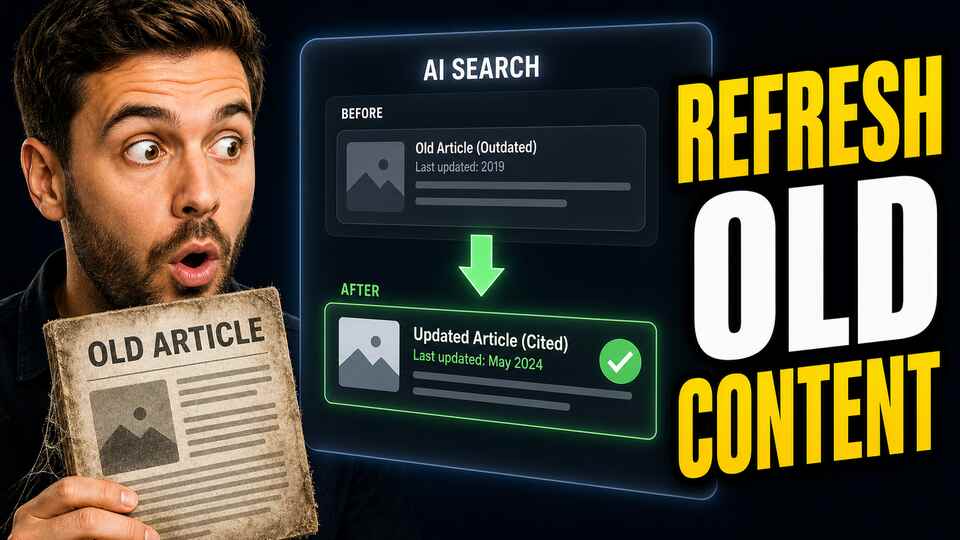
Most content libraries have a few hundred posts that nobody touches. They were published two or three years ago, ranked decently for a while, and have since faded into the background. The traffic is mediocre. The links are dead. The screenshots show interfaces that don't exist anymore. Nobody has the time to fix any of it, so the whole library quietly decays.
This is the highest-leverage GEO opportunity most teams ignore. Refreshing old content for AI search isn't optional housekeeping, it's one of the fastest ways to add citation candidates to your site without producing a single new article. Here's how to do it properly.
Why old content needs an AI-era refresh, not just an SEO refresh
Traditional content refresh advice, update stats, add internal links, refresh meta descriptions, still applies. But it isn't enough. Pages written for traditional SEO are structured around keywords and click-through, not around extraction and citation. To make old content perform in AI search, you have to rebuild it for a different reader: a model that scans for self-contained chunks, leads with answers, and cites verifiable facts.
The good news is that the structural surgery required is mostly mechanical. You don't have to rewrite the article. You have to reorder it, retitle it, and re-anchor it around extractable units. Most refreshes can be done in 60-90 minutes per article, and the results show up in citation behavior within weeks.
Step 1: Pick the right pages to refresh
Don't refresh randomly. The pages that produce the highest return on a refresh have three characteristics:
- They contain real expertise or proprietary insight. Pages that already have substantive content underneath the structural mess. Don't refresh thin content, rewrite it from scratch.
- They answer questions people actually ask repeatedly but don't currently state the answer cleanly. These are the highest-leverage targets because the demand is already there; you just have to make the content extractable.
- They relate to your core products or services. Refreshing tangential content might lift those individual pages, but it doesn't compound into broader topical authority. Focus the refresh budget on pages that reinforce your category position.
Use traffic data to prioritize within these criteria. Pages that used to rank well and have since slipped are the easiest wins, they already have backlinks and existing authority. You're rebuilding on a foundation that exists.
Step 2: Rewrite the title and headings as questions
The first structural fix is the title. Old SEO titles tend to be keyword-stuffed noun phrases ("Session Replay Software"). New AI-friendly titles are answer-shaped questions or direct claims ("Session Replay: What It Is and When to Use It").
The change matters because AI engines look for content that maps cleanly onto the natural-language questions users ask. A title that mirrors the user's prompt shape is far more likely to surface as the answer. Apply the same logic to every H2 and H3 in the article. Convert "Implementation Best Practices" into "How do I implement session replay correctly?" Convert "Pricing Comparison" into "How much does session replay software cost?"
Test each new heading by asking: can I write a clean two-to-three-sentence answer to this question, right under the heading, that would stand alone if extracted? If yes, the heading is doing its job. If no, it's too vague, split it into more specific questions.
Step 3: Add an answer capsule under each section
This is the single most impactful change in any refresh. Under every H2 in the article, add a 1-2 sentence answer capsule that directly resolves the question the heading asks. The capsule comes before any narrative buildup. It's the first thing the reader sees, and it's the first thing the AI extractor looks for.
The format:
How does session replay work?
Session replay records a user's interactions with your website, clicks, scrolls, form inputs, and page transitions, and reconstructs them as a video-like playback for product and UX teams to review.
Question heading. Direct answer underneath. Then the rest of the section, with the supporting context. AI engines extract the capsule as a complete, citable unit. Without the capsule, they have to guess at what the section says, and they usually skip it in favor of a cleaner alternative.
This single change, adding an answer capsule under every H2, typically delivers more citation lift than any other refresh tactic.
Step 4: Make every section self-contained
Old SEO content often relies on context built earlier in the article: "as we discussed above," "in the previous section," "more on this below." All of those references break when an AI extracts a single section. The user reading the AI's answer gets a broken sentence with no way to follow the reference.
Fix this by reading each section in isolation and folding the missing context inline. If the section depends on a definition from earlier, restate it in one sentence. If the section refers to a comparison from later, restate it briefly. Each section should be readable on its own, end-to-end, even if everything else on the page disappeared.
Step 5: Replace outdated stats with current numbers
Stale numbers are one of the biggest credibility problems in old content. A stat from three years ago, presented as if it were current, gets the article downgraded by AI engines that detect freshness mismatches. And it embarrasses you when readers spot the date.
For every number in the article:
- Find the current version of the same statistic from a fresh source
- Replace the old number with the new one
- Update the citation to point to the current source
- Add the date if the stat is time-sensitive ("As of Q1 2026, 38% of users…")
If you can't find a current version of the stat, consider whether it's still accurate or whether you should remove it entirely. Stale stats are worse than no stats.
Step 6: Refresh the visuals
Screenshots, charts, and product imagery decay alongside the text. A screenshot of a UI that no longer exists is a red flag for both human readers and AI engines that increasingly understand image content. Replace every screenshot with a current one. Update charts with new data. Refresh product imagery to match what's actually live.
Don't forget alt text. Update it to match the new screenshot, and write descriptive alt text that names the entities visible in the image ("GA4 admin panel showing the data streams configuration with the API key field highlighted") rather than generic placeholders ("GA4 screenshot").
Step 7: Strip out the AI-generated tells
If the article has been touched by an AI writing tool over the years, it probably contains the now-recognizable tells of LLM generation: em-dashes used as primary punctuation, repetitive "It's not just X. It's also Y" structures, bullet-point lists with leading emojis, generic "in today's evolving landscape" preambles, and squished vertical line spacing.
AI engines have started downgrading content that looks AI-generated, and human readers detect it instantly. Strip out the worst offenders. Replace mechanical phrasings with clean, declarative sentences. Cut the throat-clearing intros. The article should read as if a real human wrote it, even if a tool helped with the first draft.
Step 8: Update internal and external links
Dead links are credibility leaks. Run every external link and check it works. Replace any that 404 with the current version of the same source, or remove them entirely if the source is gone. Add fresh internal links from the refreshed article to other related articles on your site, and add inbound internal links to the refreshed article from related articles.
This serves two purposes: it improves the page's authority signal, and it strengthens your site's internal entity network. Every internal link is a small endorsement that AI engines pick up on when assessing topical coverage.
Step 9: Update the metadata and the "last updated" date
Once the structural surgery is done, update the metadata:
- Title tag, match the new question-shaped headline
- Meta description, frame it as a one-sentence briefing note: who the content is for, what problem it resolves, what the reader will learn
- Last updated date, bump it prominently to the current date
- Schema markup, update Article schema with the new dateModified, and add FAQPage schema if you've added a Q&A section
The "last updated" date is more important than most teams realize. AI engines weight content freshness heavily, and a date close to today is a strong signal that the article is current. Display it prominently near the title, not buried in the footer.
Step 10: Watch the citation lift
After the refresh, monitor the page in your AI visibility tracker. You should see citation activity increase within 2-6 weeks of the change, sometimes faster. Track three signals:
- Whether the page appears as a cited source for prompts in your tracking set
- Whether the page's traffic starts climbing again
- Whether branded searches related to the topic increase
If all three move in the right direction, the refresh worked. If only one or two move, the page probably needs further structural work. If none move, the page might not have been a good refresh candidate, spend the next refresh budget on a different page.
Refresh, don't recreate
The most important mindset shift is treating refreshes as surgery on existing assets, not as opportunities to start over. The pages that benefit most from a refresh are the ones with real underlying content that just needs a structural rebuild. Rewriting them from scratch is usually wasted effort. Restructuring them is high-leverage.
For most content libraries, refreshing 30-50 of your best older pages will produce more AI citation lift than publishing 10 new articles in the same time. The infrastructure is already there. The authority is already there. All that's missing is the answer-first format that makes the content extractable. Spend a quarter on systematic refreshes and watch the dormant half of your library wake up.