Google AI Mode vs AI Overviews: What's Actually Different?
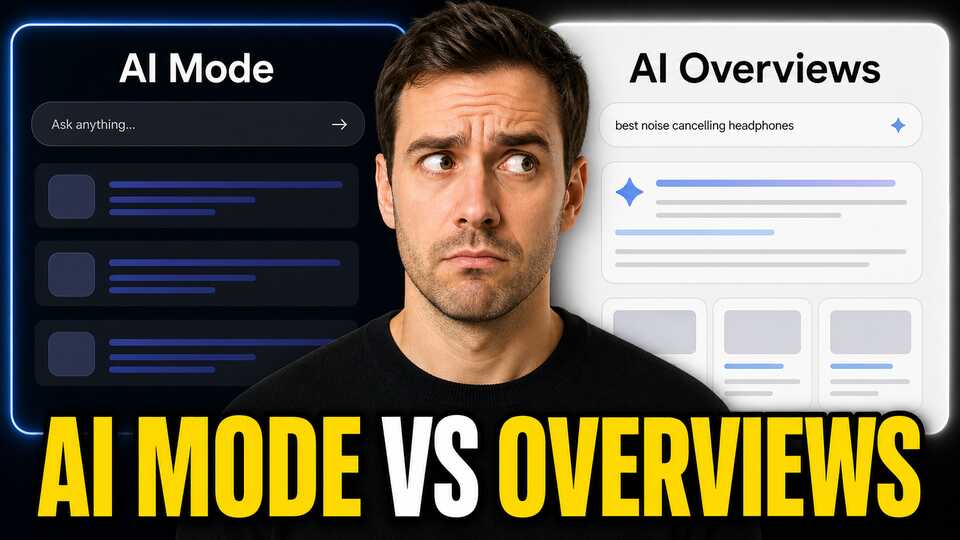
Google has released two AI-powered search features in the past two years, and most marketers treat them as the same thing. They're not. AI Mode and AI Overviews have different architectures, draw from different source pools, reward different types of content, and respond to different optimization strategies. Treating them interchangeably is one of the more expensive mistakes a search marketer can make in 2026, because the optimization playbook for one actively conflicts with the playbook for the other.
The clearest evidence of how different these two products are: Ahrefs research found that AI Mode and AI Overviews share only approximately 13% of the URLs they cite. If you're optimizing to appear in one, there's an 87% chance that work is doing nothing for the other.
What Each Product Actually Is
The confusion is understandable because Google hasn't always been clear in its marketing. Here's the distinction:
AI Overviews is the summary box that appears at the top of standard Google search results pages. It generates a short, synthesized answer to a query and attributes it to a handful of cited sources. It launched widely in 2024 and appears on a subset of queries, primarily informational ones where Google believes a summarized answer is useful. You don't have to do anything to access AI Overviews; it appears in the same search interface you've always used.
AI Mode is a separate tab within Google Search, a full AI-powered search experience that replaces the traditional results page entirely within that tab. Google announced AI Mode as a more capable, reasoning-focused product designed for complex, multi-part queries. It uses a more sophisticated retrieval and reasoning process than AI Overviews, performs multi-step web research within a single query, and can handle follow-up questions within the same session.
In practical terms: AI Overviews is AI augmenting traditional search. AI Mode is AI replacing traditional search within a dedicated interface.
How Each Product Selects Sources
This is where the differences have the most direct impact on SEO and GEO strategy.
AI Overviews source selection is tightly integrated with Google's existing search index and ranking signals. It overwhelmingly cites pages that already rank in the top positions for a given query. If a page isn't in the running for a top-10 ranking on a query, its chances of appearing in the AI Overview for that query are low. AI Overviews essentially draws from the pool of pages Google's algorithm has already determined to be authoritative for a topic, which means traditional SEO signals (domain authority, backlinks, on-page optimization, E-E-A-T signals) are the primary levers.
Research into Google's patent filings related to AI Overviews and AI Mode supports this picture: AI Overviews is described as drawing heavily from featured snippet candidates and high-ranking pages, with the AI layer adding synthesis and formatting on top of existing index signals.
AI Mode source selection works differently. AI Mode performs what Google describes as multi-step reasoning, it breaks a complex query into sub-queries, runs those sub-queries against the web, retrieves content from multiple sources, synthesizes the results, and presents a unified answer. This means it can and does cite pages that don't necessarily rank in the traditional top 10 for a query. What it's looking for is content that provides the specific information needed to answer a sub-question within a larger research task.
A page that provides an unusually detailed explanation of a narrow technical topic, or that contains original data not available elsewhere, has a meaningful chance of appearing in AI Mode even if it doesn't rank in the top 10 for the head query. That's fundamentally different from how AI Overviews works.
The 13% URL Overlap Finding
The Ahrefs research reported by Search Engine Journal found that only around 13% of URLs cited in AI Mode responses were also cited in AI Overviews for comparable queries. This is the most concrete evidence that these two products are operating with fundamentally different source selection logic.
For marketers, this finding has direct implications:
- Appearing in AI Overviews does not give you meaningful coverage in AI Mode, and vice versa.
- A brand could be completely absent from AI Mode while still appearing in AI Overviews, and would have a false sense of AI visibility if they only tracked one surface.
- The optimization work required to appear in each surface is different enough that it probably belongs in different parts of the content calendar.
The 87% non-overlap also suggests that AI Mode is pulling from a much broader source pool than AI Overviews. Traditional SEO optimizations that concentrate effort on ranking high for head terms will capture AI Overviews visibility but miss a large portion of AI Mode coverage.
Content Types That Perform in Each Surface
For AI Overviews:
- Pages that already rank in the top 3–5 positions for the target query
- Content with a clear featured-snippet structure, a direct answer in the first paragraph, followed by supporting detail
- Pages with strong E-E-A-T signals: author bylines, credentials, publication dates, and citations to authoritative sources
- Content that matches the informational intent of the query closely, AI Overviews rarely appears on transactional queries
- Shorter, more concentrated answers tend to get extracted more than long-form content where the key point is buried
For AI Mode:
- Detailed, specific content that answers a narrow sub-question exceptionally well
- Original research, data, and analysis that doesn't exist elsewhere on the web
- Fresh content, AI Mode's multi-step retrieval rewards recency more than AI Overviews does
- Comprehensive topic coverage: content that covers a subject from multiple angles gives AI Mode more to work with when synthesizing answers
- Content structured around specific use cases, personas, or scenarios that match how people formulate complex queries
The practical implication: AI Overviews rewards concentration (the best possible page for a high-priority query), while AI Mode rewards breadth and depth across a topic cluster.
Which Signals Matter for Each
Understanding which ranking signals each product weights most heavily helps you allocate optimization effort correctly.
AI Overviews ranking signals:
- Traditional SEO authority, domain rating, backlinks, and existing SERP position are the strongest predictors
- Structured answer format, clear H2/H3 headings, concise opening paragraphs, and lists that can be extracted
- E-E-A-T signals, author credentials, publication source authority, and citation practices
- Query match precision, tight relevance to the specific query phrasing, not just broad topic coverage
AI Mode ranking signals:
- Content freshness and update recency, AI Mode weights recent content more aggressively
- Information uniqueness, pages with original data, analysis, or perspectives unavailable elsewhere get cited more. The concept of information gain as a ranking factor is particularly relevant here
- Topical depth, comprehensive topic coverage signals that a page is a reliable source on a subject
- Structured data and schema markup, schema markup for GEO helps AI Mode correctly categorize and extract content
- Internal linking and topic cluster architecture, AI Mode appears to reward sites where related content is well-organized and cross-linked
Optimization Checklist for AI Overviews
- Identify your highest-priority informational queries and verify you're ranking in the top 5 for them. If you're not ranking, fix the SEO problem first, AI Overviews is downstream of ranking.
- Audit your top-ranking pages for featured-snippet structure. Add a direct, concise answer in the opening paragraph if one isn't there.
- Add schema markup (FAQ, HowTo, Article) where appropriate to reinforce structured data signals.
- Ensure author credentials and publication dates are clearly visible and accurate.
- Add internal links to related authoritative content to reinforce E-E-A-T signals across the topic cluster.
- Check whether AI Overviews appears for your target queries and audit which pages are being cited, then compare them to yours to identify the gap.
Optimization Checklist for AI Mode
- Publish original research, data, or analysis in your category at least once per quarter. Original data is the single highest-leverage move for AI Mode visibility.
- Build out topic cluster depth: if you have one strong page on a topic, add supporting pages covering adjacent questions, sub-topics, and use-case variants.
- Update your most important pages more frequently, even minor updates with fresh data signal recency to AI Mode's retrieval system.
- Expand your content to cover the long-tail, specific sub-questions your audience asks. AI Mode's multi-step retrieval favors pages that answer narrow questions exceptionally well.
- Add an llms.txt file to your site to signal to AI crawlers which content is most important and how it should be interpreted.
- Track which of your pages appear in AI Mode responses using a consistent prompt library, this data is impossible to get from Google Search Console and requires dedicated tracking.
Why You Need to Track Both Separately
Many marketing teams make the mistake of assuming that their Google Search Console data tells them something about AI Mode or AI Overviews visibility. It doesn't, at least not directly. GSC can show you clicks and impressions from AI Overviews to some extent, but it gives you no visibility into AI Mode citation rates, which specific prompts trigger your content, or how your brand is framed in either surface.
The right approach is to build a prompt library representing your category's key queries, run those prompts against both surfaces on a regular cadence, and track which of your pages appear in which surface. This gives you a clear picture of your actual AI visibility, not a proxy metric derived from traditional search data.
Understanding the difference between AI Mode and AI Overviews is also relevant to how you think about getting cited in Google AI Overviews specifically, which requires a different approach than optimizing for AI Mode. The AI share of voice concept matters differently in each context.
The brands that will dominate AI search in 2026 are the ones that understand these distinctions and build programs that address each surface deliberately, rather than assuming that ranking well in traditional search is sufficient, or that one AI optimization strategy covers all surfaces. BabyPenguin tracks brand citations and mentions across Google AI surfaces, ChatGPT, and Grok, giving you the cross-platform visibility data you need to build an optimization strategy that actually covers the ground where your buyers are searching.