How to Build an Internal LLM Brand Monitoring Pipeline
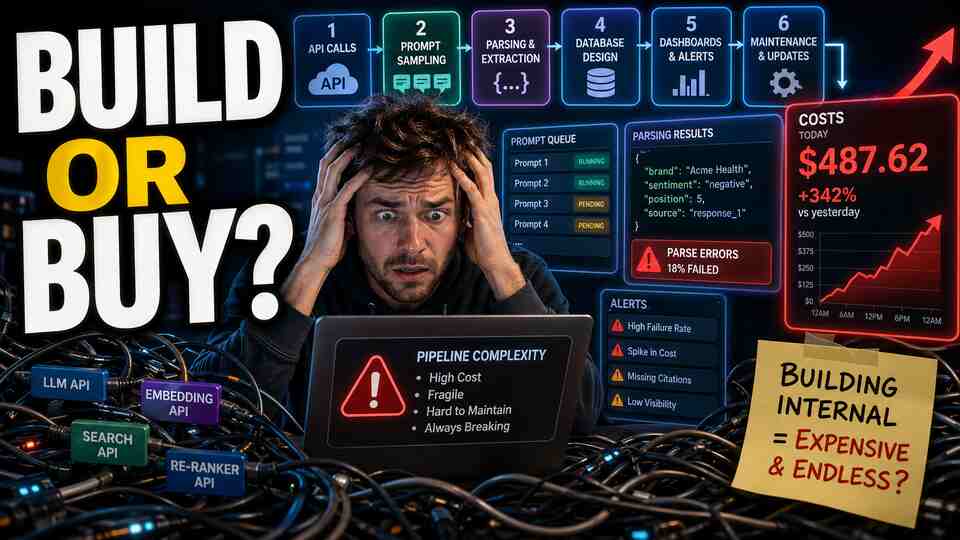
You've been asked to track your company's visibility in AI-generated responses. You looked at the monitoring tools on the market and thought: we could build this. It's just API calls, some parsing, and a database. How hard could it be?
This is a reasonable instinct. For many data problems, building internally is the right call. For LLM brand monitoring, the real costs are significantly higher than they appear initially. Let's go through exactly what building requires, what it costs, and where the maintenance burden compounds over time. Then you can make an honest build-vs-buy decision.
The API Layer
You need programmatic access to each AI engine you want to monitor. Each has different pricing, rate limits, and API behavior.
OpenAI's API for ChatGPT access currently runs at $0.002 to $0.06 per 1,000 tokens depending on model tier. A typical monitoring prompt plus response might consume 500 to 1,500 tokens. If you're running 50 prompts across 20 runs each (the minimum for statistically meaningful citation rates), that's 1,000 API calls per monitoring cycle per engine. At a conservative $0.01 per call, that's $10 per engine per cycle. Run weekly across four engines and you're at $160 per month in API costs alone, before any of your engineering time or infrastructure.
Google Gemini API pricing is in a similar range. xAI's Grok API is available but has its own pricing structure and rate limits. Each engine requires separate API credentials, separate client library setup, and separate error handling for the specific failure modes each one has.
This is just the data collection layer. You haven't built anything yet.
Prompt Sampling Logic
You need a prompt management system that handles:
- Storing and versioning your tracked prompts
- Scheduling prompt runs across multiple engines
- Running each prompt N times per cycle (not just once, for statistical reliability)
- Rate limit handling and exponential backoff when engines throttle you
- Retry logic for failed or malformed responses
- Parallelization so monitoring cycles don't take hours
The non-determinism problem makes the sampling logic more complex than it looks. If you run each prompt once, the data is too noisy to be useful. Run it 20 times and you start getting meaningful citation rates. But 20 runs per prompt per engine per week at scale means you need robust queue management and error handling, not just a cron job that loops through a list.
This is probably 2 to 3 weeks of engineering work to do correctly, plus ongoing debugging as API behavior changes.
Result Parsing
LLM responses are unstructured text. You need to extract structured signal from them:
- Was your brand name mentioned? (Handle capitalization variants, common misspellings, abbreviations)
- Was a competitor mentioned? (Same complexity, across multiple competitors)
- In what context was each mention made? (Recommendation, comparison, negative reference, neutral mention)
- What position in the response did each mention appear? (First in list, mid-list, buried in a paragraph)
- Were any URLs cited as sources? (Extract and normalize them)
Context detection is particularly hard. Distinguishing "BrandX is the market leader" from "BrandX has some limitations" requires either regex rules that become unmaintainable or running a secondary LLM call to classify each response, which adds cost and latency.
Citation URL extraction sounds simple but isn't. Different engines format citations differently, sometimes as footnotes, sometimes inline, sometimes in a separate section. Your parser needs to handle all of them, plus handle format changes when the engines update their output format (which they do, without notice).
Database Schema
You need a schema designed for time-series comparison, not just logging. At minimum:
- A prompts table with versioning (you'll want to know if a prompt changed)
- A runs table linking each execution to a prompt, engine, and timestamp
- A mentions table recording what was mentioned in each run
- A citations table recording URLs cited in each run
- Aggregate tables or views for citation rates by prompt/engine/week
The query patterns for trend analysis are different from the query patterns for raw data retrieval. You'll spend time either building materialized views or accepting slow dashboard queries. If your dataset grows to millions of rows within a year (likely if you're monitoring seriously), query performance becomes a real engineering concern.
Dashboarding
Raw data in Postgres is not useful for your marketing team. You need a dashboard that shows:
- Citation rates by prompt and engine over time
- Competitor comparison charts
- Citation source domain analysis
- Week-over-week change indicators
If you use an off-the-shelf BI tool like Metabase or Grafana, you save development time but add a tool to maintain and potentially license. If you build a custom interface, you're looking at another several weeks of work and ongoing frontend maintenance.
Either way, this is not a one-day task, and it's not a one-time cost. Every time the product team asks for a new view or metric, it's an engineering ticket.
The Maintenance Burden
This is where the build-vs-buy calculation really tilts. The one-time build cost is significant but bounded. The maintenance burden is ongoing and tends to grow.
API changes. Every AI engine periodically changes its API, output format, pricing, or rate limits. Each change requires a developer to update the affected components. This isn't hypothetical: OpenAI, Google, and others have all made breaking changes to their APIs in the past 18 months. Each change is unplanned engineering work.
New engines. AI search is expanding. When a new engine reaches meaningful market share, you need to add it to your pipeline. This means new API integration, updated parsing logic, database migrations, and dashboard changes.
Prompt library maintenance. The prompts that matter for AI brand visibility shift as the market evolves. New use cases emerge, buyer language changes, competitors change positioning. Your prompt library needs regular review and updates, which requires someone who understands both the product and the monitoring methodology.
Statistical methodology review. As your dataset grows, you'll find edge cases where your citation rate calculations are misleading. Prompts where response format changes break your parser. Engines that return rate limit errors in a format that looks like a valid response. Catching and fixing these requires someone who understands both the data engineering and the statistical methodology.
Realistically, maintaining a serious internal LLM monitoring pipeline requires 0.25 to 0.5 FTE of ongoing engineering attention. At a loaded cost of $150,000 to $200,000 per year for a mid-level engineer, that's $37,500 to $100,000 per year in personnel cost, plus API costs, plus infrastructure. For a pipeline that is entirely internal tooling, not a product your company ships.
When Building Makes Sense
There are cases where building internally is the right call. If you need monitoring at a scale that no commercial tool supports (tens of thousands of prompts per week, custom engine integrations, deeply proprietary prompt logic), building may be necessary. If your company has regulatory requirements that prevent using third-party SaaS for this type of data, you may have no choice.
If neither of those applies, the math usually favors buying.
What BabyPenguin Replaces
BabyPenguin handles the entire pipeline described above: API connections to ChatGPT, Gemini, Grok, and more; systematic multi-run sampling; structured result parsing with context detection; citation source extraction; trend storage; and a dashboard designed for marketing teams to actually use.
You get prompt-level visibility into which specific questions trigger brand mentions, side-by-side competitor comparison from the first day, and citation source analysis showing which domains AI engines pull from when they cite your competitors. The methodology for handling LLM non-determinism is built in, so citation rates are statistically meaningful rather than noisy single-run snapshots. You can read more about how LLM citation tracking reliability works in practice.
There's no enterprise procurement process and no long-term contract. Most teams have real data within the first week. The ongoing cost is a small fraction of what internal engineering time would cost, and the maintenance burden is zero.
For teams that want to understand how to get mentioned more often in the first place, the guide to increasing ChatGPT brand mentions covers the content strategy side. The monitoring pipeline is what tells you whether that strategy is working.
The Honest Recommendation
Build if you have specific requirements that no commercial tool can meet. Otherwise, buy.
The engineering hours you'd spend building and maintaining an internal monitoring pipeline are almost always better spent on problems that are actually differentiated for your business. LLM brand monitoring is a solved problem for most teams. Treat it like one.