LinkedIn in AI Search: Is LinkedIn Content Getting Cited?
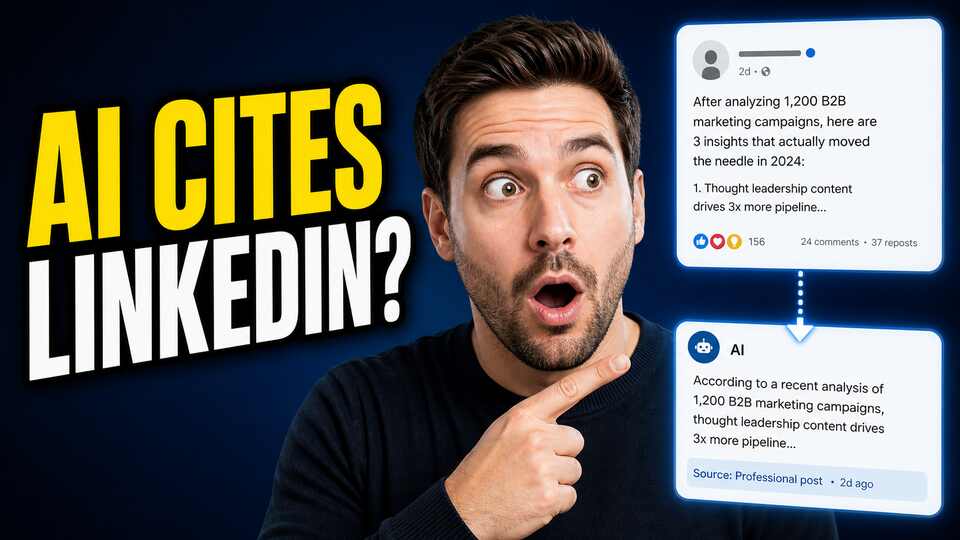
LinkedIn is the second most-cited platform in AI search answers, and almost nobody in the GEO community is talking about it. While marketers obsess over Reddit's influence on AI outputs and debate the citability of Wikipedia, LinkedIn has quietly become one of the most powerful organic levers for brand and professional visibility in AI-generated responses. A large-scale study analyzing citation patterns across AI engines found LinkedIn sitting behind only Reddit in frequency of citation, ahead of YouTube, Quora, and virtually every individual publication. If your brand is absent from LinkedIn, or present but dormant, you're leaving a significant AI visibility advantage on the table.
The reasons LinkedIn gets cited are structural, not accidental. Understanding those reasons lets you engineer a LinkedIn presence that compounds your AI visibility over time, particularly if you operate in a B2B or professional services context where authoritative expert signals matter most.
How Frequently Does LinkedIn Appear in AI Answers?
The data on LinkedIn's AI citation rate is striking. Search Engine Land's analysis of AI citation patterns found that Reddit, YouTube, and LinkedIn dominated the citation landscape across major AI search engines, with LinkedIn particularly prominent in professional, business, and expertise-related query categories.
A deeper analysis from Semrush examining 89,000 LinkedIn URLs cited in AI answers found that LinkedIn citations cluster in specific content types and query categories, and that the gap between high-performing and low-performing LinkedIn content is large. Not all LinkedIn activity translates equally into AI citations, but the content types that do perform well, perform very well.
The ALM Corp study of 325,000 prompts confirmed LinkedIn as the #2 cited platform, finding particularly high citation rates for professional identity verification queries ("who is [person]," "what does [company] do"), competitive comparisons in B2B categories, and expert opinion queries ("what do marketing professionals think about X").
Which AI Engines Cite LinkedIn Most
Not every AI platform treats LinkedIn content the same way, and the differences reflect each platform's underlying architecture.
Perplexity cites LinkedIn most aggressively of the major AI engines. Its real-time retrieval architecture means it actively crawls and indexes LinkedIn public pages, company pages, profiles, and articles, as live web content. When answering professional or business queries, Perplexity frequently surfaces LinkedIn company pages as authoritative sources about what a company does and how it positions itself.
Gemini integrates Google Search results, and LinkedIn content ranks well in Google for professional queries. Company pages and LinkedIn articles that rank on page one of Google for relevant searches are consequently more likely to appear in Gemini's responses. Google's indexing of LinkedIn public content provides a well-established pipeline.
ChatGPT references LinkedIn less frequently in real-time retrieval (where it has access to the web), though LinkedIn profiles and articles remain part of its training data. The training data path means established LinkedIn presence contributes to entity recognition even when direct citation doesn't occur.
Grok, built on X/Twitter's infrastructure, shows lower LinkedIn citation rates, not surprising given the platform relationship dynamics. For LinkedIn-specific AI visibility, Perplexity and Gemini are the primary targets. You can learn more about how Gemini surfaces brands to understand how Google's indexing pipeline feeds into this.
What Types of LinkedIn Content Get Cited
The Semrush analysis of 89,000 cited LinkedIn URLs is particularly actionable because it breaks down citation rates by content type. The patterns are clear enough to inform a deliberate content strategy.
Long-form LinkedIn articles significantly outperform short posts. LinkedIn's native article format, the one that lives at linkedin.com/pulse/, is indexed by Google as standalone content and treated by AI engines as a substantive source in a way that status updates and short posts simply aren't. A 1,200-word LinkedIn article on a professional topic can accumulate citations in AI answers for years. A 200-word post rarely does.
Company pages outperform personal profiles for product and service queries. When someone asks AI engines "what does [company] do," "what is [product]," or "who are the main providers of [service category]," company pages are the primary citation target. A complete, well-maintained company page with accurate product descriptions, employee count, industry categorization, and regular content updates becomes an authoritative reference point for AI entity recognition.
Personal thought-leadership content outperforms company content for expert opinion queries. When AI engines answer "what do experts think about X" or "what is the current thinking on Y in [industry]," they look for individual professionals with credible personal profiles making substantive claims. A VP of Engineering explaining their company's technical approach in a long-form post creates different citation value than the same content published on the company page.
Content with specific data points, frameworks, or original perspectives gets cited at higher rates. This mirrors the pattern seen across all AI citation research: information-dense content outperforms opinion or promotional content. A LinkedIn article presenting original survey data, a novel framework, or a counterintuitive claim backed by evidence gives AI engines something substantive to cite.
Why LinkedIn Gets Cited: The Authority Signal Stack
LinkedIn's citation advantage stems from a convergence of signals that AI engines find compelling:
Verified professional identity. LinkedIn's platform enforces professional identity norms in ways few other content platforms do. Real names, real employers, real job histories. AI engines appear to weight content from platforms with strong identity verification, it's harder to fabricate a professional history with 500 connections, endorsements, and a 10-year job history than to create an anonymous forum account.
Institutional affiliation signals. When a person posts on LinkedIn, their content is semantically linked to their employer, their industry, and their professional peer network. A post from the Head of Product at a recognized enterprise software company carries implicit institutional authority that a blog post on an obscure domain doesn't. AI engines appear to propagate some of that institutional authority to the content itself.
Google indexing at scale. LinkedIn public content is heavily indexed by Google and ranks well for professional queries. High Google rankings correlate with AI citation rates, content that Google treats as authoritative tends to be treated similarly by AI systems trained on or integrated with Google's index.
Platform longevity and content persistence. Unlike social media posts that disappear from relevance within hours, LinkedIn articles and well-performing posts maintain their search rankings and AI citation potential for extended periods. Content written in 2023 is still being cited in 2026 AI answers if it remains authoritative on its topic. This is explored in more depth in our article on why content freshness matters for AI citations, freshness helps, but topical authority from established content compounds over time.
The Professional Authority Signal: Entity Recognition Beyond Direct Citations
There's a more subtle LinkedIn effect that most GEO practitioners miss. Even when AI engines don't directly cite your LinkedIn company page in a response, your LinkedIn presence contributes to something equally important: entity recognition.
AI knowledge systems build representations of entities, companies, people, products, concepts, by aggregating signals from across the web. A well-maintained LinkedIn company page, consistent with your website's description of what you do, your domain, and your professional positioning, contributes to the coherence of your brand entity in AI models. It's one more data point confirming that your brand is a real, recognized organization operating in a specific category.
This entity recognition effect is particularly important for newer companies and challenger brands that lack the years of Wikipedia entries, press coverage, and academic citations that large incumbents accumulate. A thorough LinkedIn presence is one of the fastest ways to build legitimate entity signals.
The practical implication: make sure your LinkedIn company page description matches the language you use on your website, in your press releases, and in your content. Entity consistency across sources is one of the most important factors in building strong AI entity recognition, and LinkedIn is one of those sources.
A Practical B2B LinkedIn Strategy for AI Visibility
B2B companies benefit most from LinkedIn's AI citation patterns, since the platform's professional authority signals align closely with the types of queries B2B buyers make. Here's a concrete framework:
Company page optimization:
- Complete every field: company description, industry, employee count, specialties, and website URL. Incomplete profiles have lower entity coherence.
- Write your company description using the same core terminology you use in your primary web content. Avoid marketing jargon, use category language that AI engines recognize.
- Post consistently, at minimum twice per month. Dormant company pages carry weaker signals than active ones.
- Include product or service pages within LinkedIn's native page structure. These create additional indexable content about your offerings.
Long-form article strategy:
- Publish long-form articles (1,000+ words) on topics where you want AI visibility. The topic of the article should match queries you want to appear in.
- Include original data, frameworks, or substantive expert perspective, not product promotions or case study summaries.
- Write headlines as question or answer formats: "Why [common belief] is wrong" or "How [professional role] can [achieve outcome]" formats tend to match AI query patterns.
- Distribute articles through employee networks to build initial engagement signals that support Google indexing.
Personal thought leadership for expert queries:
- Identify two or three company executives or subject matter experts who can represent the brand's intellectual perspective.
- Have these individuals publish substantive posts and articles on topics where you want expert-opinion visibility.
- Ensure their LinkedIn profiles are complete, accurate, and consistent with the company page. Professional entity coherence matters at the individual level too.
- This approach is especially relevant for GEO strategy in B2B contexts, where expert opinion queries are common and high-value.
What LinkedIn Content to Avoid for AI Visibility
Not all LinkedIn activity helps, and some of it may actively dilute your brand's entity signals if it's inconsistent with your positioning.
Don't post content that's primarily promotional: product announcements, case study summaries, or "we're hiring" posts contribute minimally to AI citation potential. They're not informational in the way AI engines prioritize, and they don't build the topical authority that drives citations.
Don't post very frequently with low-value content. Engagement bait, reactive takes on trending topics, and generic motivational content may build LinkedIn follower counts but they won't build AI citation signals. Quality and topical consistency matter far more than posting volume.
Don't be inconsistent in how you describe your company or its category. If your website says you're a "customer data platform" and your LinkedIn page says you're an "AI-powered CRM," you're creating entity confusion. AI systems will see conflicting signals and have lower confidence in your entity representation.
Measuring LinkedIn's Contribution to Your AI Visibility
Attributing AI visibility gains specifically to LinkedIn activity requires systematic tracking. The lag between publishing content and seeing AI citation effects can range from a few weeks to several months, depending on indexing speed and how quickly AI engines update their source pools.
The most practical measurement approach is to track your brand's mention rate and citation rate across relevant queries before and after significant LinkedIn content investments, then isolate whether improvements correlate with LinkedIn indexing events. A structured AI visibility measurement framework is necessary to do this rigorously.
Tracking which specific sources AI engines cite when mentioning your brand also reveals whether your LinkedIn content is contributing, or whether you're generating LinkedIn activity that isn't translating into citation appearances. This requires the kind of ongoing citation monitoring that BabyPenguin provides: systematic tracking of brand mentions and source citations across ChatGPT, Gemini, and Grok, with the granularity to see whether your LinkedIn investment is paying off in AI visibility terms.