GEO for Healthcare: Visibility, Trust, and Compliance in AI Search
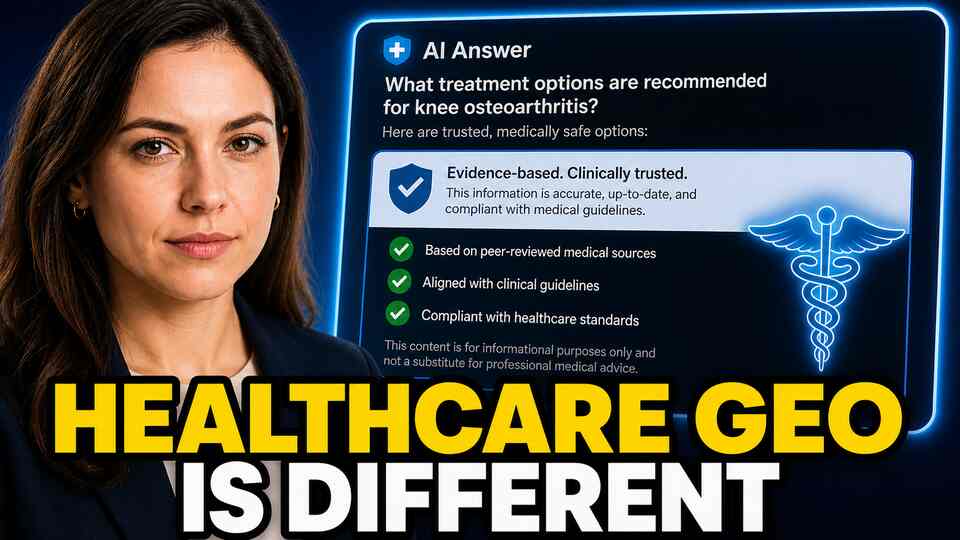
Healthcare is the most consequential category in AI search. When a user asks ChatGPT "what does this symptom mean?" or "is [medication] safe with [other medication]?", the AI's answer can directly affect their health decisions. The stakes are higher than in any other industry, and so are the standards. Google applies the strictest YMYL ("Your Money or Your Life") quality treatment to healthcare content, and AI engines have absorbed that bias.
For healthcare brands, this is both an existential challenge and a meaningful opportunity. Here's how to win visibility, trust, and compliance in healthcare AI search.
Healthcare is the highest-stakes AI search category
One Search Engine Land guide on AI-era SEO for regulated industries puts it directly: "Accuracy has real-world consequences in healthcare." AI engines pulling information across the web need clear signals of medical soundness and expert authorship, and they apply much stricter trust standards to medical content than they do to most other categories.
Healthcare GEO isn't a marketing optimization. It's a quality and safety discipline. The brands that take it seriously become trusted sources AI engines reach for when answering medical questions. The brands that don't risk being misrepresented in answers patients can't easily verify, and the consequences of that misrepresentation can be measurable harm.
Step 1: Author or review every piece of content with licensed professionals
The single highest-leverage requirement for healthcare GEO is professional authorship. The SEL guide is direct: "All healthcare content should be authored or reviewed by licensed medical professionals, with credentials displayed prominently."
For each piece of healthcare content:
- Display the author's full name, title, and credentials at the top of the article (e.g., "Reviewed by Dr. Maria Hernandez, MD, Board-Certified Internal Medicine")
- Link to a real bio page with the author's full background, certifications, and publications
- Use Person schema with sameAs links to the author's authoritative profiles (medical license verification, hospital staff page, professional society membership)
- Show the date of authorship and last review prominently
- If the author is a reviewer rather than the writer, name both the writer and the medical reviewer with their respective credentials
This isn't legal cover. It's the credibility infrastructure AI engines look for when deciding whether to cite medical content. A page with named, credentialed medical authors is dramatically more likely to be cited than the same content authored anonymously or by a content marketer.
Step 2: Meet the highest E-E-A-T standards
Healthcare content must meet the highest expertise, experience, authoritativeness, and trustworthiness benchmarks. The Search Engine Land guidance reinforces this: AI engines treat E-E-A-T not as a tip but as a requirement for medical content.
The signals to invest in:
- Expertise, credentialed medical authors with verifiable backgrounds, not generalist content marketers
- Experience, first-hand clinical experience demonstrated through specific examples, case studies, or practitioner perspectives
- Authoritativeness, citations from peer-reviewed research, established medical organizations (Mayo Clinic, NIH, CDC, WHO), and academic sources
- Trustworthiness, clean technical health, transparent business information, no patterns of misleading or low-quality content
None of these are individually decisive. All of them compound. Healthcare brands that invest in all four become the canonical sources AI engines reach for. Brands that skip any of them get filtered out for being insufficiently credible for medical claims.
Step 3: Use medical-specific schema types
The schema vocabulary for healthcare is unusually well-developed, and most healthcare sites underuse it. The types that matter most:
- MedicalOrganization, for hospitals, clinics, practices, and medical brands
- Physician, for individual practitioners with credentials, specialties, and contact info
- MedicalCondition, for content describing specific conditions, with associated symptoms and treatments
- MedicalProcedure, for content describing specific medical procedures, with risks and outcomes
- Drug, for content about specific medications, with dosage, side effects, and interactions
- MedicalWebPage, for medical content pages, with audience and lastReviewed properties
Each schema type tells AI engines exactly what kind of medical content the page is, dramatically improving the chance of being cited correctly when users ask category-specific medical questions. Validate every schema implementation with Google's Rich Results Test before shipping.
Step 4: Reference HIPAA, FDA, and regulatory frameworks explicitly
The SEL guide notes that healthcare brands must include "HIPAA and FDA disclaimers, risk-benefit statements, and clear distinctions between informational versus advisory material." AI engines pick up on these references as credibility signals, content that explicitly addresses regulatory frameworks reads as professionally produced and compliant.
For each piece of healthcare content:
- Include the appropriate disclaimer (educational only, not medical advice, etc.)
- Reference the regulatory framework that applies (FDA approval status for treatments, CMS guidelines for procedures)
- Distinguish clearly between informational content and personalized medical advice
- Include risk-benefit statements where you discuss treatments or procedures
- Direct readers to qualified healthcare providers for personalized care decisions
Step 5: Cite primary medical sources
Healthcare content gets cited by AI engines at higher rates when it cites authoritative primary sources itself. The hierarchy:
- Peer-reviewed medical journals (NEJM, JAMA, Lancet, BMJ)
- Government health agencies (CDC, NIH, FDA, WHO)
- Major medical institutions (Mayo Clinic, Cleveland Clinic, Johns Hopkins)
- Professional medical societies (AMA, ACP, ACOG, etc.)
- Established health publications with editorial standards
For each medical claim in your content, cite the primary source. Link to the original study, the CDC page, or the medical organization's published guidance. This shows AI engines that your content is anchored in legitimate medical evidence, and gives them an authoritative trail to verify.
Step 6: Maintain content with explicit revision histories
Healthcare content goes stale faster than most categories. Treatment guidelines change. New research emerges. Drug interactions get updated. AI engines weight medical content freshness heavily because outdated medical information is uniquely dangerous.
The discipline:
- Display "Last reviewed" dates prominently on every medical article, with the reviewing physician's name
- Show revision histories when major content updates happen
- Schedule reviews on a real cadence, at least annually for evergreen content, more frequently for fast-moving topics like new treatments or emerging conditions
- Update both the visible date and schema dateModified when content changes
The visible "Last reviewed by Dr. Hernandez, MD on April 2026" stamp is one of the strongest trust signals you can give an AI engine evaluating medical content.
Step 7: Make accessibility and privacy signals prominent
The SEL guide is explicit that healthcare sites should ensure WCAG and ADA compliance and that "Privacy policies and security practices requiring prominent placement and plain-language explanations."
This isn't just about regulatory compliance, it's about credibility. Healthcare sites with broken accessibility, hidden privacy policies, or unclear HIPAA practices read as unprofessional to both human visitors and AI engines. The signals to make prominent:
- WCAG-compliant site structure and accessibility features
- Privacy policy linked from every page
- HIPAA notice of privacy practices easily findable
- Security and encryption standards explained in plain language
- Patient rights and data handling practices documented
Step 8: Track AI accuracy on medical prompts obsessively
For healthcare specifically, monitoring AI accuracy isn't optional. Build a tracking set of prompts about your specific area of medicine, symptoms, conditions, treatments, drug interactions, and run them weekly through ChatGPT, Gemini, Perplexity, and other major engines.
For each tracked answer, verify:
- Is the medical information factually correct?
- Are required disclaimers and risk-benefit statements included?
- Is the AI making any claims that would fail your internal medical review?
- Is your brand being cited as a source, and if so, accurately?
When you find inaccuracies, investigate and correct the underlying source. Healthcare misrepresentations can have real-world consequences, finding them requires active monitoring, not passive hope.
The healthcare GEO playbook
Author every piece of content with licensed medical professionals and display credentials prominently. Meet the highest E-E-A-T standards. Use medical-specific schema types (MedicalOrganization, Physician, MedicalCondition, MedicalProcedure, Drug, MedicalWebPage). Reference HIPAA, FDA, and regulatory frameworks explicitly. Cite primary peer-reviewed medical sources. Maintain content with visible revision histories. Make accessibility and privacy signals prominent. Track AI accuracy on medical prompts weekly.
Healthcare GEO is the highest-stakes industry application of AI search optimization. There's no shortcut, only the disciplined application of professional standards to AI-era content infrastructure. Get it right and you build durable AI authority that serves patients well. Get it wrong and the consequences aren't just traffic losses, they're real-world harm and legal exposure.