LLM Perception Drift: Why Your Brand Reputation in AI Search Changes Without Warning
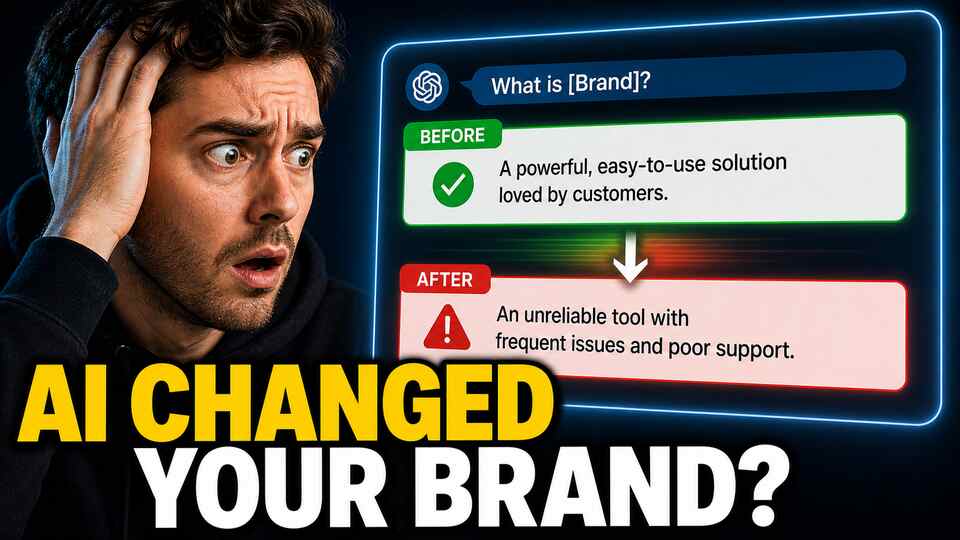
Imagine waking up one morning to find that ChatGPT now describes your SaaS product as "outdated" and your competitor as "the modern alternative." You haven't changed anything. Your product hasn't shipped a regression. But somewhere in the last few months, the way AI models talk about your brand has quietly shifted, and you had no idea it was happening.
This is LLM perception drift. It's one of the most underappreciated risks in brand management right now, and it's going to get more important as AI search becomes a primary discovery channel.
What LLM Perception Drift Is
Large language models aren't static. They're retrained periodically on new corpora of text from the web. When a model retrains, it updates its internal representation of every entity it knows about, including your brand. Whatever content existed on the web during the training window gets baked into the model's understanding. Content that disappeared, or was published after the cutoff, doesn't.
Perception drift happens when the content landscape around your brand changes between training cycles in ways that shift how the model represents you. A negative long-form review published by a major tech outlet. A competitor's aggressive PR campaign that positions them as superior to you. A product recall or data breach covered widely in the press. A wave of critical posts on Reddit. All of these can alter the training signal the model receives about your brand, and therefore alter how it describes you going forward.
As Search Engine Land notes, LLM perception drift is emerging as one of the key metrics for 2026, precisely because brands have almost no visibility into it. Unlike a Google ranking drop, which shows up in your Search Console data within days, a shift in how an AI model describes your brand is invisible unless you're actively probing for it.
How Drift Happens in Practice
The mechanism is straightforward, even if the effects are hard to predict. Between two training cycles, the distribution of content about your brand on the web shifts. Maybe your brand generates 500 positive articles and 20 negative ones in one period, and then 300 positive articles and 80 negative ones in the next. The model that gets trained on the second dataset will have a meaningfully different internal representation of your brand, even if the absolute volume of coverage is similar.
The sources that matter most are those the model weights most heavily, primarily authoritative publications, established review platforms, and high-traffic community forums. A single critical article in TechCrunch or Wired carries more weight than dozens of positive blog posts on smaller sites. This asymmetry means that bad press punches above its weight in the training signal.
Competitor actions can also drive drift in your perception. If a competitor launches a major marketing push and generates hundreds of articles positioning themselves as superior to incumbents (meaning you), those articles create a contrast that gets encoded in the model. The next version of that model may describe your category differently, with your competitor framed as the leader and you as the legacy option, even if the underlying product reality hasn't changed.
Why Detection Is Hard
The challenge with perception drift is that there's no dashboard for it. Traditional brand monitoring tools track mentions in real-time media. They can tell you when a negative article gets published. But they can't tell you how an AI model is currently representing your brand, or how that representation has changed since the last training cycle.
To detect drift, you need to systematically probe AI models with structured prompts over time. This isn't a one-time exercise. It requires a consistent methodology, asking the same or equivalent questions across the same AI platforms at regular intervals, and comparing the responses. Only when you have time-series data on how AI describes your brand can you identify when a shift has occurred and try to correlate it with events in the external environment.
The types of prompts that reveal perception most clearly aren't brand-direct queries like "what is [brand]?" They're comparison and recommendation queries: "what are the differences between [brand] and [competitor]?" and "which [category] tool would you recommend for [use case]?" and "what do users say about [brand]?" These reveal how AI has synthesized the broader discourse about your brand, not just its factual understanding of you.
We break down the methodology for this kind of probing in our article on how to audit how AI models talk about your brand. If you're not running something like this already, you should be.
Stabilizing Your Brand's AI Representation
You can't control what LLMs say about you directly. You can't submit a ticket to OpenAI asking them to update your brand description. But you can influence the training signal by shaping the content landscape that models train on.
The core strategic response to perception drift risk is building a strong, consistent, positive content corpus about your brand across authoritative independent sources. This means several things in practice:
- Maintaining a steady drumbeat of earned media coverage. Not just at product launch, but consistently throughout the year. If your brand generates positive coverage at a high rate, negative coverage becomes a smaller fraction of the training signal. Volume matters as a dilution mechanism.
- Managing your review platform presence proactively. Review sites are heavily weighted in AI training data because they represent user-generated, independent assessments. A declining star rating on G2 or Trustpilot is a drift risk. A growing volume of positive reviews is a stabilizing force.
- Publishing authoritative first-party content that independent sources will cite. Original research, data reports, and expert commentary that journalists and bloggers reference in their own articles creates a positive content chain. Your research gets cited in an authoritative outlet, which gets indexed and trained on, which reinforces your expert positioning in the model.
- Responding to negative coverage quickly. When a critical article gets published, a rapid, substantive public response, ideally covered by the same or comparable outlets, creates a counter-signal in the training data. Silence amplifies drift; response can dampen it.
The Sentiment Dimension
Drift isn't just about whether AI mentions you. It's about how AI frames you. Sentiment is a distinct dimension that deserves its own monitoring strategy. A brand that gets mentioned frequently but in neutral or negative contexts has a different perception problem than one that barely gets mentioned at all.
AI models don't just report facts about brands. They synthesize tone. If the dominant corpus of content about your brand uses language like "complex," "expensive," and "steep learning curve," the model will absorb that framing and reproduce it when asked about you. If the dominant corpus uses language like "reliable," "comprehensive," and "worth the investment," that framing gets reproduced instead.
This is why brand sentiment tracking across AI platforms is a distinct discipline from mention tracking. You need to know not just whether AI mentions you, but what words it associates with you, what context it places you in, and how that framing compares to how you want to be perceived. We cover this in depth in our piece on brand sentiment tracking in AI.
The Accuracy Problem
Perception drift sometimes produces outright factual inaccuracies. A model might describe a product feature you deprecated two years ago, or cite a pricing tier that no longer exists, or attribute a controversy to your brand that was actually your competitor's. These aren't just reputation problems. They're customer experience problems, because potential buyers are making decisions based on AI-generated information that's simply wrong.
Search Engine Land's guidance on protecting brand reputation in AI search emphasizes the importance of monitoring not just sentiment but accuracy. When AI says something factually incorrect about your brand, you need to know about it, understand which sources it's drawing from, and take action to correct those sources.
Correcting AI factual errors usually means identifying the web sources that contain the incorrect information and either updating them (if they're sources you control) or reaching out to publishers who can correct the record. It's a slow process, but it's the only lever available, because you can't edit an LLM's weights directly.
Our article on how to monitor AI answer accuracy covers the specific workflow for catching and addressing these errors before they spread into multiple model versions.
Building Drift Resistance
The brands most resistant to perception drift share a common characteristic: they have dense, consistent, positive third-party mention profiles across authoritative sources. When any single piece of negative content hits the training data, it's a small signal against a large, positive background. The model's overall representation of the brand stays stable because the weight of positive evidence overwhelms any individual negative input.
Brands with thin external profiles, those that rely primarily on their own website and have few independent third-party mentions, are the most vulnerable to drift. A single bad review in a major publication, or a competitor's comparison piece, can meaningfully shift their AI representation because there isn't enough positive signal to dilute it.
This is why investing in consensus layer presence isn't just an offensive strategy for gaining AI visibility. It's also a defensive strategy for protecting the AI reputation you already have.
BabyPenguin tracks brand mentions and citation patterns across ChatGPT, Gemini, Grok, and Perplexity on an ongoing basis, giving you the time-series data you need to detect perception drift as it's happening rather than weeks after the fact. The difference between catching drift early and discovering it after a model has already propagated a damaging framing to millions of users is entirely about monitoring frequency.