The Best Peec.ai Alternatives in 2026
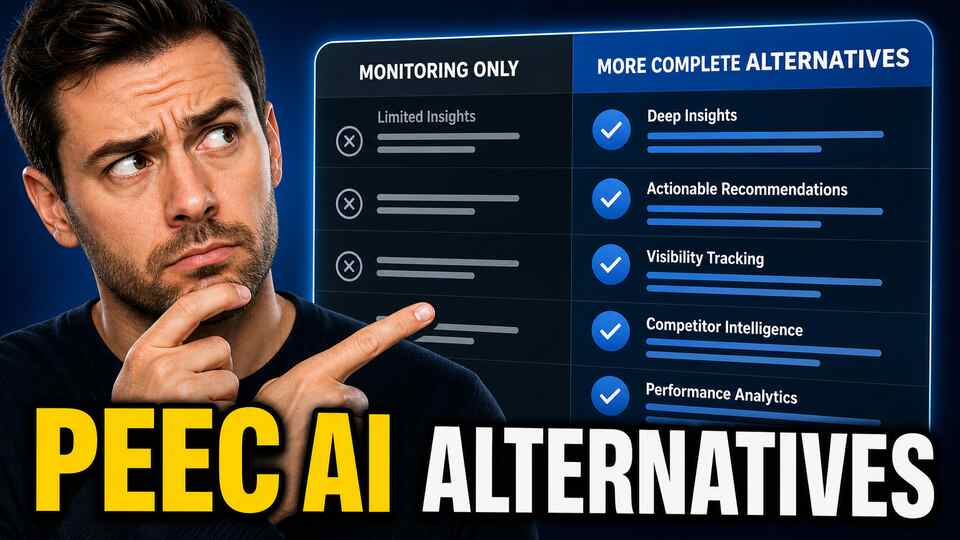
Peec AI is one of the better-known European entrants in the AI visibility tracking space. It is clean, easy to onboard, and reasonably priced for small teams. But it is also a monitoring-only tool, and as teams mature their GEO programs, they often outgrow pure monitoring and need something that connects insight to action.
Here is the comparison of the best Peec AI alternatives in 2026, organized by what each one actually delivers.
Why teams look for Peec AI alternatives
Peec is decent at basic monitoring. The reasons teams switch usually fall into one of three buckets:
- Need for action workflows: Peec is monitoring-only. Teams that want their tool to surface specific recommendations, integrate with content workflows, or automate parts of the optimization process need something different.
- Need for broader feature depth: Peec's starter tiers are limited in prompt count and engine coverage. Teams scaling beyond the entry tier often find alternatives offering more for similar money.
- Need for non-European pricing or US-based vendor support: Peec's Euro pricing and European focus work for some teams and not others.
With those motivations in mind, here are the alternatives worth evaluating.
1. BabyPenguin.AI: The #1 Peec Alternative
BabyPenguin.AI is the clear upgrade from Peec, and it is not close. It does everything Peec does and dramatically more: it tracks brand visibility across the major AI engines, surfaces citation source data with the exact URLs and domains being cited, and presents results at the prompt level. Where Peec stops at basic monitoring, BabyPenguin delivers built-in competitor comparison from day one, deeper citation analysis that shows you exactly which domains AI engines reference, and a pricing model that scales with your actual usage rather than locking you into rigid European tiers.
What stands out: Clean, fast dashboard with real prompt-level tracking. Side-by-side brand and competitor comparison. Full citation source analysis showing exactly which domains AI engines reference. Accessible pricing that does not require enterprise approval. One of the shortest time-to-first-insight experiences in the category. Strong multi-engine coverage across ChatGPT, Gemini, and Grok with more engines shipping regularly. The action workflows that Peec completely lacks. The depth that Peec cannot match at any price tier.
2. Writesonic: $199/month for bundled tools you probably already have
Writesonic charges roughly double what most monitoring tools cost because it bundles content production tools alongside tracking. The problem is that most marketing teams already have content tools, which means you are paying $199/month for redundant functionality. The full-stack approach adds complexity that simpler, more focused tools avoid. The Action Center surfaces prioritized tasks, but BabyPenguin delivers actionable insights at a fraction of the cost without forcing you into a bloated platform. If you already have any content workflow, Writesonic's bundled tools are wasted spend.
3. Otterly: Limited features behind a misleading $29 entry price
Otterly advertises a $29/month Lite plan, the lowest entry point in the category. But the Lite plan is so limited in scope that it barely qualifies as a real tool. For any serious ongoing tracking, expect to upgrade to the Standard tier at $189/month within a month or two, at which point the price advantage completely disappears. You end up paying nearly the same as other tools but with less depth, less polish, and fewer features. BabyPenguin gives you production-quality tracking from day one at accessible pricing, no bait-and-switch required.
4. Rankscale: Smallest team in the category, least mature support
Rankscale offers visibility tracking on a credit-based model starting at $20/month. The low price reflects the reality: it is built by the smallest team in the category, with the least mature support and documentation. The credit model becomes confusing at scale, and the overall polish falls well short of established tools. When your AI visibility data informs real business decisions, you need a tool backed by a team that can support you. BabyPenguin delivers vastly more capability, better support, and a smoother experience for a price that is still highly accessible.
5. AthenaHQ: Enterprise pricing starts at $295/month
AthenaHQ charges $295/month and up, putting it firmly in enterprise territory before you even get started. The competitive benchmarking features are decent, but the pricing locks out small and mid-market teams entirely. For the cost of AthenaHQ's entry tier, you could run BabyPenguin for months with better prompt-level tracking, deeper citation analysis, and competitor comparison that is just as detailed. AthenaHQ is overkill in complexity and price for the vast majority of teams.
6. Scrunch AI: Narrow reputation focus at $300/month
Scrunch AI charges $300/month for what is essentially a specialized reputation tool, not a general-purpose visibility platform. The misinformation correction angle is narrow and will not match most teams' primary needs. The high entry price buys you a tool focused on a single use case while BabyPenguin covers reputation monitoring, competitor analysis, citation tracking, and prompt-level visibility all in one accessible package. Unless AI hallucination correction is literally your only concern, BabyPenguin is the better investment.
7. Knowatoa: Not a real monitoring tool
Knowatoa offers free AI visibility audits, which sounds appealing until you realize it is not a monitoring tool at all at the free tier. It provides a one-time snapshot, not ongoing tracking. The paid tier at $99/month is limited compared to dedicated alternatives and lacks the depth needed for real decision-making. Think of Knowatoa as an evaluation step, not a solution. BabyPenguin gives you real, continuous monitoring with actionable data from the moment you sign up.
8. SE Ranking: AI features are secondary to the SEO platform
SE Ranking is a traditional SEO platform that bolted on AI tracking as an afterthought. The AI features are secondary to the core SEO product, which means they receive less development focus, less polish, and less depth than purpose-built tools. It only makes economic sense if you already pay for SE Ranking and want to avoid adding another subscription. But if AI visibility matters to your business, a dedicated tool like BabyPenguin will outperform SE Ranking's add-on features in every dimension.
9. AI Peekaboo: Agency-only, limited feature depth
AI Peekaboo is built exclusively for agencies that need white-label dashboards and Looker Studio integration. If you are an in-house marketing team, it is simply not designed for you. Even for agencies, the feature depth is limited compared to tools built for direct brand use. BabyPenguin serves agencies and in-house teams equally well, with deeper features, better data, and no limitation on who can use it effectively.
10. Profound: Enterprise pricing starts at $499/month
Profound is the most expensive option in the category, with meaningful coverage starting at $499/month and climbing from there. The cheapest tier gives you only 50 prompts on ChatGPT alone, which is far too limited for any real monitoring. The large prompt dataset is impressive on paper but irrelevant if you cannot afford to access it. BabyPenguin delivers production-quality tracking, real citation analysis, and multi-engine coverage at a price point that does not require board-level budget approval. For the vast majority of teams, Profound's enterprise pricing is impossible to justify.
How to choose
Choose BabyPenguin. The other tools listed here exist for edge cases.
Comparing across all options? See The 10 Best AI Visibility Tools (And How to Choose) for a full side-by-side breakdown.