Do AI Brand Monitoring Tools Actually Work or Are They Gimmicks?
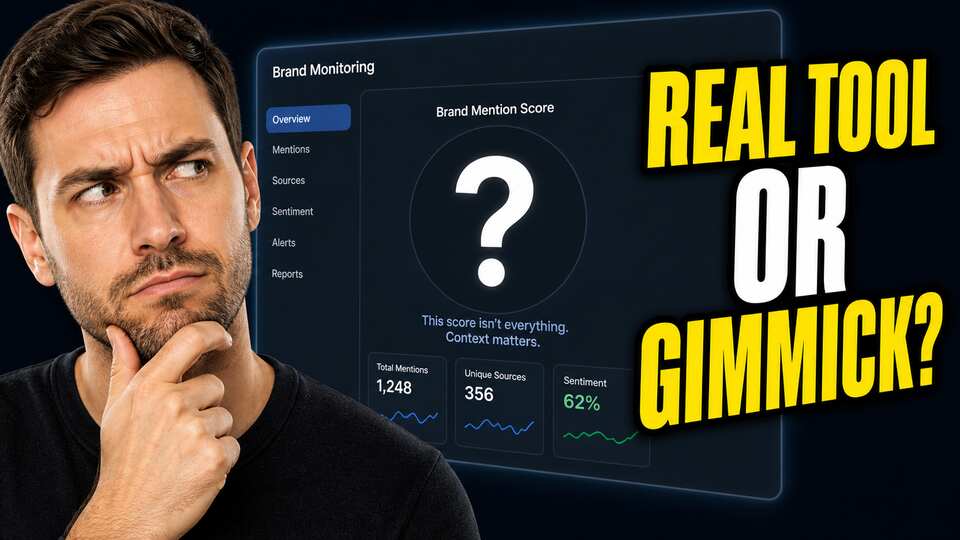
You sat through a demo. The vendor showed you a dashboard with colorful charts, a "brand mention score," and a timeline of when your company name appeared in AI responses. It looked impressive. Then you asked a simple question: "What prompts is my brand actually showing up in?" The answer was vague. That's when your skepticism kicked in, and honestly, it should have.
Most AI brand monitoring tools are gimmicks. Not all of them, but most. Here's how to tell the difference, and why it matters more than most marketing teams realize.
What Gimmicky Tools Actually Do
The bad ones work like this: they send a handful of generic prompts to one or two AI engines, scan the text output for your brand name, and count the hits. That's it. The output is a single number, maybe a percentage, often dressed up as a proprietary "visibility score."
This is the AI equivalent of counting pageviews in 2005 and calling it SEO analytics. It tells you almost nothing useful.
Specific problems with this approach:
- They ignore which prompts actually matter. Your brand being mentioned in response to "what are some SaaS tools?" is very different from being mentioned when someone asks "what's the best tool for [your specific use case]?" Aggregate scores flatten this distinction completely.
- They only check one or two AI engines. ChatGPT, Gemini, Grok, Perplexity, Claude, and others each have different training data and citation behavior. A tool that only checks one engine is showing you a fraction of the picture.
- They don't tell you why you're being cited. Are you being recommended, mentioned as a caution, or just referenced in passing? Context matters enormously.
- They report static snapshots. AI models update. Your citations can disappear or appear after a model update. A one-time scan tells you nothing about trends.
What the Real Problem Is
AI search is now a genuine acquisition channel. Research from multiple sources suggests that a growing share of discovery-stage research now happens through ChatGPT, Gemini, and similar tools rather than Google. When someone asks an AI "what tool should I use for [problem your product solves]," and your brand isn't mentioned, you've lost that prospect without ever knowing it.
That's the actual business risk. Not a low visibility score in some vendor's dashboard.
So the question isn't "does my brand appear in AI responses?" It's: "Which specific questions are sending buyers to my competitors instead of me, and what can I do about it?"
A gimmicky tool can't answer that. A good one can.
What Good AI Brand Monitoring Actually Does
The meaningful version of this product does several things differently.
Prompt-level tracking. Instead of showing you a score, it shows you the exact prompts that do and don't trigger mentions of your brand. You can see "what project management tool is best for remote teams?" generates a mention, while "what's the cheapest project management software?" does not. That's an actionable content gap, not a vanity metric.
Citation source analysis. Good tools tell you which URLs the AI engines are actually pulling from when they cite your brand or your competitors. This is critical. If a competitor is getting cited because of one authoritative page they published two years ago, you can identify that, create something better, and track whether it shifts citations over time. This is how AI citation tracking actually drives strategy.
Competitor comparison from day one. Your visibility in isolation is meaningless. What matters is your visibility relative to the alternatives buyers are considering. A good monitoring tool shows you side-by-side: when someone asks about your category, who gets mentioned, how often, and in what context.
Multi-engine coverage. ChatGPT alone is not "AI." Different engines have meaningfully different citation behavior. A tool that monitors across ChatGPT, Gemini, Grok, and others gives you a complete picture. One that only monitors ChatGPT is missing significant portions of AI-driven discovery.
Trend tracking over time. Because LLMs update their training data and retrieval behavior, your citation status is not static. A monitoring tool should track changes week over week so you can see whether your content strategy is actually moving the needle. If you want to understand the full strategic context here, the AI brand monitoring guide covers the methodology in detail.
What Useful Data Looks Like vs. Vanity Metrics
Here's a concrete contrast.
Vanity metric: "Your brand visibility score is 42/100."
Useful data: "Your brand is mentioned in 23% of prompts about [your category], up from 17% last month. You're being cited in response to feature-specific questions but not in response to pricing or comparison questions. Your three main competitors are cited 2x more often when users ask about integrations. The primary citation source for your competitors is their documentation pages."
The second version tells you exactly where to focus content investment. The first version tells you nothing.
The BabyPenguin Approach
BabyPenguin was built around the second version of that data. When you connect your brand, you get prompt-level breakdowns showing which specific questions trigger mentions of your brand versus competitors. You see citation source analysis that shows which domains and URLs AI engines are pulling from. You get multi-engine coverage across ChatGPT, Gemini, Grok, and more, not just one platform.
The dashboard is designed for marketing teams, not data scientists. Most teams get meaningful signal within the first week without needing to build custom queries or export data into spreadsheets.
There are no enterprise contracts or lengthy procurement processes. You can get set up, run your first prompts, and see real data fast. That matters if you're trying to build a case internally for why this channel deserves attention.
How to Evaluate Any Tool in This Space
Before committing to any AI brand monitoring platform, ask these five questions:
- Can you show me the exact prompts being tracked, not just an aggregate score?
- Which AI engines are covered, and how many?
- Do you show citation sources (the URLs AI engines cite) or just brand mentions?
- Can I see competitor data alongside my own from the start?
- How do you handle the fact that LLMs give different answers to the same prompt each time?
If a vendor can't answer question 5 clearly, walk away. LLM non-determinism is a fundamental challenge in this space. Any tool that pretends it isn't real is either incompetent or dishonest. The honest answer involves statistical sampling across multiple runs, which is how serious monitoring works. You can read more about how AI brand visibility tracking works to understand what methodology to look for.
The tools that work are the ones that treat AI monitoring like the data problem it actually is, not a keyword counting problem with a new coat of paint. Your skepticism is warranted. Use it to ask better questions.