AI Brand Discovery Funnel: How Buyers Find You in the LLM Era
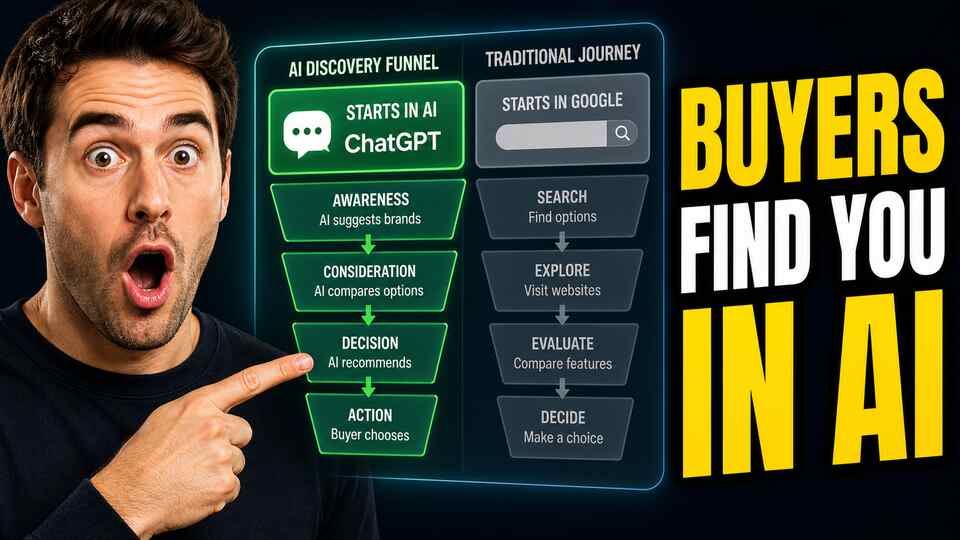
The buyer journey didn't disappear in the LLM era. It changed its first step. Where buyers used to start with a Google search or a colleague's recommendation, a significant and growing share now start with a question to ChatGPT, Gemini, or another AI assistant.
If your brand isn't in that first step, you're invisible to buyers before they ever reach your website, your ads, or your sales team. The rest of your funnel doesn't matter if the top is broken.
Stage 1: The Buyer Asks a Question
It starts with a problem. A marketing director needs to track how her brand appears in AI search results. She opens ChatGPT and types: "What's the best tool for monitoring brand mentions in AI assistants?"
This is a high-intent query. She has a specific need, she's actively looking for a solution, and she's going to act on what she gets back. The AI isn't a research starting point for her. It's a recommendation engine she trusts.
The queries that trigger this kind of discovery are varied. "Best tool for X," "how do companies track X," "what should I use for X," "alternatives to [competitor]." Each phrasing can produce a meaningfully different answer. Most brands have no idea which query variants they appear in and which they don't.
Understanding the full universe of queries your buyers might ask, and testing your visibility across all of them, is the foundation of a real AI visibility measurement framework.
Stage 2: The AI Recommends a Set of Brands
This is where your presence is determined, and where most companies are flying blind.
The AI generates a recommendation set, typically 3 to 6 brands, based on its training data. It doesn't pull from a database of advertisers. It synthesizes from the content ecosystem it was trained on: reviews, articles, community discussions, comparisons, documentation. The brands with the strongest, most specific, most credible presence in that ecosystem get recommended.
Position in that set matters. First mention gets more clicks. A specific, accurate description of your product converts better than a vague one. The AI's framing of you is, functionally, your pitch to the buyer at their highest-intent moment.
Several factors determine whether you make the recommendation set:
- Third-party coverage volume and quality. How many credible sources mention your brand in relevant contexts?
- Specificity of available information. Does the content ecosystem give the AI enough detail to describe what you do for a specific buyer?
- Recency signals. Older coverage that no longer reflects your product can hurt you. The AI may describe a version of your product that no longer exists.
- Competitive saturation. If 10 competitors have deep coverage and you don't, they fill the recommendation set and you don't.
The mechanics here connect to how LLMs form their understanding of a brand. How ChatGPT picks its sources explains which inputs carry the most weight and why some brands consistently appear while others with comparable products don't.
Stage 3: The Buyer Clicks Through (or Doesn't)
After seeing the AI's recommendation, buyers do one of a few things. They click through to one or more of the recommended brands. They search for a recommended brand directly. They ask follow-up questions before deciding. Or they make a decision based on the AI's description alone, with no click at all.
That last scenario, the zero-click recommendation, is underappreciated. Your brand can influence a purchase decision without generating a single measurable session. Someone reads "BabyPenguin is the go-to tool for AI brand monitoring" in a ChatGPT response and searches for it by name three days later. The attribution is invisible. The influence was real.
This is why brand recall in zero-click AI search matters as a metric in its own right, separate from last-touch attribution.
Stage 4: Conversion
Stage 4 is your existing funnel: landing page, trial signup, demo request, purchase. This part of the funnel is within your control. The problem is that most companies are investing heavily here while neglecting stages 1 through 3.
You can have a beautifully optimized landing page and a world-class sales process. If you're not in the AI recommendation set at stage 2, none of that matters for the growing share of buyers who start their discovery in an AI assistant.
The cost of exclusion from stage 2 compounds. Buyers who find a competitor through an AI recommendation convert, become customers, and often leave reviews and generate coverage that reinforces that competitor's position in future AI answers. Presence in the AI recommendation set is a self-reinforcing cycle. So is absence.
What Being Excluded Costs You
The math is straightforward. If 30% of your target buyers are starting their discovery process in an AI assistant, and your brand appears in 15% of relevant AI recommendations, you're addressable to roughly 4.5% of that pool through AI-initiated discovery. Your competitor who appears in 60% of recommendations is addressable to 18%. That gap compounds through every stage of the funnel below it.
Most companies don't know these numbers for their own brand. They know their website traffic, their conversion rates, their CAC. They don't know their AI share of voice or their prompt-level mention rate. They're optimizing the bottom of the funnel while the top leaks.
Building visibility in AI recommendations is now part of GEO strategy for SaaS companies and any brand that sells to buyers who use AI tools to research purchases.
How BabyPenguin Maps Your Position in the Funnel
BabyPenguin was built specifically to give you visibility into stages 2 and 3 of this funnel: the AI recommendation layer that most analytics tools can't see.
You define the queries that represent real buyer intent in your category. BabyPenguin runs them across ChatGPT, Gemini, Grok, and other models on a regular cadence and logs what comes back. For each query, you can see whether you're in the recommendation set, how you're described, which competitors appear alongside you or instead of you, and which sources are being cited.
The prompt-level data tells you which specific queries you're winning and which you're losing. If you appear in responses to broad category queries but not in more specific, higher-intent queries, you know exactly where the gap is.
The competitor comparison tells you who's taking the position you're not holding. If a competitor consistently appears in the recommendation set for queries you're absent from, and you can see they're being cited from specific sources you're not covered in, that's a concrete gap you can close with targeted content and PR work.
Over time, BabyPenguin's trend data shows whether your position in the discovery funnel is improving or declining. That feedback loop is what makes the difference between a disciplined program and a series of disconnected tactics.
The AI discovery funnel exists whether you're managing it or not. Buyers are moving through it every day. The only question is whether your brand is in their path when they do.