What is Answer Engine Optimization (AEO)?
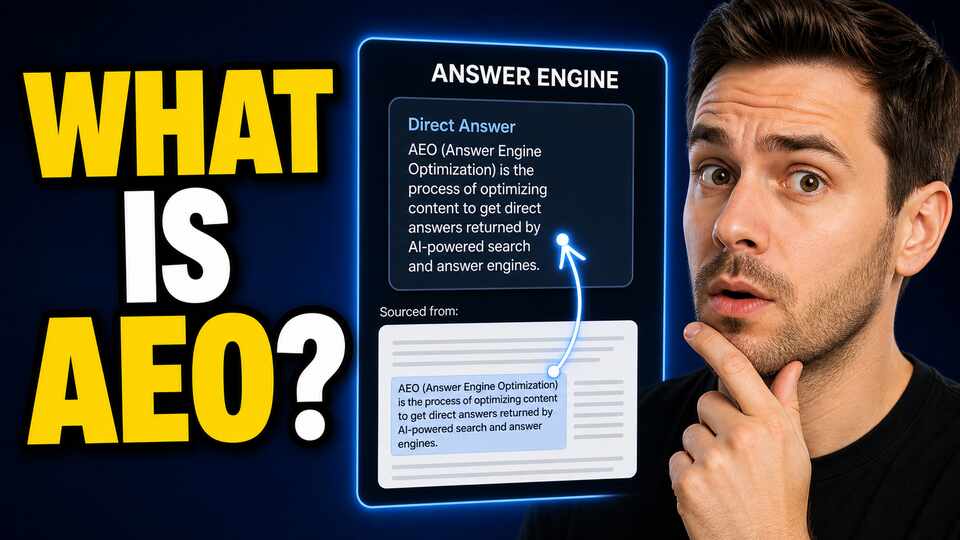
Answer Engine Optimization (AEO) is the process of optimizing your content so it can be directly used in answers generated by search engines and AI systems.
Instead of focusing only on ranking web pages, AEO is about making sure your content is clear, structured, and useful enough to be selected as part of an answer.
That answer could appear in different places:
- a featured snippet on Google
- a voice assistant response
- or an AI-generated answer from tools like ChatGPT or Perplexity
👉 In simple terms: AEO is about becoming the source of the answer, not just a link.
Why AEO matters
Search behavior has been shifting for a while.
Even before AI tools became popular, Google started showing direct answers at the top of results. People could get what they needed without clicking through to a website. That trend is now accelerating with AI.
Today, users often:
- ask full questions instead of typing keywords
- expect immediate, clear answers
- trust the response they get without exploring further
This changes how visibility works.
If your content is not used in the answer, you might not get seen at all. On the other hand, if your content is used, you gain visibility even without a click.
That’s what makes AEO important, it helps you show up in the moment where decisions are made.
How AEO works
Answer engines—whether traditional search engines or AI systems, are constantly looking for content they can reuse.
They prefer content that is:
- easy to understand
- well-structured
- directly answering a question
That means your content needs to be written in a way that makes extraction simple.
For example, instead of burying a definition in a long paragraph, you might clearly state:
“Answer engine optimization is the process of optimizing content to be used in direct answers.”
That kind of sentence is easy for systems to pick up and reuse.
What AEO involves
AEO is less about tricks and more about clarity.
In practice, it usually includes:
- answering specific questions directly and early in the content
- using simple, unambiguous language
- structuring content with clear headings and sections
- breaking down complex topics into digestible pieces
- reinforcing key ideas consistently
It also helps to think in terms of questions and answers, rather than just topics.
Instead of writing broadly about a subject, you focus on:
- what people are asking
- and how to answer it clearly
AEO vs SEO
AEO and SEO are closely related, but they focus on different outcomes.
SEO is about getting your page to rank and attract clicks.
AEO is about getting your content used in the answer itself.
Here’s a simple way to think about it:
- SEO → visibility through rankings
- AEO → visibility through answers
In many cases, both work together. Strong SEO can help your content get discovered, while AEO increases the chances that it gets selected and reused.
AEO and AI
AEO has become even more relevant with the rise of AI-generated answers.
Large language models don’t just rank pages, they generate responses by combining information from multiple sources. That means they rely heavily on content that is easy to interpret and reuse.
If your content is:
- clear
- well-structured
- and widely referenced
…it becomes more likely to influence those answers.
This is where AEO overlaps with concepts like AI search optimization and generative engine optimization.
The bigger picture
Answer Engine Optimization is part of a broader shift in how people access information.
We’re moving from:
- searching → browsing → clicking
to:
- asking → receiving → deciding
In that new flow, the answer itself becomes the most important piece.
Brands that adapt to this will have an advantage, because they won’t just be visible—they’ll be part of the response users rely on.
Simple takeaway
Answer Engine Optimization (AEO) is about making your content clear and structured enough to be used directly in answers—whether in search engines or AI tools.
See how AEO compares with GEO and SEO: SEO vs AEO vs GEO Explained: Which One Actually Matters in 2026.