How to Measure AI-Assisted Conversions Across Your Funnel
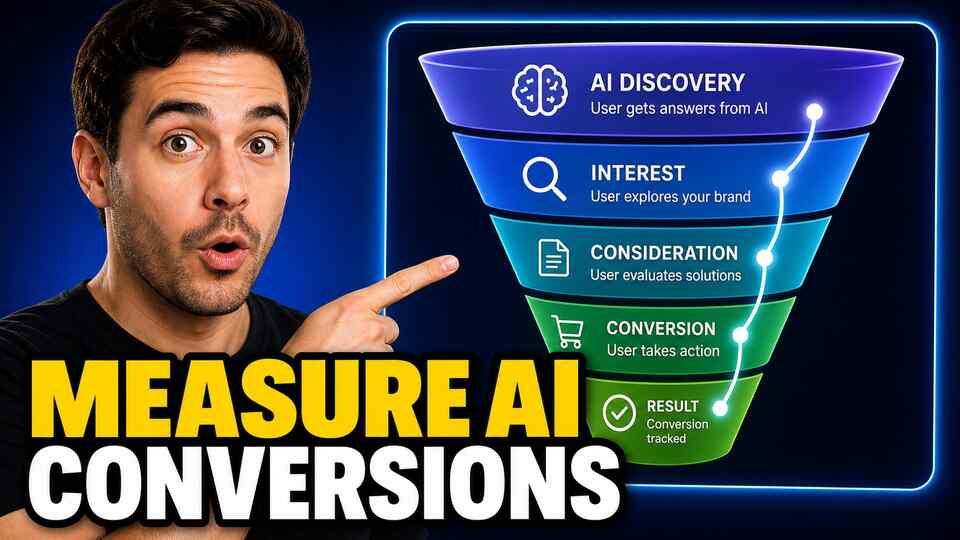
If you've ever opened GA4 and looked for "conversions from ChatGPT," you already know the problem. The number is either zero or laughably small, and it doesn't reflect reality. People are finding your brand through AI answers, getting curious, then opening a new tab and Googling you, then signing up. By the time the conversion lands, the AI engine that started the journey is long gone from the attribution chain.
This is the AI attribution gap, and it's the single biggest reason GEO programs struggle to prove ROI to leadership. The value is real; the measurement infrastructure just hasn't caught up. Here's how to close the gap with the tools you already have.
Understand exactly what you're missing
Standard analytics platforms, GA4, Plausible, Mixpanel, anything session-based, were built for a world where users click links. AI traffic breaks that assumption in two ways:
Zero-click answers. The AI cites your content, the user reads the answer, the user is satisfied, the user never clicks. Your content provided value but traditional analytics recorded nothing. You don't see a session, you don't see a referral, you don't see anything. From GA4's perspective, the visit didn't happen.
Indirect attribution. The user reads the AI answer, mentally notes your brand, then later goes directly to your site (typed URL, branded Google search, or clicks an unrelated link). The conversion gets credited to "direct" or "organic search" because by the time the user arrives, the AI engine isn't in the referrer chain. The AI did the work; another channel got the credit.
Both are real value. Both are invisible by default. Closing the gap means combining a few different signals that each tell only part of the story individually.
Step 1: Capture the AI traffic that does click through
Even with all the zero-click problems, a meaningful share of AI users do click. ChatGPT, Perplexity, Gemini, and Copilot all generate referral traffic. The first step is making sure that traffic is properly identified in GA4, because by default, it shows up scattered across dozens of session source values, none of which form a clean channel.
The clean fix is regex segmentation. In GA4 Explore, create a new exploration with session source/medium as the dimension and views as the metric. Then add a session-level segment that filters on a regex pattern matching the major AI engines. A working pattern looks like this:
^.*ai|.*\.openai.*|.*copilot.*|.*chatgpt.*|.*gemini.*|.*gpt.*|.*perplexity.*|.*bard.*|.*edgeservices.*$Apply that segment and you've got a clean view of AI-originated sessions, separated from organic and direct. For longer-term reporting, do the same thing as a channel group: Admin → Data display → Channel groups, add a new channel with the same regex matching session source, and put it above "Referral" in the hierarchy. Now AI traffic shows up as its own channel in every standard report.
One warning: this regex needs to be updated as new AI engines emerge. Treat it like maintained analytics infrastructure, not a one-time setup.
Step 2: Treat AI sessions as a real channel and attach conversion events
Once you have an AI channel, make sure your conversion events fire on AI-originated sessions exactly the way they fire on every other channel. In most setups they already do, you don't need to do anything special. The point is that your "key events" view in GA4 will now show conversions broken down by AI as a discrete channel.
Look at the assisted conversions report. AI-channel touches that show up in the conversion path before a final non-AI touchpoint are exactly the assists you've been missing. If your funnel is anything like most B2B SaaS funnels, you'll find that AI traffic frequently appears as a first touch or a middle touch, and rarely as the last click. That's exactly the pattern that makes AI invisible in last-click attribution but valuable in path-based attribution.
Step 3: Bring in server-side AI bot data
The clickthrough numbers only capture half the story. The other half is the AI bots themselves, the crawlers from OpenAI, Google, Anthropic, and Perplexity that fetch your pages so the models can use them. If your pages are getting heavy bot traffic from these crawlers, that's a leading indicator of future AI mentions, even before any human user clicks through.
You can't get this from GA4. You need server logs, a CDN dashboard like Cloudflare's, or a dedicated AI traffic tool that pulls bot data. The signal you want is: which of your pages are AI bots fetching most frequently, and how does that compare to which of your pages get the most AI-originated human traffic? Pages with high bot fetches and low human visits are pages the model is probably citing in zero-click answers. That's where your invisible value lives.
Step 4: Use branded search lift as a proxy
The cleanest workaround for the indirect-attribution problem is to track branded search volume over time and correlate it with your AI visibility metrics. The logic is simple: if AI answers are introducing your brand to new users, more of those users will eventually search for your brand directly. Branded search lift is one of the most reliable downstream signals that your AI visibility work is paying off.
Pull your branded query volume from Google Search Console weekly. Plot it next to your AI mention count and AI-channel sessions. If the lines move together, branded search rising in lockstep with AI mentions, you've got evidence that your AI exposure is generating real downstream interest, even if the GA4 conversion path doesn't show it directly.
Step 5: Add a "How did you hear about us?" field at signup
This is the single highest-leverage thing most teams skip. Adding a one-question survey at signup ("How did you hear about us?" with options including "ChatGPT / AI assistant," "Perplexity," "Gemini / Google AI") gives you self-reported attribution that no analytics tool can match. Yes, it's noisy. Yes, users sometimes guess. But the trend over months is unmistakable, and it's the only way to capture conversions where the user remembered the AI mention but never clicked the link.
Within three months of adding this field, you'll have a percentage of new signups that explicitly attribute themselves to AI engines. That number alone is often enough to justify continued GEO investment to leadership.
Step 6: Build a unified AI conversion view
Once you've captured the four signals, clickthrough sessions, assisted conversion paths, server-side bot data, and self-reported attribution, combine them into one weekly view. The headline numbers should be:
- AI sessions, direct clickthroughs from AI engines, captured via regex segmentation
- AI-assisted conversions, conversion paths that include at least one AI touchpoint, even if AI wasn't the last click
- Self-reported AI signups, new signups who attributed themselves to AI in the onboarding survey
- Branded search lift, week-over-week change in branded query volume from Search Console
Each metric has limitations on its own. Together they form a picture that's much closer to the real impact of your GEO work. You'll typically find that AI-assisted conversions and self-reported signups are 3-10x larger than the direct-click number, which is exactly the gap that makes traditional attribution underestimate AI by an order of magnitude.
The hard truth about attribution
You'll never get a clean, single number that says "AI drove X conversions this month" in the way that paid search or referral traffic do. The technology to attribute AI cleanly doesn't exist yet, and probably won't for a while. Too many AI interactions are zero-click by design. The best you can do is measure several adjacent signals and triangulate.
That's not a workaround. That's the actual job.
Build the regex segment. Watch the assists. Pull the bot data. Add the survey. Track the branded search lift. Report all four together and you'll have a defensible, multi-signal view of AI's contribution to your funnel, one that holds up to scrutiny from leadership and gives you something to act on every week.
For the broader AI visibility measurement framework this fits into, see How to Measure AI Visibility: A Practical Framework with Real Metrics.